Carbajo Aníbal E, Vezzani Darío
Ecología de Enfermedades Transmitidas por Vectores, Instituto de Investigación e Ingeniería Ambiental, Universidad Nacional de General San Martín, Buenos Aires, Argentina.
Consejo Nacional de Investigaciones Científicas y Técnicas, Buenos Aires, Argentina.
Mem Inst Oswaldo Cruz. 2015 Apr;110(2):259-62. doi: 10.1590/0074-02760150005.
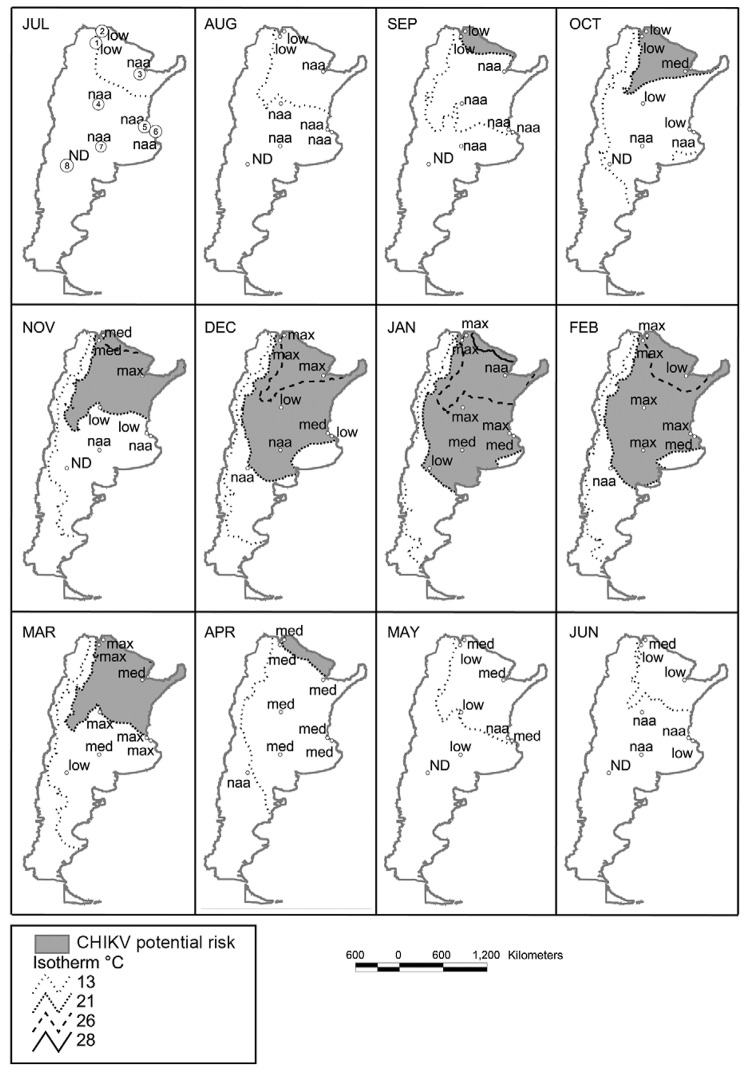
Chikungunya virus (CHIKV) transmission has been detected in America in 2013 and recently reached south up to Bolivia, Brazil and Paraguay, bordering countries of Argentina. The presence of the mosquito Aedes aegypti in half of the country together with the regional context drove us to make a rapid assessment of transmission risk. Temperature thresholds for vector breeding and for virus transmission, together with adult activity from the literature, were mapped on a monthly basis to estimate risk. Transmission of chikungunya by Ae. aegypti in the world was seen at monthly mean temperatures from 21-34ºC, with the majority occurring between 26-28ºC. In Argentina temperatures above 21ºC are observed since September in the northeast, expanding south until January and retreating back to the northeast in April. The maximum area under risk encompasses more than half the country and around 32 million inhabitants. Vector adult activity was registered where monthly means temperatures exceeded 13ºC, in the northeast all over the year and in the northern half from September-May. The models herein proposed show that conditions for transmission are already present. Considering the regional context and the historic inability to control dengue in the region, chikungunya fever illness seems unavoidable.
2013年美洲检测到基孔肯雅病毒(CHIKV)传播,最近该病毒已向南蔓延至与阿根廷接壤的玻利维亚、巴西和巴拉圭。该国一半地区存在埃及伊蚊,再加上区域背景因素,促使我们对传播风险进行快速评估。根据文献中的数据,每月绘制一次媒介繁殖和病毒传播的温度阈值以及成虫活动情况,以估计风险。埃及伊蚊传播基孔肯雅病毒的情况在世界范围内可见于月平均温度为21-34ºC时,大多数情况发生在26-28ºC之间。在阿根廷,东北部自9月起观察到温度高于21ºC,向南扩展至1月,4月又退回东北部。风险最大的区域覆盖该国一半以上地区,涉及约3200万居民。当每月平均温度超过13ºC时记录到媒介成虫活动,全年在东北部以及9月至次年5月在该国北半部均有活动。本文提出的模型表明传播条件已经具备。考虑到区域背景以及该地区历史上无法控制登革热的情况,基孔肯雅热似乎不可避免。