Huo Yu-Jia, Qiao Ling, Zheng Xiao-Wei, Cui Cheng, Ma Yuan-Fang, Lu Feng
Henan Engineering Laboratory of Antibody Medicine, Medical School of Henan University, Kaifeng, Henan 475001, China.
Chin Med J (Engl). 2015 May 5;128(9):1209-14. doi: 10.4103/0366-6999.156131.
In prokaryotic organisms, the mechanism responsible for the accurate partition of newly replicated chromosomes into daughter cells is incompletely understood. Segregation of the replication terminus of the circular prokaryotic chromosome poses special problems that have not previously been addressed. The aim of this study was to investigate the roles of several protein components (MreB, MreC, and MreD) of the prokaryotic cytoskeleton for the faithful transmission of the chromosomal terminus into daughter cells.
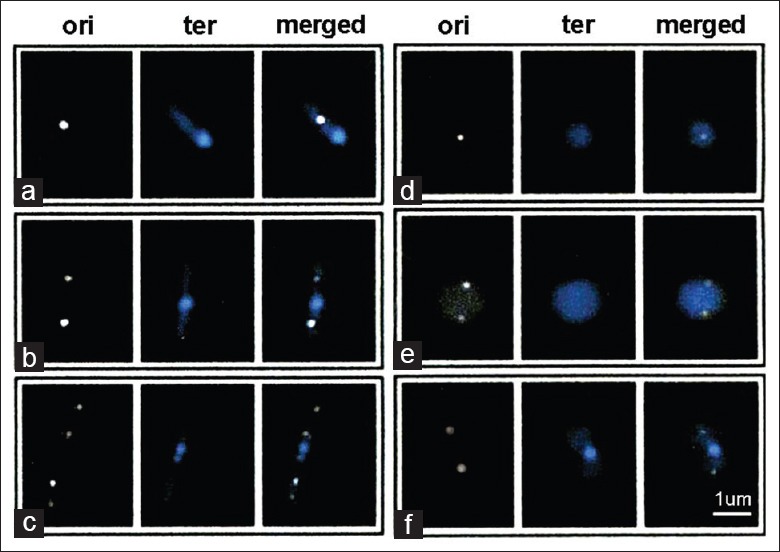
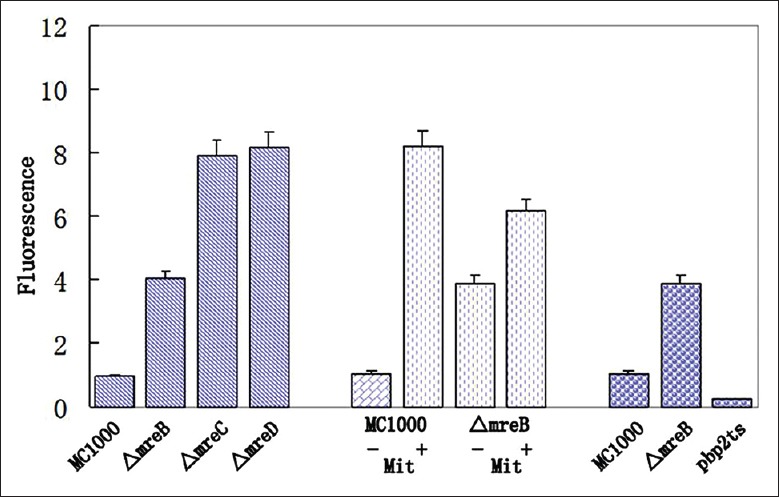
Strain LQ1 (mreB::cat), LQ2 (mreC::cat), and LQ3 (mreD::cat) were constructed using the Red recombination system. LQ11/pLAU53, LQ12/pLAU53, LQ13/pLAU53, LQ14/pLAU53, and LQ15/pLAU53 strains were generated by P1transduction of (tetO) 240 -Gm and (lacO) 240 -Km cassettes from strains IL2 and IL29. Fluorescence microscopy was performed to observe localization pattern of fluorescently-labeled origin and terminus foci in wild-type and mutant cells. SOS induction was monitored as gfp fluorescence from PsulA-gfp in log phase cells grown in Luria-Bertani medium at 37°C by measurement of emission at 525 nm with excitation at 470 nm in a microplate fluorescence reader.
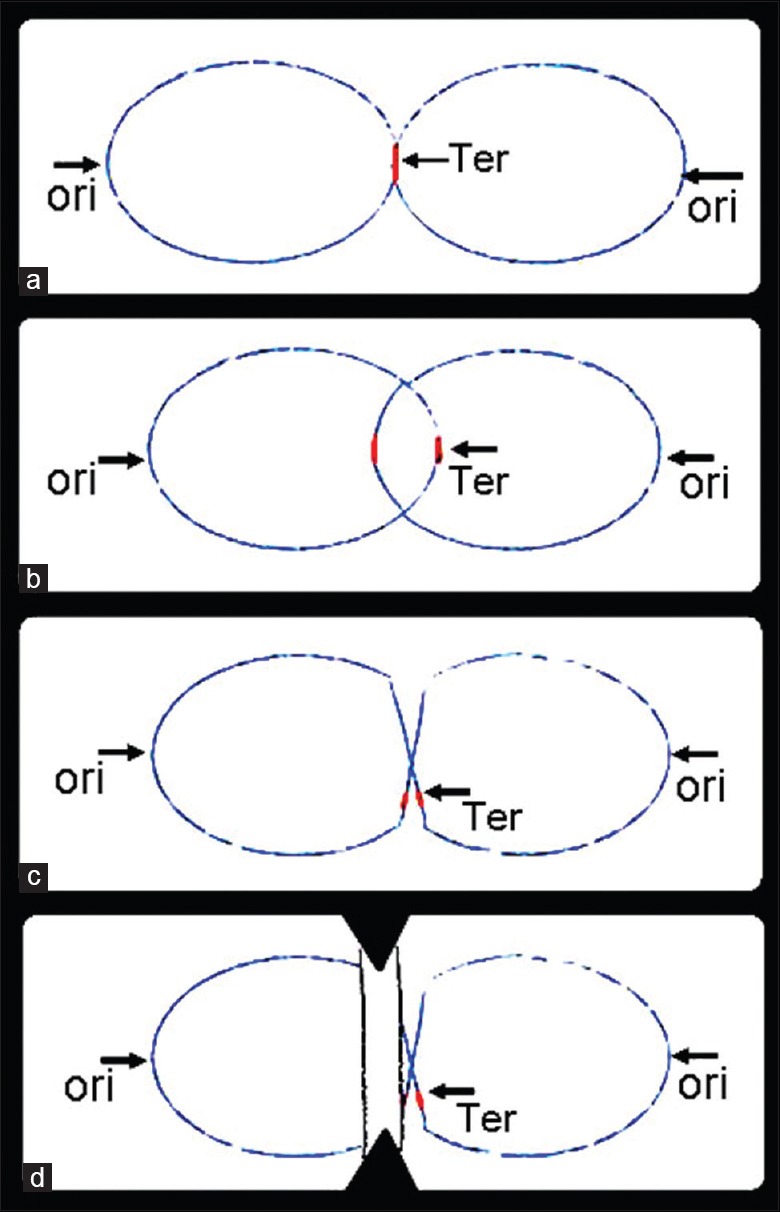
Mutational deletion of the mreB, mreC, or mreD genes was associated with selective loss of the terminus region in approximately 40% of the cells within growing cultures. This was accompanied by significant induction of the SOS DNA damage response, suggesting that deletion of terminus sequences may have occurred by chromosomal cleavage, presumably caused by ingrowth of the division septum prior to segregation of the replicated terminal.
These results imply a role for the MreBCD cytoskeleton in the resolution of the final products of terminus replication and/or in the specific movement of newly replicated termini away from midcell prior to completion of septal ingrowth. This would identify a previously unrecognized stage in the overall process of chromosome segregation.
在原核生物中,负责将新复制的染色体准确分配到子细胞中的机制尚未完全了解。环状原核染色体复制终点的分离带来了以前未曾解决的特殊问题。本研究的目的是调查原核细胞骨架的几种蛋白质成分(MreB、MreC和MreD)在将染色体终点忠实地传递到子细胞中的作用。
使用Red重组系统构建菌株LQ1(mreB::cat)、LQ2(mreC::cat)和LQ3(mreD::cat)。通过从IL2和IL29菌株进行P1转导(tetO)240 -Gm和(lacO)240 -Km盒,产生LQ11/pLAU53、LQ12/pLAU53、LQ13/pLAU53、LQ14/pLAU53和LQ15/pLAU53菌株。进行荧光显微镜观察,以观察野生型和突变细胞中荧光标记的起点和终点焦点的定位模式。通过在37°C的Luria-Bertani培养基中生长的对数期细胞中,用微孔板荧光读数器在470 nm激发下测量525 nm处的发射,监测SOS诱导,以PsulA-gfp的gfp荧光表示。
mreB、mreC或mreD基因的突变缺失与生长培养物中约40%的细胞中终点区域的选择性丢失有关。这伴随着SOS DNA损伤反应的显著诱导,表明终点序列的缺失可能是由染色体切割引起的,推测是由于复制终点分离之前隔膜向内生长所致。
这些结果暗示MreBCD细胞骨架在解决终点复制的最终产物和/或在隔膜向内生长完成之前将新复制的终点从细胞中部特异性移开方面发挥作用。这将确定染色体分离整个过程中一个以前未被认识的阶段。