Schwab Christine, Bugnyar Thomas, Schloegl Christian, Kotrschal Kurt
Konrad-Lorenz-Research Station for Ethology, Gruenau ; Department for Behaviour, Neurobiology and Cognition, University of Vienna.
Anim Behav. 2008 Feb 1;75(2):501-508. doi: 10.1016/j.anbehav.2007.06.006.
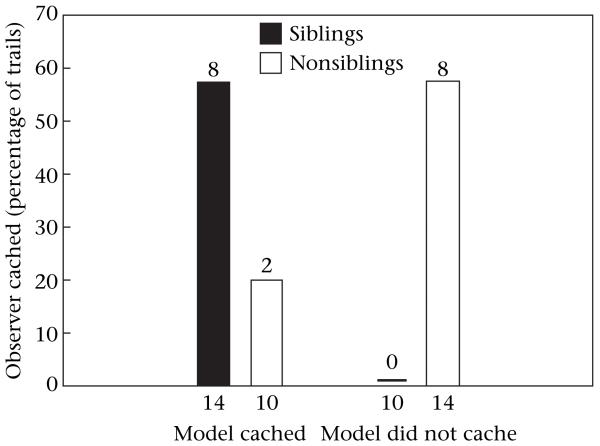
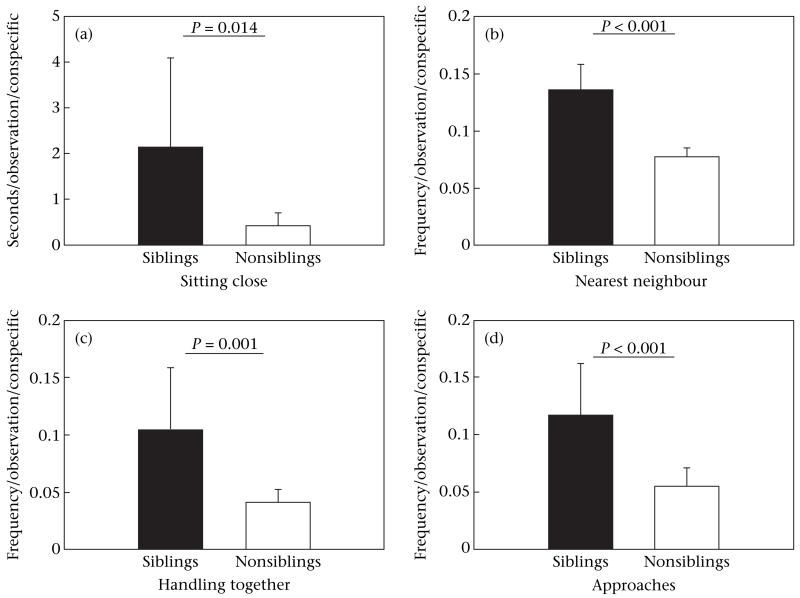
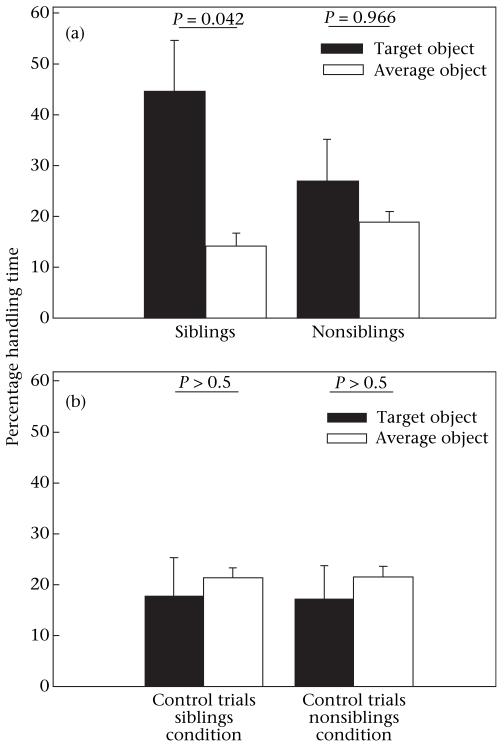
It has been suggested that social dynamics affect social learning but empirical support for this idea is scarce. Here we show that affiliate relationships among kin indeed enhance the performance of common ravens, , in a social learning task. Via daily behavioural protocols we first monitored social dynamics in our group of captive young ravens. Siblings spent significantly more time in close proximity to each other than did nonsiblings. We subsequently tested birds on a stimulus enhancement task in model-observer dyads composed of both siblings and nonsiblings. During demonstration the observer could watch the model manipulating one particular object (target object) in an adjacent room. After removing the model, the observer was confronted with five different objects including the former target object. Observers from sibling dyads handled the target object for significantly longer periods of time as compared with the other four available objects, whereas observers from nonsibling dyads did not show a preference for the target object. Also, siblings matched the model's decision to cache or not to cache objects significantly more often than did nonsiblings. Hence, siblings were likely to attend to both, the behaviour of the model (caching or noncaching) and object-specific details. Our results support the hypothesis that affiliate relations between individuals affect the transmission of information and may lead to directed social learning even when spatial proximity has been experimentally controlled for.
有人提出社会动态会影响社会学习,但这一观点的实证支持却很少。在此我们表明,亲属之间的关联关系确实能提升普通渡鸦在一项社会学习任务中的表现。通过日常行为记录,我们首先监测了圈养的幼鸦群体中的社会动态。与非同胞相比,同胞之间彼此近距离相处的时间显著更长。随后,我们在由同胞和非同胞组成的示范者 - 观察者二元组中,对鸟类进行了刺激增强任务测试。在示范过程中,观察者可以看到示范者在相邻房间操作一个特定物体(目标物体)。在示范者离开后,观察者面对五个不同的物体,包括之前的目标物体。与其他四个可用物体相比,来自同胞二元组的观察者对目标物体的处理时间明显更长,而来自非同胞二元组的观察者对目标物体没有表现出偏好。此外,同胞比非同胞更频繁地与示范者在是否贮藏物体上的决定保持一致。因此,同胞可能会关注示范者的行为(贮藏或不贮藏)以及物体的特定细节。我们的结果支持了这样一个假设,即个体之间的关联关系会影响信息传递,并且即使在实验中控制了空间接近度的情况下,也可能导致定向社会学习。