Liu LiLi, Lee Ki-Young
Department of Marine Biotechnology, College of Ocean Science and Technology, Kunsan National University, Gunsan 573-701, Korea.
Dev Reprod. 2014 Sep;18(3):139-43. doi: 10.12717/DR.2014.18.3.139.
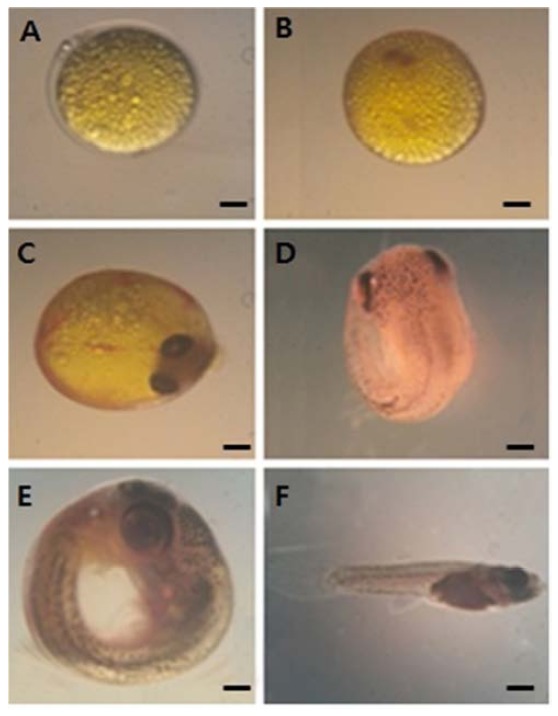
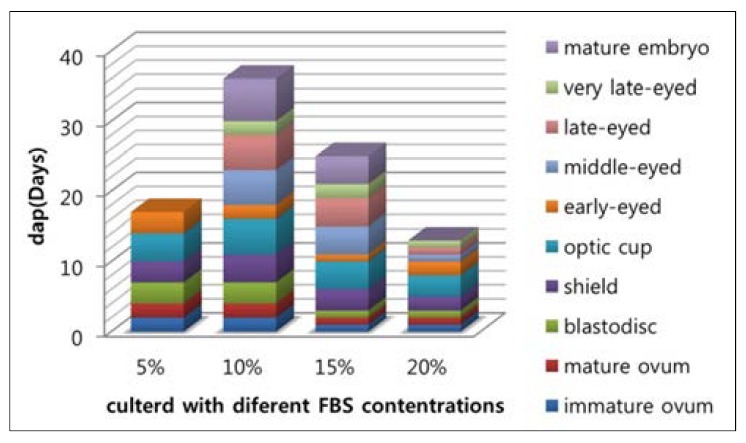
Different with other fishes, the guppies (Poecilia reticulata) is ovoviviparity, which retain their fertilized eggs within the follicle throughout gestation. The synchronously growing diplotene oocytes store nutrients in droplets and yolk, before their maturation and fertilization. The lecithotrophic strategy of development entails the provisioning of embryos with resources from the maternal yolk deposit rather than from a placenta, it allows the extracorporeal culture of guppy embryo. Studies on their early development of live bearers like the guppy including lineage tracing and genetic manipulations, have been limited. Therefore, to optimize conditions of embryo in vitro culture, explanted embryos from pregnant females were incubated in embryo medium (L-15 medium, supplemented with 5, 10, 15, 20% fetal bovine serum, respectively). We investigated whether the contents of FBS in vitro culture medium impact the development of embryos, and whether they would hatch in vitro. Our study found that in 5% of FBS of the medium, although embryos developed significantly slower in vitro than in the ovary, it was impossible to exactly quantify the developmental delay in culture, due to the obvious spread in developmental stage within each batch of eggs, and embryos can only be maintained until the early-eyed. And although in culture with 20% FBS the embryos can sustain rapid development of early stage, but cannot be cultured for the entire period of their embryonic development and ultimately died. In the medium with 10% and 15% FBS, the embryos seems well developed, even some can continue to grow after follicle ruptures until it can be fed. We also observed that embryonic in these two culture conditions were significantly different in development speed, in 15% it is faster than 10%. But 10% FBS appears to be more optimizing condition than 15% one on development process of embryos and survival rate to larvae stage.
与其他鱼类不同,孔雀鱼(Poecilia reticulata)是卵胎生的,在整个妊娠期内,它们的受精卵都保留在卵泡内。同步生长的双线期卵母细胞在成熟和受精之前,会在液滴和卵黄中储存营养物质。卵黄营养型发育策略是为胚胎提供来自母体卵黄沉积而非胎盘的资源,这使得孔雀鱼胚胎能够进行体外培养。对孔雀鱼等胎生鱼类早期发育的研究,包括谱系追踪和基因操作,一直很有限。因此,为了优化胚胎体外培养条件,将怀孕雌鱼的离体胚胎在胚胎培养基(L-15培养基,分别添加5%、10%、15%、20%胎牛血清)中培养。我们研究了体外培养基中胎牛血清的含量是否会影响胚胎发育,以及胚胎是否会在体外孵化。我们的研究发现,在培养基中含有5%胎牛血清时,尽管胚胎在体外发育明显比在卵巢中慢,但由于每批卵的发育阶段明显分散,无法准确量化培养中的发育延迟,并且胚胎只能维持到眼点出现早期。尽管在含有20%胎牛血清的培养中,胚胎在早期阶段能够持续快速发育,但不能在整个胚胎发育期间进行培养,最终死亡。在含有10%和15%胎牛血清的培养基中,胚胎似乎发育良好,甚至有些在卵泡破裂后还能继续生长直到可以摄食。我们还观察到,在这两种培养条件下胚胎的发育速度有显著差异,15%时比10%时快。但在胚胎发育过程和到幼虫阶段的存活率方面,10%胎牛血清似乎比15%胎牛血清更优化。