Christodoulou Evangelos, Chinthakunta Suresh, Reddy Divya, Khalil Saif, Apostolou Thomas, Drees Philipp, Kafchitsas Konstantinos
Asklepios Klinik Lindenlohe, Schwandorf, Germany.
Globus Medical Inc., Ave 2560 General Armistead Ave, Audubon, PA 19403 USA.
Scoliosis. 2015 May 1;10:15. doi: 10.1186/s13013-015-0039-6. eCollection 2015.
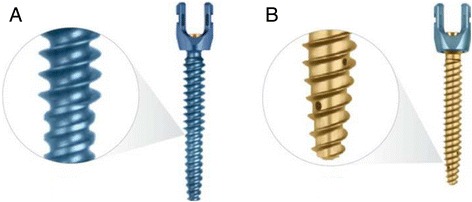
The pullout strength of pedicle screws is influenced by many factors, including diameter of the screws, implant design, and augmentation with bone cement such as PMMA. In the present study, the pullout strength of an innovative fenestrated screw augmented with PMMA was investigated and was compared to unaugmented fenestrated, standard and dual outer diameter screw.
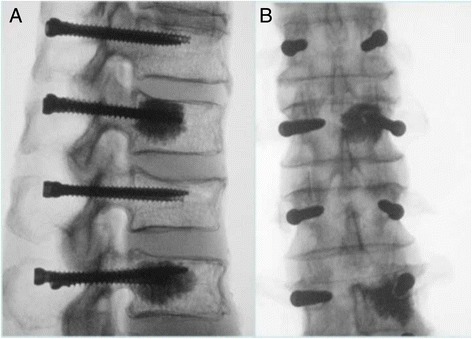
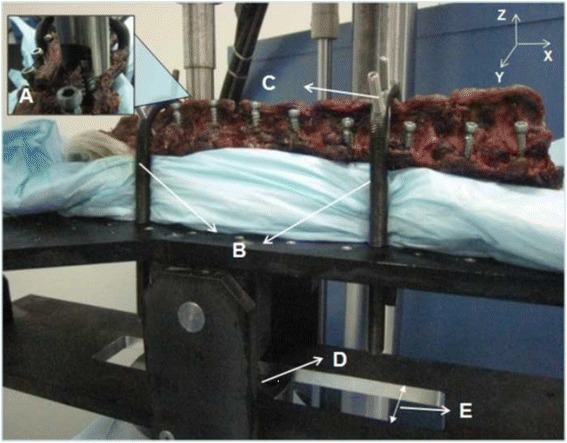
Twenty four thoracolumbar vertebrae (T10-L5, age 60 to 70 years) from three cadavers were implanted with the four different pedicle screws. Twelve screws of each type were instrumented into either left or right pedicle with standard screw paired with unaugmented and dual outer diameter screw paired with augmented fenestrated screw in any given vertebra. Axial pullout testing was conducted at a rate of 5 mm/min. Force to failure (Newtons) for each pedicle screw was recorded.
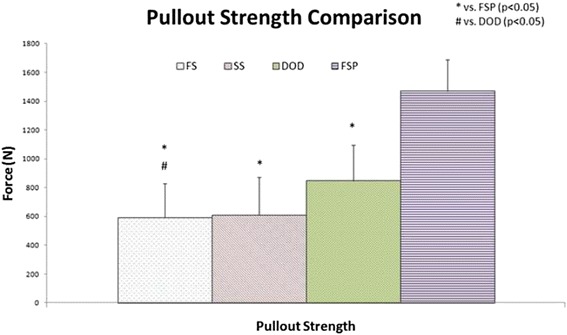
The augmented fenestrated screws had the highest pullout strength, which represented an average increase of 149%, 141%, and 78% in comparison to unaugmented, standard, and dual outer diameter screws, respectively. Pullout strength of unaugmented screws was comparable to that of standard screws, however it was significantly lower than dual outer diameter screws.
Fenestrated screws augmented with PMMA improve the fixation strength and result in significantly higher pullout strength compared to dual outer diameter, standard and unaugmented fenestrated screws. Screws with dual outer diameter provided enhanced bone-screw purchase and may be considered as an alternative technique to increase the bone-screw interface in cases where augmentation using bone cement is not feasible. Unaugmented screws can be left in the pedicle even without cement and provide similar pullout strength to standard screws.
椎弓根螺钉的拔出强度受多种因素影响,包括螺钉直径、植入物设计以及使用聚甲基丙烯酸甲酯(PMMA)等骨水泥增强。在本研究中,对一种创新的经PMMA增强的开窗螺钉的拔出强度进行了研究,并与未增强的开窗螺钉、标准螺钉和双外径螺钉进行了比较。
从三具尸体上获取24个胸腰椎椎体(T10-L5,年龄60至70岁),植入四种不同的椎弓根螺钉。每种类型的12枚螺钉分别植入左侧或右侧椎弓根,在任何给定椎体中,标准螺钉与未增强螺钉配对,双外径螺钉与增强开窗螺钉配对。以5毫米/分钟的速率进行轴向拔出测试。记录每个椎弓根螺钉的破坏力(牛顿)。
增强开窗螺钉具有最高的拔出强度,与未增强螺钉、标准螺钉和双外径螺钉相比,平均分别提高了149%、141%和78%。未增强螺钉的拔出强度与标准螺钉相当,但显著低于双外径螺钉。
与双外径、标准和未增强的开窗螺钉相比,经PMMA增强的开窗螺钉提高了固定强度,拔出强度显著更高。双外径螺钉提供了增强的骨-螺钉把持力,在使用骨水泥增强不可行的情况下,可被视为增加骨-螺钉界面的替代技术。即使不使用骨水泥,未增强螺钉也可留在椎弓根内,其拔出强度与标准螺钉相似。