Lal Neeraj, Beggs Andrew D, Willcox Benjamin E, Middleton Gary W
Cancer Immunology and Immunotherapy Centre; School of Cancer Sciences; University of Birmingham ; Birmingham, UK.
Oncoimmunology. 2015 Apr 2;4(3):e976052. doi: 10.4161/2162402X.2014.976052. eCollection 2015 Mar.
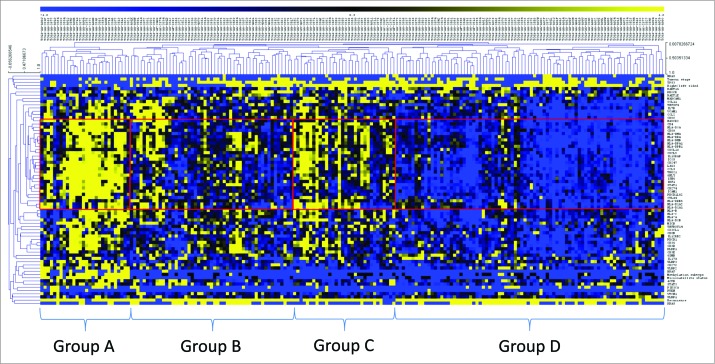
Although tumor infiltrating lymphocyte (TIL) density is prognostic and predictive in colorectal cancer (CRC), the impact of tumor genetics upon colorectal immunobiology is unclear. Identification of genetic factors that influence the tumor immunophenotype is essential to improve the effectiveness of stratified immunotherapy approaches. We carried out a bioinformatics analysis of CRC data in The Cancer Genome Atlas (TCGA) involving two-dimensional hierarchical clustering to define an immune signature that we used to characterize the immune response across key patient groups. An immune signature termed The Co-ordinate Immune Response Cluster (CIRC) comprising 28 genes was coordinately regulated across the patient population. Four patient groups were delineated on the basis of cluster expression. Group A, which was heavily enriched for patients with microsatellite instability (MSI-H) and POL mutations, exhibited high CIRC expression, including the presence of several inhibitory molecules: , PDL1, PDL2, , and . In contrast, mutation was enriched in patient groups with lower CIRC expression. This work links the genetics and immunobiology of colorectal tumorigenesis, with implications for the development of stratified immunotherapeutic approaches. Microsatellite instability and POL mutations are linked with high mutational burden and high immune infiltration, but the coordinate expression of inhibitory pathways observed suggests combination checkpoint blockade therapy may be required to improve efficacy. In contrast, mutant tumors predict for a relatively poor immune infiltration and low inhibitory molecule expression. In this setting, checkpoint blockade may be less efficacious, highlighting a requirement for novel strategies in this patient group.
尽管肿瘤浸润淋巴细胞(TIL)密度在结直肠癌(CRC)中具有预后和预测价值,但肿瘤遗传学对结直肠癌免疫生物学的影响尚不清楚。识别影响肿瘤免疫表型的遗传因素对于提高分层免疫治疗方法的有效性至关重要。我们对癌症基因组图谱(TCGA)中的CRC数据进行了生物信息学分析,采用二维层次聚类来定义一种免疫特征,我们用它来描述关键患者群体的免疫反应。一种名为协同免疫反应簇(CIRC)的免疫特征由28个基因组成,在患者群体中受到协同调节。根据聚类表达划分出四个患者组。A组富含微卫星不稳定(MSI-H)和POL突变患者,表现出高CIRC表达,包括存在几种抑制分子: 、PDL1、PDL2、 和 。相比之下, 突变在CIRC表达较低的患者组中富集。这项工作将结直肠癌发生的遗传学和免疫生物学联系起来,对分层免疫治疗方法的发展具有启示意义。微卫星不稳定和POL突变与高突变负荷和高免疫浸润相关,但观察到的抑制途径的协同表达表明可能需要联合检查点阻断疗法来提高疗效。相比之下, 突变肿瘤预示着免疫浸润相对较差且抑制分子表达较低。在这种情况下,检查点阻断可能效果较差,凸显了该患者群体对新策略的需求。