Rao P S S, Bell Richard L, Engleman Eric A, Sari Youssef
Department of Pharmacology, College of Pharmacy and Pharmaceutical Sciences, University of Toledo Toledo, OH, USA.
Department of Psychiatry, Indiana University School of Medicine Indianapolis, IN, USA.
Front Neurosci. 2015 Apr 23;9:144. doi: 10.3389/fnins.2015.00144. eCollection 2015.
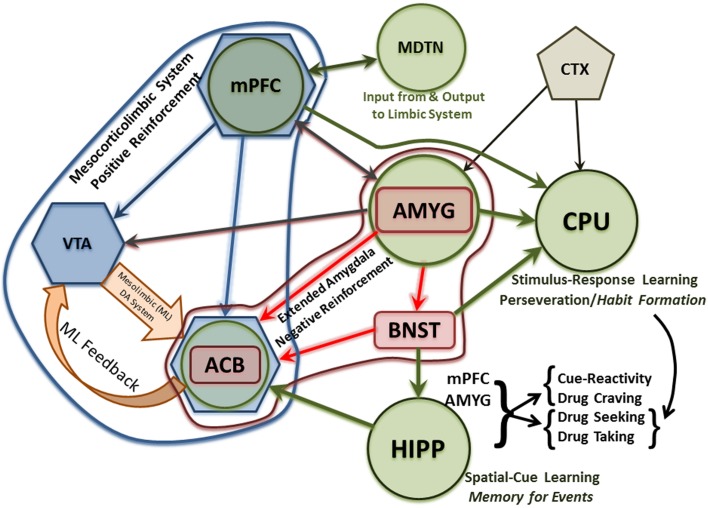
Alcoholism is a serious public health concern that is characterized by the development of tolerance to alcohol's effects, increased consumption, loss of control over drinking and the development of physical dependence. This cycle is often times punctuated by periods of abstinence, craving and relapse. The development of tolerance and the expression of withdrawal effects, which manifest as dependence, have been to a great extent attributed to neuroadaptations within the mesocorticolimbic and extended amygdala systems. Alcohol affects various neurotransmitter systems in the brain including the adrenergic, cholinergic, dopaminergic, GABAergic, glutamatergic, peptidergic, and serotonergic systems. Due to the myriad of neurotransmitter and neuromodulator systems affected by alcohol, the efficacies of current pharmacotherapies targeting alcohol dependence are limited. Importantly, research findings of changes in glutamatergic neurotransmission induced by alcohol self- or experimenter-administration have resulted in a focus on therapies targeting glutamatergic receptors and normalization of glutamatergic neurotransmission. Glutamatergic receptors implicated in the effects of ethanol include the ionotropic glutamate receptors (AMPA, Kainate, and NMDA) and some metabotropic glutamate receptors. Regarding glutamatergic homeostasis, ceftriaxone, MS-153, and GPI-1046, which upregulate glutamate transporter 1 (GLT1) expression in mesocorticolimbic brain regions, reduce alcohol intake in genetic animal models of alcoholism. Given the hyperglutamatergic/hyperexcitable state of the central nervous system induced by chronic alcohol abuse and withdrawal, the evidence thus far indicates that a restoration of glutamatergic concentrations and activity within the mesocorticolimbic system and extended amygdala as well as multiple memory systems holds great promise for the treatment of alcohol dependence.
酒精中毒是一个严重的公共卫生问题,其特征是对酒精作用产生耐受性、饮酒量增加、失去对饮酒的控制以及出现身体依赖性。这个循环常常被戒酒、渴望和复发阶段所打断。耐受性的发展以及戒断效应的表现(即依赖性)在很大程度上归因于中脑边缘系统和杏仁核扩展系统内的神经适应性变化。酒精会影响大脑中的各种神经递质系统,包括肾上腺素能、胆碱能、多巴胺能、γ-氨基丁酸能、谷氨酸能、肽能和5-羟色胺能系统。由于酒精会影响众多神经递质和神经调节系统,目前针对酒精依赖的药物治疗效果有限。重要的是,酒精自我给药或实验者给药所诱导的谷氨酸能神经传递变化的研究结果,使得人们将重点放在了针对谷氨酸能受体和使谷氨酸能神经传递正常化的治疗方法上。与乙醇作用相关的谷氨酸能受体包括离子型谷氨酸受体(AMPA、海人藻酸受体和NMDA)以及一些代谢型谷氨酸受体。关于谷氨酸能内稳态,头孢曲松、MS-153和GPI-1046可上调中脑边缘脑区的谷氨酸转运体1(GLT1)表达,在酒精中毒的遗传动物模型中可减少酒精摄入量。鉴于慢性酒精滥用和戒断所诱导的中枢神经系统的谷氨酸能亢进/过度兴奋状态,目前的证据表明,恢复中脑边缘系统、杏仁核扩展系统以及多个记忆系统内的谷氨酸能浓度和活性,对于治疗酒精依赖具有很大的前景。