
运动通过增加白细胞介素10来改善高脂饮食诱导的心脏功能障碍。
Exercise ameliorates high fat diet induced cardiac dysfunction by increasing interleukin 10.
作者信息
Kesherwani Varun, Chavali Vishalakshi, Hackfort Bryan T, Tyagi Suresh C, Mishra Paras K
机构信息
Department of Cellular and Integrative Physiology, University of Nebraska Medical Center Omaha, NE, USA.
Department of Physiology and Biophysics, University of Louisville Louisville, KY, USA.
出版信息
Front Physiol. 2015 Apr 22;6:124. doi: 10.3389/fphys.2015.00124. eCollection 2015.
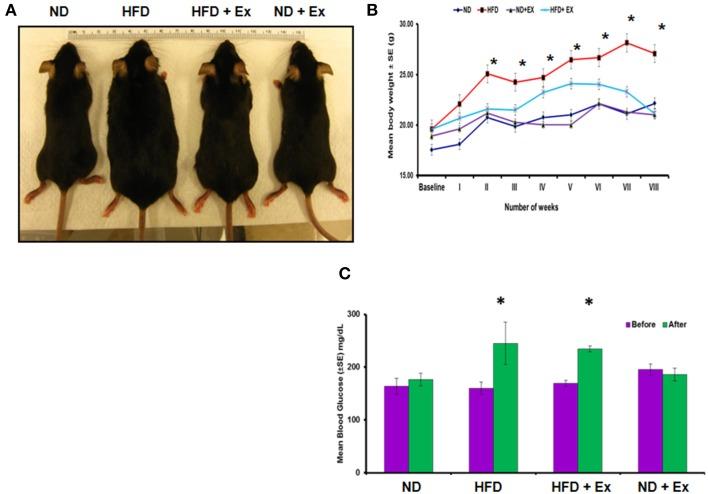
Increasing evidence suggests that a sedentary lifestyle and a high fat diet (HFD) leads to cardiomyopathy. Moderate exercise ameliorates cardiac dysfunction, however underlying molecular mechanisms are poorly understood. Increased inflammation due to induction of pro-inflammatory cytokine such as tumor necrosis factor-alpha (TNF-α) and attenuation of anti-inflammatory cytokine such as interleukin 10 (IL-10) contributes to cardiac dysfunction in obese and diabetics. We hypothesized that exercise training ameliorates HFD- induced cardiac dysfunction by mitigating obesity and inflammation through upregulation of IL-10 and downregulation of TNF-α. To test this hypothesis, 8 week old, female C57BL/6J mice were fed with HFD and exercised (swimming 1 h/day for 5 days/week for 8 weeks). The four treatment groups: normal diet (ND), HFD, HFD + exercise (HFD + Ex) and ND + Ex were analyzed for mean body weight, blood glucose level, TNF-α, IL-10, cardiac fibrosis by Masson Trichrome, and cardiac dysfunction by echocardiography. Mean body weights were increased in HFD but comparatively less in HFD + Ex. The level of TNF-α was elevated and IL-10 was downregulated in HFD but ameliorated in HFD + Ex. Cardiac fibrosis increased in HFD and was attenuated by exercise in the HFD + Ex group. The percentage ejection fraction and fractional shortening were decreased in HFD but comparatively increased in HFD + Ex. There was no difference between ND and ND + Ex for the above parameters except an increase in IL-10 level following exercise. Based on these results, we conclude that exercise mitigates HFD- induced cardiomyopathy by decreasing obesity, inducing IL-10, and reducing TNF-α in mice.
越来越多的证据表明,久坐不动的生活方式和高脂肪饮食(HFD)会导致心肌病。适度运动可改善心脏功能障碍,然而其潜在的分子机制尚不清楚。肥胖和糖尿病患者中,促炎细胞因子如肿瘤坏死因子-α(TNF-α)的诱导导致炎症增加,抗炎细胞因子如白细胞介素10(IL-10)的减少也会导致心脏功能障碍。我们假设运动训练通过上调IL-10和下调TNF-α减轻肥胖和炎症,从而改善HFD诱导的心脏功能障碍。为了验证这一假设,给8周龄的雌性C57BL/6J小鼠喂食HFD并进行运动(每天游泳1小时,每周5天,共8周)。分析四个治疗组:正常饮食(ND)、HFD、HFD + 运动(HFD + Ex)和ND + Ex的平均体重、血糖水平、TNF-α、IL-10、通过Masson三色染色法检测的心脏纤维化以及通过超声心动图检测的心脏功能障碍。HFD组的平均体重增加,但HFD + Ex组相对较少。HFD组中TNF-α水平升高,IL-10水平下调,但在HFD + Ex组中得到改善。HFD组心脏纤维化增加,而在HFD + Ex组中运动使其减轻。HFD组射血分数和缩短分数百分比降低,但在HFD + Ex组中相对增加。除运动后IL-10水平升高外,ND组和ND + Ex组在上述参数上没有差异。基于这些结果,我们得出结论,运动通过降低肥胖、诱导IL-10和降低小鼠体内TNF-α来减轻HFD诱导的心肌病。



 Zotero 插件