Bossé Janine T, Li Yanwen, Walker Stephanie, Atherton Tom, Fernandez Crespo Roberto, Williamson Susanna M, Rogers Jon, Chaudhuri Roy R, Weinert Lucy A, Oshota Olusegun, Holden Matt T G, Maskell Duncan J, Tucker Alexander W, Wren Brendan W, Rycroft Andrew N, Langford Paul R
Section of Paediatrics, Department of Medicine, Imperial College London, St Mary's Campus, London W2 1PG, UK
Section of Paediatrics, Department of Medicine, Imperial College London, St Mary's Campus, London W2 1PG, UK.
J Antimicrob Chemother. 2015 Aug;70(8):2217-22. doi: 10.1093/jac/dkv121. Epub 2015 May 8.
The objective of this study was to determine the distribution and genetic basis of trimethoprim resistance in Actinobacillus pleuropneumoniae isolates from pigs in England.
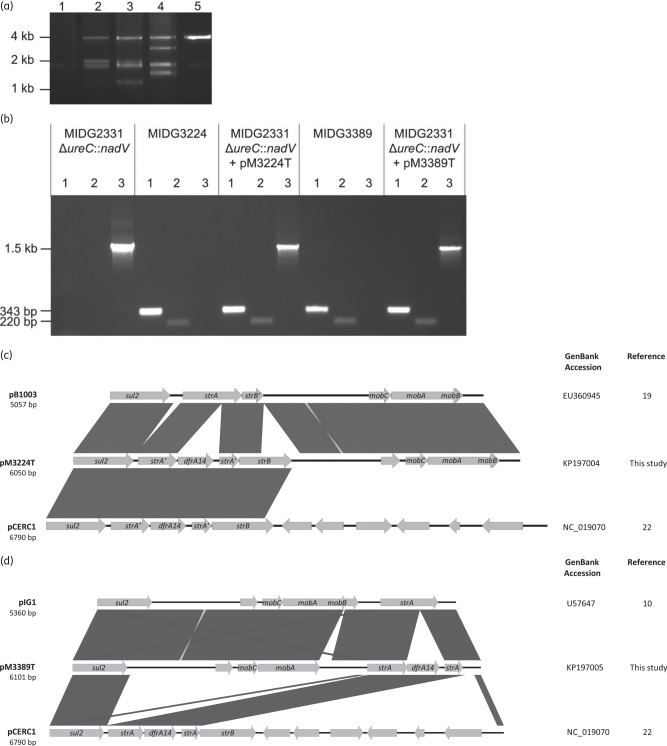
Clinical isolates collected between 1998 and 2011 were tested for resistance to trimethoprim and sulphonamide. The genetic basis of trimethoprim resistance was determined by shotgun WGS analysis and the subsequent isolation and sequencing of plasmids.
A total of 16 (out of 106) A. pleuropneumoniae isolates were resistant to both trimethoprim (MIC >32 mg/L) and sulfisoxazole (MIC ≥256 mg/L), and a further 32 were resistant only to sulfisoxazole (MIC ≥256 mg/L). Genome sequence data for the trimethoprim-resistant isolates revealed the presence of the dfrA14 dihydrofolate reductase gene. The distribution of plasmid sequences in multiple contigs suggested the presence of two distinct dfrA14-containing plasmids in different isolates, which was confirmed by plasmid isolation and sequencing. Both plasmids encoded mobilization genes, the sulphonamide resistance gene sul2, as well as dfrA14 inserted into strA, a streptomycin-resistance-associated gene, although the gene order differed between the two plasmids. One of the plasmids further encoded the strB streptomycin-resistance-associated gene.
This is the first description of mobilizable plasmids conferring trimethoprim resistance in A. pleuropneumoniae and, to our knowledge, the first report of dfrA14 in any member of the Pasteurellaceae. The identification of dfrA14 conferring trimethoprim resistance in A. pleuropneumoniae isolates will facilitate PCR screens for resistance to this important antimicrobial.
本研究的目的是确定来自英国猪的胸膜肺炎放线杆菌分离株中三甲氧苄氨嘧啶耐药性的分布及其遗传基础。
对1998年至2011年间收集的临床分离株进行三甲氧苄氨嘧啶和磺胺类药物耐药性检测。通过鸟枪法全基因组测序分析以及随后的质粒分离和测序来确定三甲氧苄氨嘧啶耐药性的遗传基础。
在106株胸膜肺炎放线杆菌分离株中,共有16株对三甲氧苄氨嘧啶(MIC>32mg/L)和磺胺异恶唑(MIC≥256mg/L)均耐药,另有32株仅对磺胺异恶唑(MIC≥256mg/L)耐药。对三甲氧苄氨嘧啶耐药分离株的基因组序列数据显示存在dfrA14二氢叶酸还原酶基因。多个重叠群中质粒序列的分布表明不同分离株中存在两种不同的含dfrA14质粒,这通过质粒分离和测序得到证实。两种质粒均编码移动基因、磺胺类耐药基因sul2,以及插入到与链霉素耐药相关基因strA中的dfrA14,尽管两种质粒的基因顺序不同。其中一种质粒还编码与链霉素耐药相关的基因strB。
这是首次描述在胸膜肺炎放线杆菌中赋予三甲氧苄氨嘧啶耐药性的可移动质粒,据我们所知,这也是巴斯德菌科任何成员中dfrA14的首次报道。在胸膜肺炎放线杆菌分离株中鉴定出赋予三甲氧苄氨嘧啶耐药性的dfrA14将有助于对这种重要抗菌药物耐药性的PCR筛查。