Downe S, Finlayson K, Melvin C, Spiby H, Ali S, Diggle P, Gyte G, Hinder S, Miller V, Slade P, Trepel D, Weeks A, Whorwell P, Williamson M
Research in Childbirth and Health (ReaCH) group, University of Central Lancashire, Preston, UK.
Women & Children's Health Research Team, East Lancashire Hospitals NHS Trust, Burnley General Hospital, Burnley, UK.
BJOG. 2015 Aug;122(9):1226-34. doi: 10.1111/1471-0528.13433. Epub 2015 May 11.
(Primary) To establish the effect of antenatal group self-hypnosis for nulliparous women on intra-partum epidural use.
Multi-method randomised control trial (RCT).
Three NHS Trusts.
Nulliparous women not planning elective caesarean, without medication for hypertension and without psychological illness.
Randomisation at 28-32 weeks' gestation to usual care, or to usual care plus brief self-hypnosis training (two × 90-minute groups at around 32 and 35 weeks' gestation; daily audio self-hypnosis CD). Follow up at 2 and 6 weeks postnatal.
Primary: epidural analgesia. Secondary: associated clinical and psychological outcomes; cost analysis.
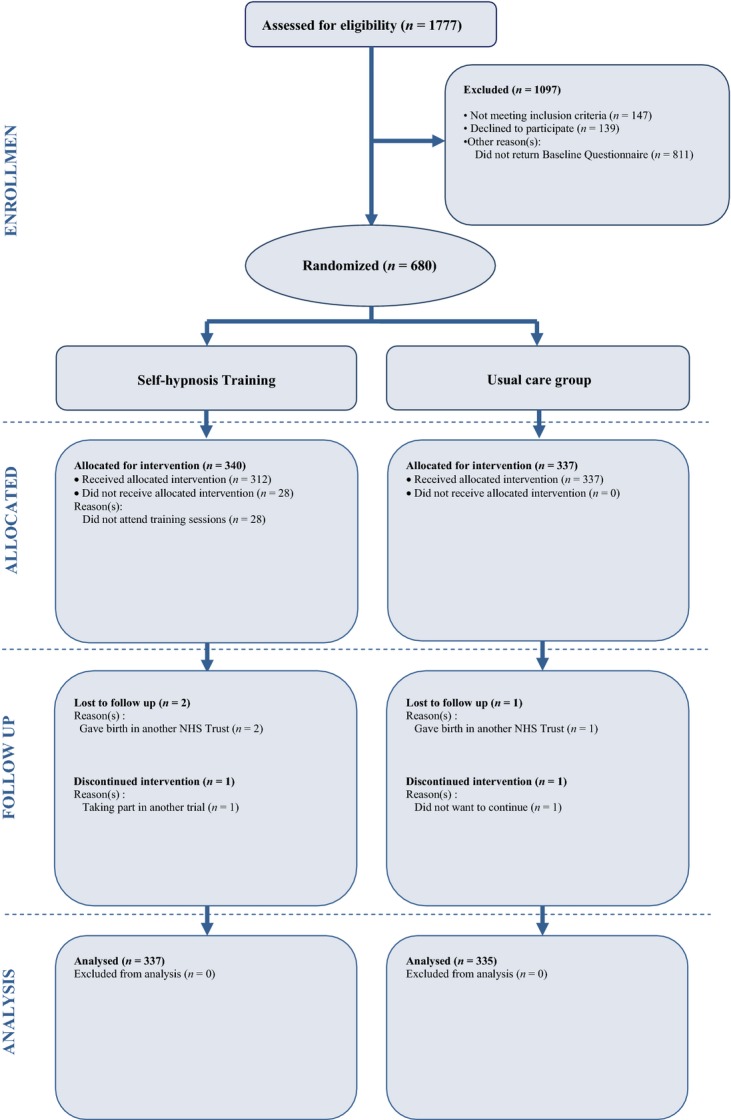
Six hundred and eighty women were randomised. There was no statistically significant difference in epidural use: 27.9% (intervention), 30.3% (control), odds ratio (OR) 0.89 [95% confidence interval (CI): 0.64-1.24], or in 27 of 29 pre-specified secondary clinical and psychological outcomes. Women in the intervention group had lower actual than anticipated levels of fear and anxiety between baseline and 2 weeks post natal (anxiety: mean difference -0.72, 95% CI -1.16 to -0.28, P = 0.001); fear (mean difference -0.62, 95% CI -1.08 to -0.16, P = 0.009) [Correction added on 7 July 2015, after first online publication: 'Mean difference' replaced 'Odds ratio (OR)' in the preceding sentence.]. Postnatal response rates were 67% overall at 2 weeks. The additional cost in the intervention arm per woman was £4.83 (CI -£257.93 to £267.59).
Allocation to two-third-trimester group self-hypnosis training sessions did not significantly reduce intra-partum epidural analgesia use or a range of other clinical and psychological variables. The impact of women's anxiety and fear about childbirth needs further investigation.
(主要)确定未生育女性产前小组自我催眠对产时硬膜外麻醉使用情况的影响。
多方法随机对照试验(RCT)。
三个国民保健服务信托机构。
不打算择期剖宫产、未服用高血压药物且无心理疾病的未生育女性。
在妊娠28 - 32周时随机分为常规护理组,或常规护理加简短自我催眠训练组(在妊娠约32周和35周时各进行两次90分钟的小组训练;每日使用自我催眠音频CD)。产后2周和6周进行随访。
主要指标:硬膜外镇痛。次要指标:相关临床和心理结局;成本分析。
680名女性被随机分组。硬膜外麻醉的使用情况无统计学显著差异:干预组为27.9%,对照组为30.3%,优势比(OR)为0.89 [95%置信区间(CI):0.64 - 1.24],在29项预先设定的次要临床和心理结局中的27项也无差异。干预组女性在基线至产后2周期间实际的恐惧和焦虑水平低于预期(焦虑:平均差值 -0.72,95% CI -1.16至 -0.28,P = 0.001);恐惧(平均差值 -0.62,95% CI -1.08至 -0.16,P = 0.009)[2015年7月7日首次在线发表后添加的修正内容:前一句中的“平均差值”取代了“优势比(OR)”]。产后2周时总体回复率为67%。干预组每位女性的额外成本为4.83英镑(CI -257.93至267.59英镑)。
分配至孕晚期小组自我催眠训练课程并未显著减少产时硬膜外镇痛的使用或一系列其他临床和心理变量。女性对分娩的焦虑和恐惧的影响需要进一步研究。