Koné Siaka, Fürst Thomas, Jaeger Fabienne N, Esso Emmanuel L J C, Baïkoro Nahoua, Kouadio Kouamé A, Adiossan Lukas G, Zouzou Fabien, Boti Louis I, Tanner Marcel, Utzinger Jürg, Bonfoh Bassirou, Dao Daouda, N'Goran Eliézer K
Centre Suisse de Recherches Scientifiques en Côte d'Ivoire, Abidjan, Côte d'Ivoire;
Department of Epidemiology and Public Health, Swiss Tropical and Public Health Institute, Basel, Switzerland.
Glob Health Action. 2015 May 8;8:27271. doi: 10.3402/gha.v8.27271. eCollection 2015.
Current vital statistics from governmental institutions in Côte d'Ivoire are incomplete. This problem is particularly notable for remote rural areas that have limited access to the health system.
To record all deaths from 2009 to 2011 and to identify the leading causes of death in the Taabo health and demographic surveillance system (HDSS) in south-central Côte d'Ivoire.
Deaths recorded in the first 3 years of operation of the Taabo HDSS were investigated by verbal autopsy (VA), using the InterVA-4 model. InterVA-4 is based on the World Health Organization 2012 VA tool in terms of input indicators and categories of causes of death.
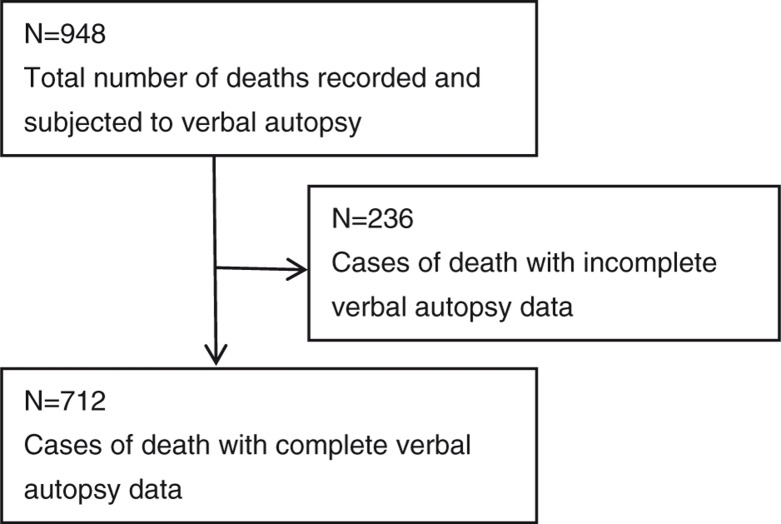
Overall, 948 deaths were recorded, of which 236 (24.9%) had incomplete VA data. Among the 712 deaths analyzed, communicable diseases represented the leading causes (58.9%), with most deaths attributed to malaria (n=129), acute respiratory tract infections (n=110), HIV/AIDS (n=80), and pulmonary tuberculosis (n=46). Non-communicable diseases accounted for 18.9% of the deaths and included mainly acute abdomen (n=38), unspecified cardiac diseases (n=15), and digestive neoplasms (n=13). Maternal and neonatal conditions accounted for 8.3% of deaths, primarily pneumonia (n=19) and birth asphyxia (n=16) in newborns. Among the 3.8% of deaths linked to trauma and injury, the main causes were assault (n=6), accidental drowning (n=4), contact with venomous plants/animals (n=4), and traffic-related accidents (n=4). No clear causes were determined in 10.0% of the analyzed deaths.
Communicable diseases remain the predominant cause of death in rural Côte d'Ivoire. Based on these findings, measures are now being implemented in the Taabo HDSS. It will be interesting to monitor patterns of mortality and causes of death in the face of rapid demographic and epidemiological transitions in this part of West Africa.
科特迪瓦政府机构目前的人口动态统计数据不完整。这一问题在农村偏远地区尤为突出,这些地区获得卫生系统服务的机会有限。
记录2009年至2011年期间的所有死亡情况,并确定科特迪瓦中南部塔博卫生与人口监测系统(HDSS)的主要死亡原因。
使用InterVA-4模型,通过口头尸检(VA)对塔博HDSS运行头三年记录的死亡情况进行调查。InterVA-4在输入指标和死因类别方面以世界卫生组织2012年VA工具为基础。
总体而言,记录了948例死亡,其中236例(24.9%)的VA数据不完整。在分析的712例死亡中,传染病是主要死因(58.9%),大多数死亡归因于疟疾(n=129)、急性呼吸道感染(n=110)、艾滋病毒/艾滋病(n=80)和肺结核(n=46)。非传染病占死亡人数的18.9%,主要包括急腹症(n=38)、未明确的心脏病(n=15)和消化道肿瘤(n=13)。孕产妇和新生儿疾病占死亡人数的8.3%,主要是新生儿肺炎(n=19)和出生窒息(n=16)。在与创伤和伤害相关的3.8%的死亡中,主要原因是袭击(n=6)、意外溺水(n=4)、接触有毒植物/动物(n=4)和交通事故(n=4)。10.0%的分析死亡病例未确定明确病因。
传染病仍然是科特迪瓦农村地区的主要死亡原因。基于这些发现,塔博HDSS目前正在采取措施。面对西非这一地区迅速的人口和流行病学转变,监测死亡率模式和死亡原因将很有意义。