Streatfield P Kim, Khan Wasif A, Bhuiya Abbas, Hanifi Syed M A, Alam Nurul, Diboulo Eric, Sié Ali, Yé Maurice, Compaoré Yacouba, Soura Abdramane B, Bonfoh Bassirou, Jaeger Fabienne, Ngoran Eliezer K, Utzinger Juerg, Melaku Yohannes A, Mulugeta Afework, Weldearegawi Berhe, Gomez Pierre, Jasseh Momodou, Hodgson Abraham, Oduro Abraham, Welaga Paul, Williams John, Awini Elizabeth, Binka Fred N, Gyapong Margaret, Kant Shashi, Misra Puneet, Srivastava Rahul, Chaudhary Bharat, Juvekar Sanjay, Wahab Abdul, Wilopo Siswanto, Bauni Evasius, Mochamah George, Ndila Carolyne, Williams Thomas N, Desai Meghna, Hamel Mary J, Lindblade Kim A, Odhiambo Frank O, Slutsker Laurence, Ezeh Alex, Kyobutungi Catherine, Wamukoya Marylene, Delaunay Valérie, Diallo Aldiouma, Douillot Laetitia, Sokhna Cheikh, Gómez-Olivé F Xavier, Kabudula Chodziwadziwa W, Mee Paul, Herbst Kobus, Mossong Joël, Chuc Nguyen T K, Arthur Samuelina S, Sankoh Osman A, Tanner Marcel, Byass Peter
Matlab HDSS, Bangladesh; International Centre for Diarrhoeal Disease Research, Bangladesh; INDEPTH Network, Accra, Ghana.
International Centre for Diarrhoeal Disease Research, Bangladesh; INDEPTH Network, Accra, Ghana; Bandarban HDSS, Bangladesh.
Glob Health Action. 2014 Oct 29;7:25369. doi: 10.3402/gha.v7.25369. eCollection 2014.
Malaria continues to be a major cause of infectious disease mortality in tropical regions. However, deaths from malaria are most often not individually documented, and as a result overall understanding of malaria epidemiology is inadequate. INDEPTH Network members maintain population surveillance in Health and Demographic Surveillance System sites across Africa and Asia, in which individual deaths are followed up with verbal autopsies.
To present patterns of malaria mortality determined by verbal autopsy from INDEPTH sites across Africa and Asia, comparing these findings with other relevant information on malaria in the same regions.
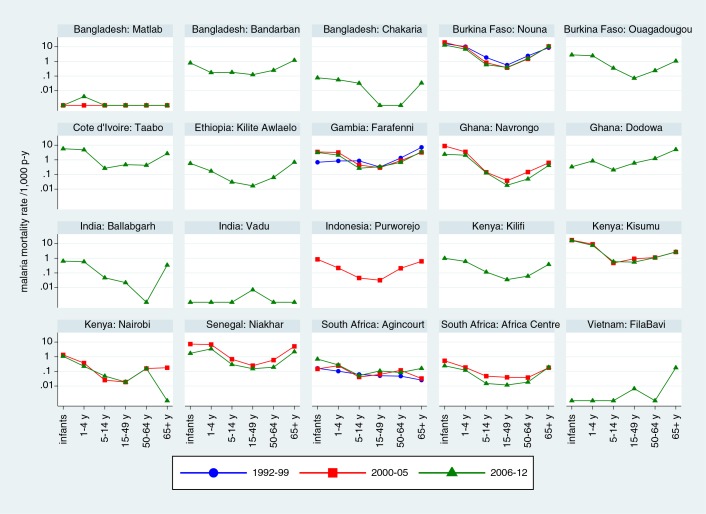
From a database covering 111,910 deaths over 12,204,043 person-years in 22 sites, in which verbal autopsy data were handled according to the WHO 2012 standard and processed using the InterVA-4 model, over 6,000 deaths were attributed to malaria. The overall period covered was 1992-2012, but two-thirds of the observations related to 2006-2012. These deaths were analysed by site, time period, age group and sex to investigate epidemiological differences in malaria mortality.
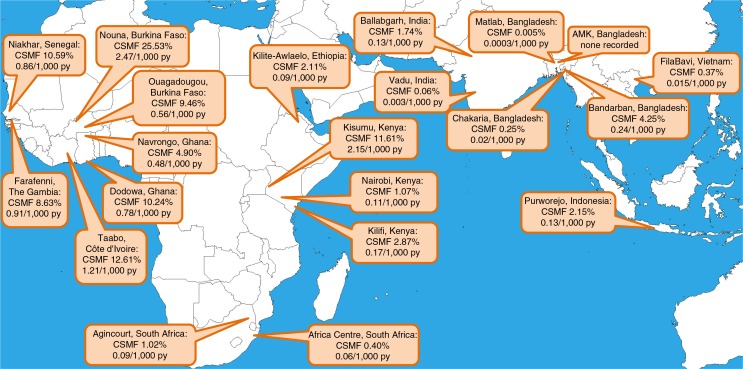
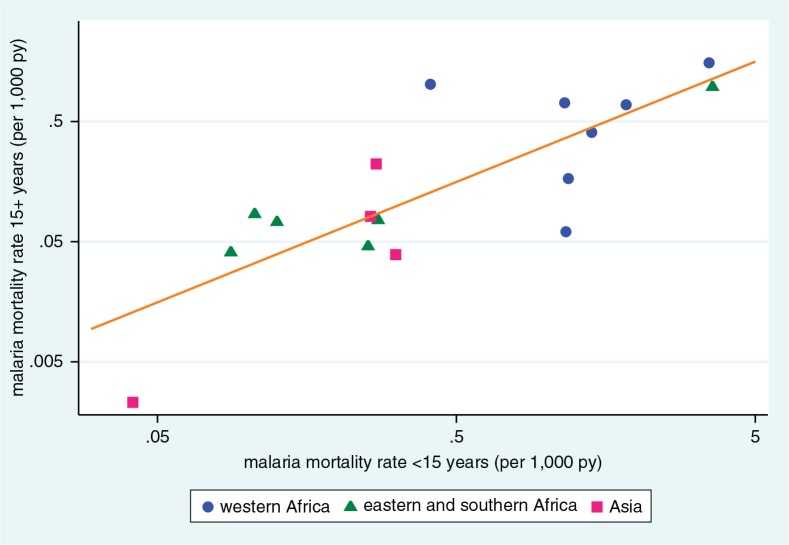
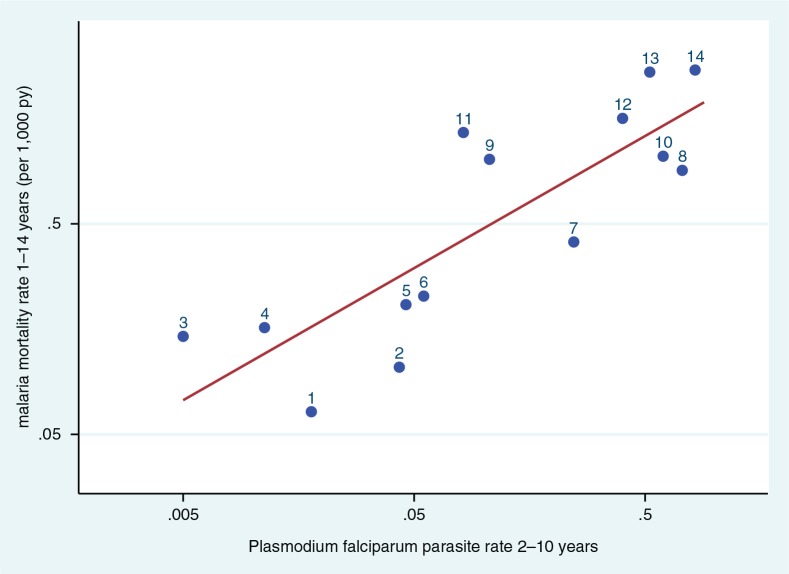
Rates of malaria mortality varied by 1:10,000 across the sites, with generally low rates in Asia (one site recording no malaria deaths over 0.5 million person-years) and some of the highest rates in West Africa (Nouna, Burkina Faso: 2.47 per 1,000 person-years). Childhood malaria mortality rates were strongly correlated with Malaria Atlas Project estimates of Plasmodium falciparum parasite rates for the same locations. Adult malaria mortality rates, while lower than corresponding childhood rates, were strongly correlated with childhood rates at the site level.
The wide variations observed in malaria mortality, which were nevertheless consistent with various other estimates, suggest that population-based registration of deaths using verbal autopsy is a useful approach to understanding the details of malaria epidemiology.
疟疾仍然是热带地区传染病死亡的主要原因。然而,疟疾死亡情况大多未进行个案记录,因此对疟疾流行病学的整体了解并不充分。深入网络(INDEPTH Network)成员在非洲和亚洲的健康与人口监测系统(Health and Demographic Surveillance System)站点开展人口监测,通过口头尸检对个体死亡情况进行追踪。
呈现通过对非洲和亚洲各深入网络站点进行口头尸检确定的疟疾死亡率模式,并将这些结果与同一地区其他有关疟疾的相关信息进行比较。
从一个涵盖22个站点、12,204,043人年期间111,910例死亡的数据库中,按照世界卫生组织2012年标准处理口头尸检数据并使用InterVA - 4模型进行分析,超过6000例死亡归因于疟疾。涵盖的总时间段为1992 - 2012年,但三分之二的观察数据与2006 - 2012年有关。按站点、时间段、年龄组和性别对这些死亡情况进行分析,以调查疟疾死亡率的流行病学差异。
各站点的疟疾死亡率相差达1:10,000,亚洲地区死亡率普遍较低(一个站点在超过50万人年期间未记录到疟疾死亡),西非部分地区死亡率最高(布基纳法索的努纳:每1000人年2.47例)。儿童疟疾死亡率与疟疾地图项目对同一地点恶性疟原虫寄生虫率的估计密切相关。成人疟疾死亡率虽低于相应的儿童死亡率,但在站点层面与儿童死亡率密切相关。
观察到的疟疾死亡率存在广泛差异,但与其他各种估计结果一致,这表明使用口头尸检进行基于人群的死亡登记是了解疟疾流行病学细节的一种有用方法。