Ramos-Lobo Angela M, Buonfiglio Daniella C, Cipolla-Neto José
Department of Physiology and Biophysics, Institute of Biomedical Sciences, University of São Paulo, Av. Lineu Prestes, 1524, São Paulo, SP 05508-000 Brazil.
Diabetol Metab Syndr. 2015 Apr 29;7:39. doi: 10.1186/s13098-015-0035-2. eCollection 2015.
In mammals, the temperature rhythm is regulated by the circadian pacemaker located in the suprachiasmatic nuclei, and is considered a "marker rhythm". Melatonin, the pineal gland hormone, is a major regulator of the endogenous rhythms including body temperature. Its production is influenced by many factors, such as type 1 diabetes mellitus. In rats, diabetes leads to hypothermia and reduced melatonin synthesis; insulin treatment reestablishes both.
To study the body temperature daily rhythm of diabetic animals and the effects of insulin and/or melatonin treatment on its structure.
We studied the effects of streptozotocin-induced diabetes (60 mg/kg) on the body temperature rhythm of Wistar rats and the possible modifications resulting from early and late treatments with insulin (6U/day) and/or melatonin (daily 0.5 mg/kg). We monitored the daily body temperature rhythm, its rhythmic parameters (MESOR, amplitude and acrophase), glycemia and body weight for 55 days. Data were classified by groups and expressed as mean ± SEM. One-way ANOVA analysis was performed followed by Bonferroni posttest. Statistical significance was set at p < 0.05.
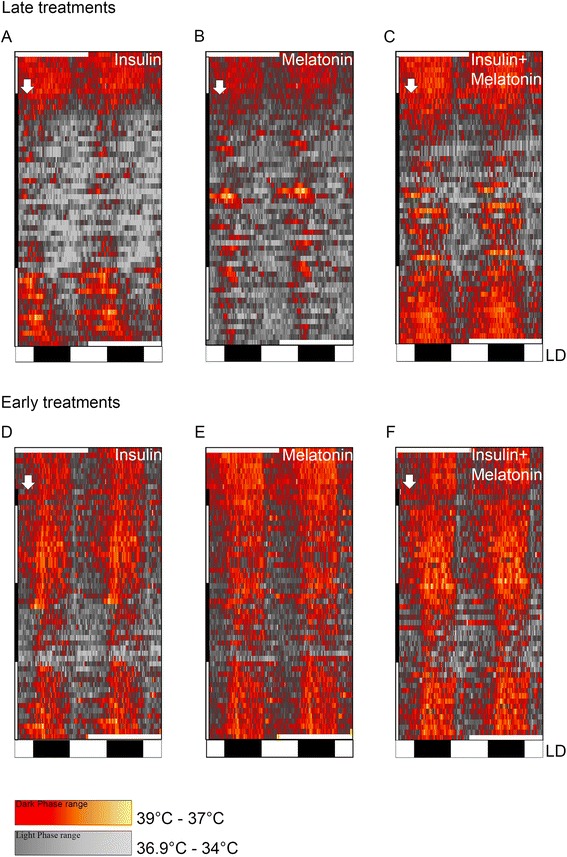
Diabetes led to complete disruption of the temperature rhythm and hypothermia, which were accentuated over time. All early treatments (insulin or/and melatonin) prevented the temperature rhythm disruption and hypothermia. Insulin plus melatonin restored the body temperature rhythm whereas insulin alone resulted less efficient; melatonin alone did not restore any of the parameters studied; however, when supplemented close to diabetes onset, it maintained the temperature rhythmicity. All these corrective effects of the early treatments were dependent on the continuous maintenance of the treatment.
Taken together, our findings show the disruption of the body temperature daily rhythm, a new consequence of insulin-dependent diabetes, as well as the beneficial effect of the complementary action of melatonin and insulin restoring the normal rhythmicity.
在哺乳动物中,体温节律由位于视交叉上核的昼夜节律起搏器调节,被视为一种“标志节律”。褪黑素是松果体分泌的激素,是包括体温在内的内源性节律的主要调节因子。其分泌受多种因素影响,如1型糖尿病。在大鼠中,糖尿病会导致体温过低和褪黑素合成减少;胰岛素治疗可使两者恢复正常。
研究糖尿病动物的体温昼夜节律以及胰岛素和/或褪黑素治疗对其节律结构的影响。
我们研究了链脲佐菌素诱导的糖尿病(60mg/kg)对Wistar大鼠体温节律的影响,以及早期和晚期给予胰岛素(6U/天)和/或褪黑素(每日0.5mg/kg)可能产生的改变。我们监测了55天的每日体温节律、其节律参数(中值、振幅和峰值相位)、血糖和体重。数据按组分类并表示为平均值±标准误。进行单因素方差分析,随后进行Bonferroni事后检验。统计学显著性设定为p<0.05。
糖尿病导致体温节律完全紊乱和体温过低,且随着时间的推移情况加剧。所有早期治疗(胰岛素或/和褪黑素)均预防了体温节律紊乱和体温过低。胰岛素加褪黑素恢复了体温节律,而单独使用胰岛素效果较差;单独使用褪黑素未能恢复所研究的任何参数;然而,在糖尿病发病初期给予补充时,它维持了体温节律性。早期治疗的所有这些纠正作用均依赖于治疗的持续维持。
综上所述,我们的研究结果表明,体温昼夜节律紊乱是胰岛素依赖型糖尿病的一个新后果,以及褪黑素和胰岛素的互补作用恢复正常节律性的有益效果。