Davies Kalatu R, Cantor Scott B, Cox Dennis D, Follen Michele
Department of Health Services Research, The University of Texas MD Anderson Cancer Center, Houston, Texas, United States of America.
Department of Statistics, Rice University, Houston, Texas, United States of America.
PLoS One. 2015 May 11;10(5):e0126573. doi: 10.1371/journal.pone.0126573. eCollection 2015.
Since colposcopy helps to detect cervical cancer in its precancerous stages, as new strategies and technologies are developed for the clinical management of cervical neoplasia, precisely determining the accuracy of colposcopy is important for characterizing its continued role. Our objective was to employ a more precise methodology to estimate of the accuracy of colposcopy to better reflect clinical practice.
For each patient, we compared the worst histology result among colposcopically positive sites to the worst histology result among all sites biopsied, thereby more accurately determining the number of patients that would have been underdiagnosed by colposcopy than previously estimated.
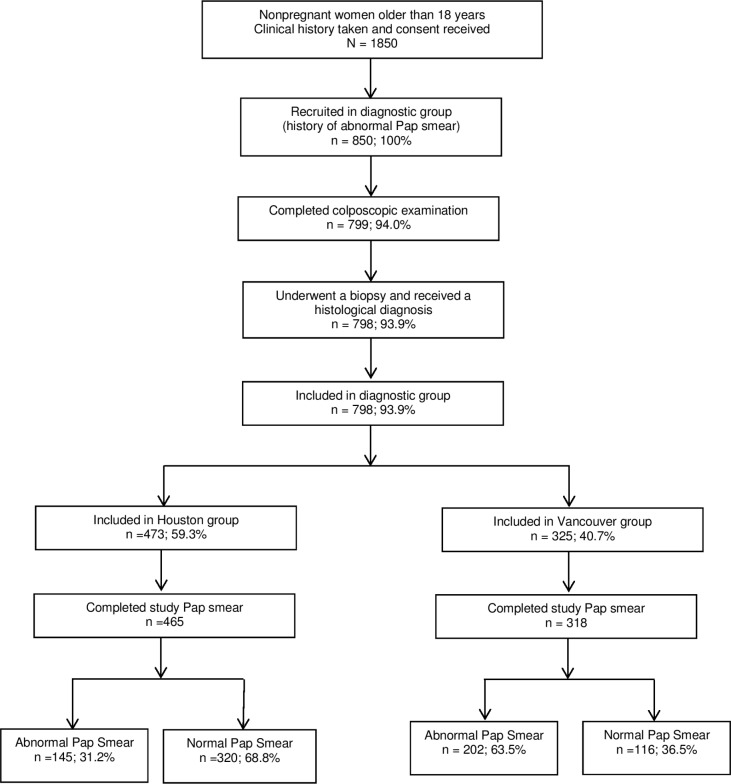
We utilized data from a clinical trial in which 850 diagnostic patients had been enrolled. Seven hundred and ninety-eight of the 850 patients had been examined by colposcopy, and biopsy samples were taken at colposcopically normal and abnormal sites. Our endpoints of interest were the percentages of patients underdiagnosed, and sensitivity and specificity of colposcopy.
With the threshold of low-grade squamous intraepithelial lesions for positive colposcopy and histology diagnoses, the sensitivity of colposcopy decreased from our previous assessment of 87.0% to 74.0%, while specificity remained the same. The drop in sensitivity was the result of histologically positive sites that were diagnosed as negative by colposcopy. Thus, 28.4% of the 798 patients in this diagnostic group would have had their condition underdiagnosed by colposcopy in the clinic.
In utilizing biopsies at multiple sites of the cervix, we present a more precise methodology for determining the accuracy of colposcopy. The true accuracy of colposcopy is lower than previously estimated. Nevertheless, our results reinforce previous conclusions that colposcopy has an important role in the diagnosis of cervical precancer.
由于阴道镜检查有助于在癌前阶段检测宫颈癌,随着针对宫颈肿瘤临床管理的新策略和技术不断发展,准确确定阴道镜检查的准确性对于明确其持续作用至关重要。我们的目标是采用更精确的方法来评估阴道镜检查的准确性,以更好地反映临床实践。
对于每位患者,我们将阴道镜检查阳性部位中最差的组织学结果与所有活检部位中最差的组织学结果进行比较,从而更准确地确定阴道镜检查漏诊患者的数量,其数量比先前估计的更多。
我们利用了一项临床试验的数据,该试验招募了850名诊断患者。850名患者中有798名接受了阴道镜检查,并在阴道镜检查正常和异常的部位采集了活检样本。我们感兴趣的终点是漏诊患者的百分比以及阴道镜检查的敏感性和特异性。
以低度鳞状上皮内病变作为阴道镜检查和组织学诊断阳性的阈值时,阴道镜检查的敏感性从我们先前评估的87.0%降至74.0%,而特异性保持不变。敏感性下降是由于组织学上阳性的部位被阴道镜检查诊断为阴性。因此,在这个诊断组的798名患者中,有28.4%的患者在临床中会被阴道镜检查漏诊。
通过在宫颈多个部位进行活检,我们提出了一种更精确的方法来确定阴道镜检查的准确性。阴道镜检查的实际准确性低于先前估计。尽管如此,我们的结果强化了先前的结论,即阴道镜检查在宫颈上皮内瘤变的诊断中具有重要作用。