Song Jie, Nair Veena A, Young Brittany M, Walton Leo M, Nigogosyan Zack, Remsik Alexander, Tyler Mitchell E, Farrar-Edwards Dorothy, Caldera Kristin E, Sattin Justin A, Williams Justin C, Prabhakaran Vivek
Department of Biomedical Engineering, University of Wisconsin-Madison, Madison, WI USA ; Department of Radiology, University of Wisconsin-Madison, Madison, WI USA.
Department of Radiology, University of Wisconsin-Madison, Madison, WI USA.
Front Hum Neurosci. 2015 Apr 27;9:195. doi: 10.3389/fnhum.2015.00195. eCollection 2015.
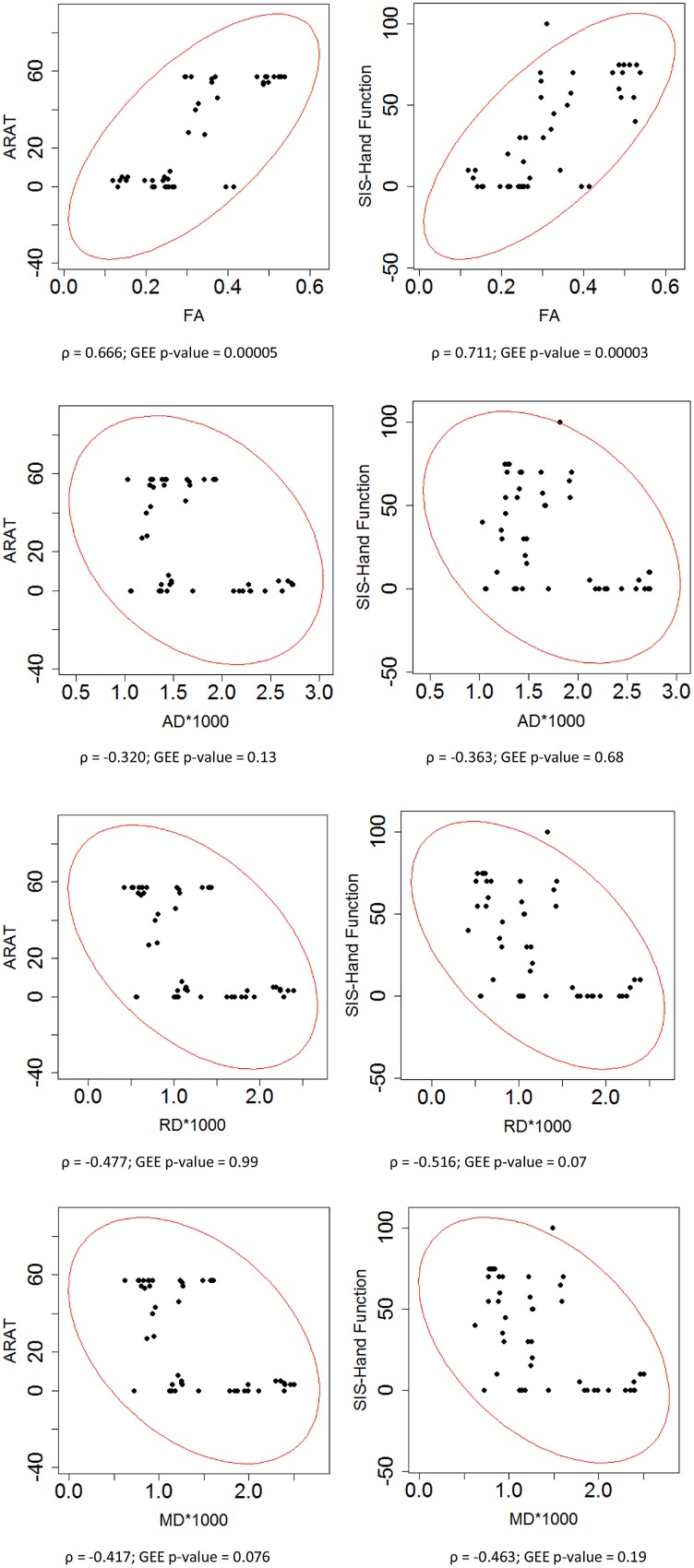
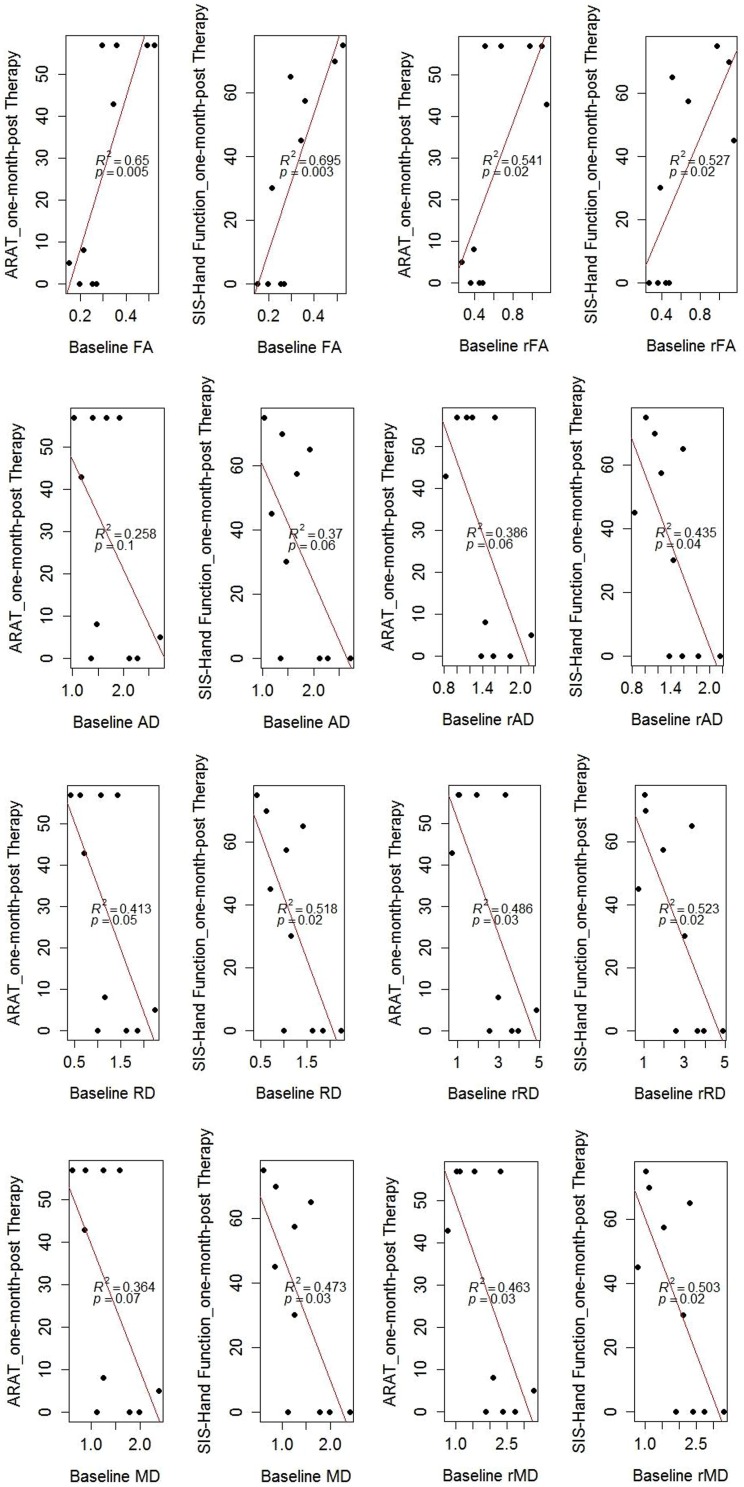
Tracking and predicting motor outcomes is important in determining effective stroke rehabilitation strategies. Diffusion tensor imaging (DTI) allows for evaluation of the underlying structural integrity of brain white matter tracts and may serve as a potential biomarker for tracking and predicting motor recovery. In this study, we examined the longitudinal relationship between DTI measures of the posterior limb of the internal capsule (PLIC) and upper-limb motor outcomes in 13 stroke patients (median 20-month post-stroke) who completed up to 15 sessions of intervention using brain-computer interface (BCI) technology. Patients' upper-limb motor outcomes and PLIC DTI measures including fractional anisotropy (FA), axial diffusivity (AD), radial diffusivity (RD), and mean diffusivity (MD) were assessed longitudinally at four time points: pre-, mid-, immediately post- and 1-month-post intervention. DTI measures and ratios of each DTI measure comparing the ipsilesional and contralesional PLIC were correlated with patients' motor outcomes to examine the relationship between structural integrity of the PLIC and patients' motor recovery. We found that lower diffusivity and higher FA values of the ipsilesional PLIC were significantly correlated with better upper-limb motor function. Baseline DTI ratios were significantly correlated with motor outcomes measured immediately post and 1-month-post BCI interventions. A few patients achieved improvements in motor recovery meeting the minimum clinically important difference (MCID). These findings suggest that upper-limb motor recovery in stroke patients receiving BCI interventions relates to the microstructural status of the PLIC. Lower diffusivity and higher FA measures of the ipsilesional PLIC contribute toward better motor recovery in the stroke-affected upper-limb. DTI-derived measures may be a clinically useful biomarker in tracking and predicting motor recovery in stroke patients receiving BCI interventions.
追踪和预测运动结果对于确定有效的中风康复策略至关重要。扩散张量成像(DTI)能够评估脑白质束的潜在结构完整性,并可能作为追踪和预测运动恢复的潜在生物标志物。在本研究中,我们调查了13名中风患者(中风后中位数为20个月)内囊后肢(PLIC)的DTI测量值与上肢运动结果之间的纵向关系,这些患者使用脑机接口(BCI)技术完成了多达15次干预疗程。在四个时间点纵向评估患者的上肢运动结果和PLIC的DTI测量值,包括分数各向异性(FA)、轴向扩散率(AD)、径向扩散率(RD)和平均扩散率(MD):干预前、干预中期、干预刚结束时和干预后1个月。将每个DTI测量值以及同侧和对侧PLIC的DTI测量值之比与患者的运动结果进行关联,以研究PLIC的结构完整性与患者运动恢复之间的关系。我们发现,同侧PLIC较低的扩散率和较高的FA值与较好的上肢运动功能显著相关。基线DTI比值与BCI干预刚结束时和干预后1个月测量的运动结果显著相关。少数患者在运动恢复方面取得了改善,达到了最小临床重要差异(MCID)。这些发现表明,接受BCI干预的中风患者的上肢运动恢复与PLIC的微观结构状态有关。同侧PLIC较低的扩散率和较高的FA测量值有助于中风影响的上肢实现更好的运动恢复。DTI衍生的测量值可能是追踪和预测接受BCI干预的中风患者运动恢复的一种临床有用的生物标志物。