Nicholls Stuart G, Quach Pauline, von Elm Erik, Guttmann Astrid, Moher David, Petersen Irene, Sørensen Henrik T, Smeeth Liam, Langan Sinéad M, Benchimol Eric I
Department of Epidemiology and Community Medicine, University of Ottawa, Ottawa, Canada; Children's Hospital of Eastern Ontario Research Institute, Ottawa, Canada.
Institute for Clinical Evaluative Sciences, Toronto, Canada.
PLoS One. 2015 May 12;10(5):e0125620. doi: 10.1371/journal.pone.0125620. eCollection 2015.
Routinely collected health data, collected for administrative and clinical purposes, without specific a priori research questions, are increasingly used for observational, comparative effectiveness, health services research, and clinical trials. The rapid evolution and availability of routinely collected data for research has brought to light specific issues not addressed by existing reporting guidelines. The aim of the present project was to determine the priorities of stakeholders in order to guide the development of the REporting of studies Conducted using Observational Routinely-collected health Data (RECORD) statement.
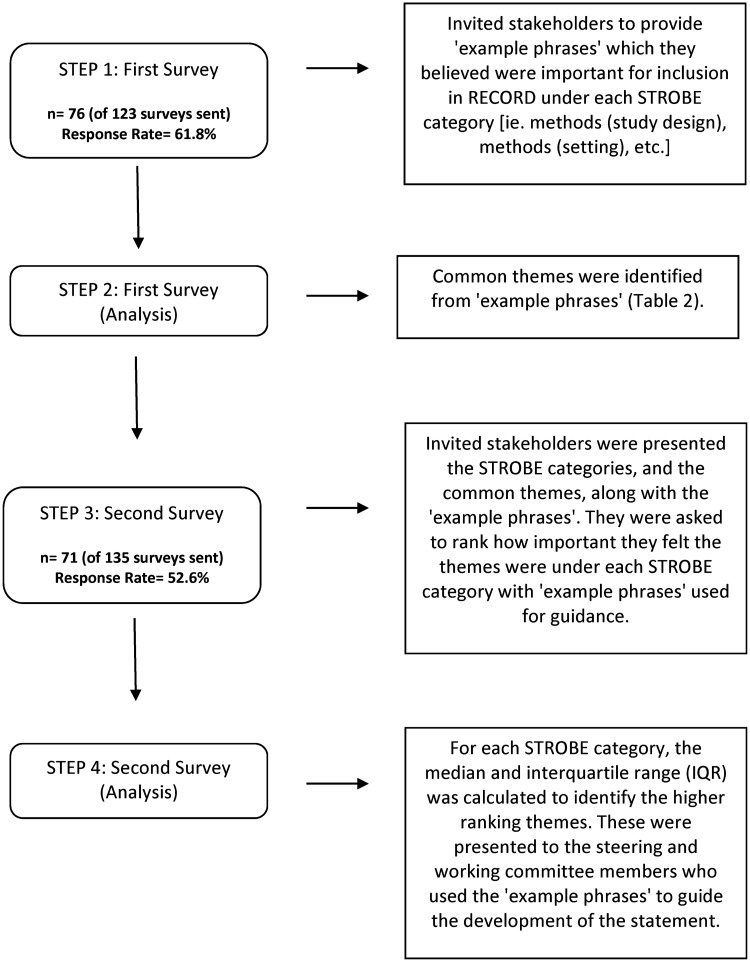
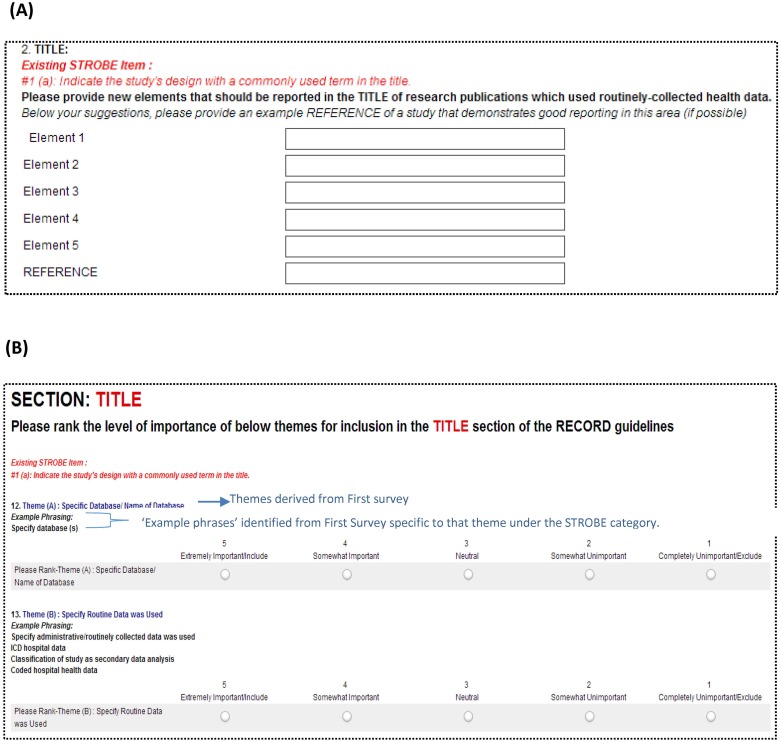
Two modified electronic Delphi surveys were sent to stakeholders. The first determined themes deemed important to include in the RECORD statement, and was analyzed using qualitative methods. The second determined quantitative prioritization of the themes based on categorization of manuscript headings. The surveys were followed by a meeting of RECORD working committee, and re-engagement with stakeholders via an online commentary period.
The qualitative survey (76 responses of 123 surveys sent) generated 10 overarching themes and 13 themes derived from existing STROBE categories. Highest-rated overall items for inclusion were: Disease/exposure identification algorithms; Characteristics of the population included in databases; and Characteristics of the data. In the quantitative survey (71 responses of 135 sent), the importance assigned to each of the compiled themes varied depending on the manuscript section to which they were assigned. Following the working committee meeting, online ranking by stakeholders provided feedback and resulted in revision of the final checklist.
The RECORD statement incorporated the suggestions provided by a large, diverse group of stakeholders to create a reporting checklist specific to observational research using routinely collected health data. Our findings point to unique aspects of studies conducted with routinely collected health data and the perceived need for better reporting of methodological issues.
为行政和临床目的而常规收集的健康数据,在没有特定先验研究问题的情况下,越来越多地用于观察性、比较效果、卫生服务研究和临床试验。常规收集的数据用于研究的快速发展和可得性揭示了现有报告指南未涉及的特定问题。本项目的目的是确定利益相关者的优先事项,以指导使用观察性常规收集的健康数据进行研究的报告(RECORD)声明的制定。
向利益相关者发送了两项经过修改的电子德尔菲调查。第一项调查确定了被认为对纳入RECORD声明很重要的主题,并采用定性方法进行分析。第二项调查根据手稿标题的分类确定了主题的定量优先级。调查之后召开了RECORD工作委员会会议,并通过在线评论期再次与利益相关者进行沟通。
定性调查(发送的123份调查问卷中有76份回复)产生了10个总体主题和13个源自现有STROBE类别的主题。纳入的总体项目中评分最高的是:疾病/暴露识别算法;数据库中纳入人群的特征;以及数据的特征。在定量调查(发送的135份调查问卷中有71份回复)中,分配给每个汇编主题的重要性因它们所分配的手稿部分而异。在工作委员会会议之后,利益相关者的在线排名提供了反馈,并导致最终清单的修订。
RECORD声明纳入了大量不同利益相关者提供的建议,以创建一份专门针对使用常规收集的健康数据进行观察性研究的报告清单。我们的研究结果指出了使用常规收集的健康数据进行研究的独特方面,以及对更好地报告方法学问题的认知需求。