Huang Ming-de, Chen Wen-ming, Qi Fu-zhen, Xia Rui, Sun Ming, Xu Tong-peng, Yin Li, Zhang Er-bao, De Wei, Shu Yong-qian
Department of Medical Oncology, Huai'an First People's Hospital, Nanjing Medical University, Huai'an City, Jiangsu Province, 223301, People's Republic of China.
Department of Oncology, Jining No. 1 People's Hospital, No. 6, Jiankang Road, Jining City, Shandong Province, 272011, People's Republic of China.
J Hematol Oncol. 2015 May 14;8:50. doi: 10.1186/s13045-015-0146-0.
Hepatocellular carcinoma (HCC) is one of the leading causes of cancer-related death, especially in China. And the mechanism of its progression remains poorly understood. Growing evidence indicates that long non-coding RNAs (lncRNAs) are found to be dysregulated in many cancers, including HCC. ANRIL, a lncRNA co-clustered mainly with p14/ARF has been reported to be dysregulated in gastric cancer, esophageal squamous cell carcinoma, and lung cancer. However, its clinical significance and potential role in HCC are still not documented.
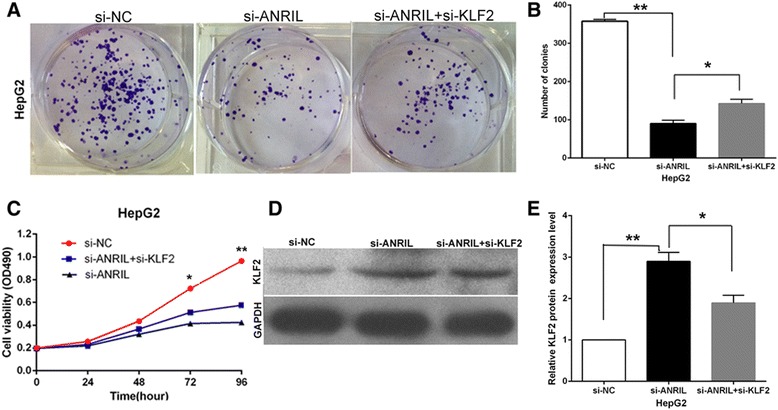
In this study, expression of ANRIL was analyzed in 77 HCC tissues and matched normal tissues by using quantitative polymerase chain reaction (qRT-PCR). ANRIL expression was upregulated in HCC tissues, and the higher expression of ANRIL was significantly correlated with tumor size and Barcelona Clinic Liver Cancer (BCLC) stage. Moreover, taking advantage of loss-of-function experiments in HCC cells, we found that knockdown of ANRIL expression could impair cell proliferation and invasion and induce cell apoptosis both in vitro and in vivo. We also found that ANRIL could epigenetically repress Kruppel-like factor 2 (KLF2) transcription in HCC cells by binding with PRC2 and recruiting it to the KLF2 promoter region. We also found that SP1 could regulate the expression of ANRIL.
Our results suggest that lncRNA ANRIL, as a growth regulator, may serve as a new biomarker and target for therapy in HCC.
肝细胞癌(HCC)是癌症相关死亡的主要原因之一,尤其是在中国。其进展机制仍知之甚少。越来越多的证据表明,长链非编码RNA(lncRNA)在包括HCC在内的许多癌症中存在失调。ANRIL是一种主要与p14/ARF共聚集的lncRNA,据报道在胃癌、食管鳞状细胞癌和肺癌中存在失调。然而,其在HCC中的临床意义和潜在作用仍未得到证实。
在本研究中,通过定量聚合酶链反应(qRT-PCR)分析了77例HCC组织及配对正常组织中ANRIL的表达。ANRIL在HCC组织中表达上调,且ANRIL的高表达与肿瘤大小和巴塞罗那临床肝癌(BCLC)分期显著相关。此外,利用HCC细胞的功能丧失实验,我们发现敲低ANRIL表达可在体外和体内损害细胞增殖和侵袭并诱导细胞凋亡。我们还发现ANRIL可通过与PRC2结合并将其招募至KLF2启动子区域,在表观遗传上抑制HCC细胞中Kruppel样因子2(KLF2)的转录。我们还发现SP1可调节ANRIL的表达。
我们的结果表明,lncRNA ANRIL作为一种生长调节因子,可能成为HCC治疗的新生物标志物和靶点。