Pena Homero Rabelo, de Lima Marilia Carvalho, Brandt Katia Galeão, de Antunes Margarida Maria Castro, da Silva Giselia Alves Pontes
Hospital Barão de Lucena, Recife, Pernambuco, CEP 52050-041, Brazil.
Department of Maternal and Child Health, Universidade Federal de Pernambuco, Recife, Brazil.
BMC Pregnancy Childbirth. 2015 May 13;15:112. doi: 10.1186/s12884-015-0547-7.
In recent years, a high prevalence of vitamin D deficiency amongst pregnant women and newborns has been observed throughout several regions of the world, especially in the presence of preeclampsia (PE) or obesity (OB). The aim of this study was to investigate whether nonobese and obese preeclamptic pregnant women and their newborns have low 25(OH)D compared with nonobese and obese nonpreeclamptic pregnant women; and to verify whether the maternal level of this vitamin correlates with the newborns' level.
This is a cross-sectional study conducted with 179 pregnant women recruited immediately before delivery, divided into four groups: PE(+)/OB(-); PE(+)/OB(+); PE(-)/OB(+); and PE(-)/OB(-), with gestational age ≥ 34 weeks. Maternal peripheral blood and newborns umbilical cord blood were collected and 25(OH)D levels were measured by chemiluminescence (LIAISON®).
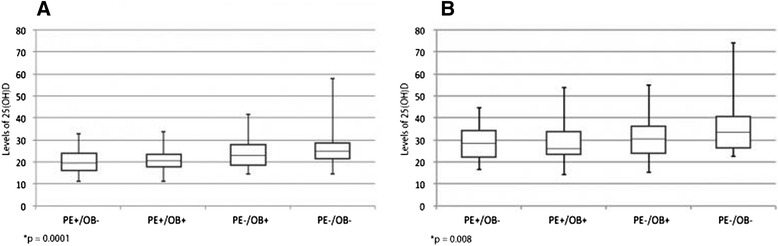
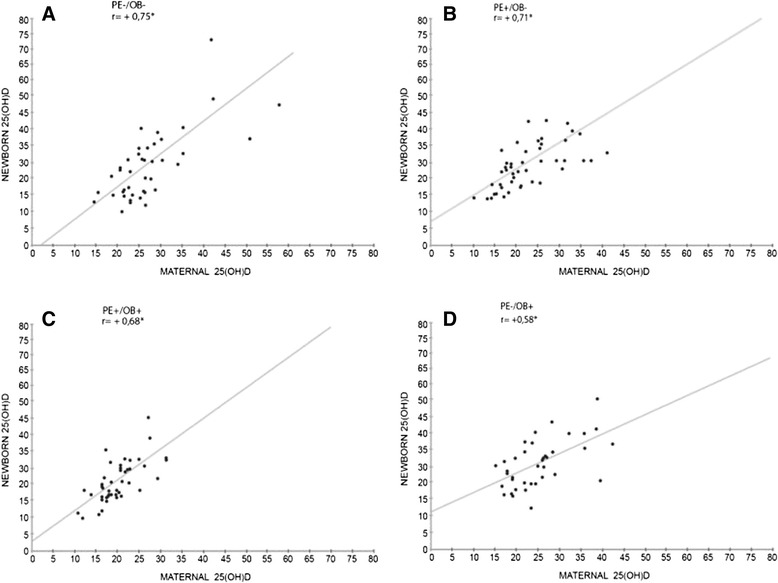
Infants born to preeclamptic mothers had a lower median 25(OH)D level than those born to nonpreeclamptic mothers (p < 0.01). Obese pregnant women and their newborns had higher frequencies of 25(OH)D deficiency, but the difference with respect to nonobese pregnant women and their newborns was not significant. The vitamin D status of preeclamptic obese women was not worse than that of their nonobese counterparts. Newborns and maternal 25(OH)D levels were significantly correlated (p = 0.01). Obesity weakened this correlation.
Preeclamptic women and their newborns presented higher frequencies of 25(OH)D deficiency, but 25(OH)D levels were not significantly influenced by obesity. Obese pregnant women transferred less 25(OH)D to their fetuses.
近年来,在世界多个地区都观察到孕妇和新生儿中维生素D缺乏的高患病率,尤其是在子痫前期(PE)或肥胖(OB)的情况下。本研究的目的是调查与非肥胖和非子痫前期孕妇相比,非肥胖和肥胖的子痫前期孕妇及其新生儿的25(OH)D水平是否较低;并验证该维生素的母体水平是否与新生儿水平相关。
这是一项横断面研究,对179名在分娩前立即招募的孕妇进行了研究,分为四组:PE(+)/OB(-);PE(+)/OB(+);PE(-)/OB(+);和PE(-)/OB(-),孕周≥34周。采集孕妇外周血和新生儿脐带血,并通过化学发光法(LIAISON®)测量25(OH)D水平。
子痫前期母亲所生婴儿的25(OH)D中位数水平低于非子痫前期母亲所生婴儿(p<0.01)。肥胖孕妇及其新生儿的25(OH)D缺乏频率较高,但与非肥胖孕妇及其新生儿相比,差异不显著。子痫前期肥胖女性的维生素D状况并不比非肥胖女性差。新生儿和母体的25(OH)D水平显著相关(p = 0.01)。肥胖削弱了这种相关性。
子痫前期妇女及其新生儿的25(OH)D缺乏频率较高,但25(OH)D水平不受肥胖的显著影响。肥胖孕妇向胎儿转移的25(OH)D较少。