Mählmann Kathrin, Feige Karsten, Juhls Christiane, Endmann Anne, Schuberth Hans-Joachim, Oswald Detlef, Hellige Mareu, Doherr Marcus, Cavalleri Jessika-M V
Clinic for Horses, University of Veterinary Medicine Hannover, Foundation, Hannover, Germany.
Mologen AG, Berlin, Germany.
BMC Vet Res. 2015 May 14;11:107. doi: 10.1186/s12917-015-0414-9.
Equine melanoma has a high incidence in grey horses. Xenogenic DNA vaccination may represent a promising therapeutic approach against equine melanoma as it successfully induced an immunological response in other species suffering from melanoma and in healthy horses. In a clinical study, twenty-seven, grey, melanoma-bearing, horses were assigned to three groups (n = 9) and vaccinated on days 1, 22, and 78 with DNA vectors encoding for equine (eq) IL-12 and IL-18 alone or in combination with either human glycoprotein (hgp) 100 or human tyrosinase (htyr). Horses were vaccinated intramuscularly, and one selected melanoma was locally treated by intradermal peritumoral injection. Prior to each injection and on day 120, the sizes of up to nine melanoma lesions per horse were measured by caliper and ultrasound. Specific serum antibodies against hgp100 and htyr were measured using cell based flow-cytometric assays. An Analysis of Variance (ANOVA) for repeated measurements was performed to identify statistically significant influences on the relative tumor volume. For post-hoc testing a Tukey-Kramer Multiple-Comparison Test was performed to compare the relative volumes on the different examination days. An ANOVA for repeated measurements was performed to analyse changes in body temperature over time. A one-way ANOVA was used to evaluate differences in body temperature between the groups. A p-value < 0.05 was considered significant for all statistical tests applied.
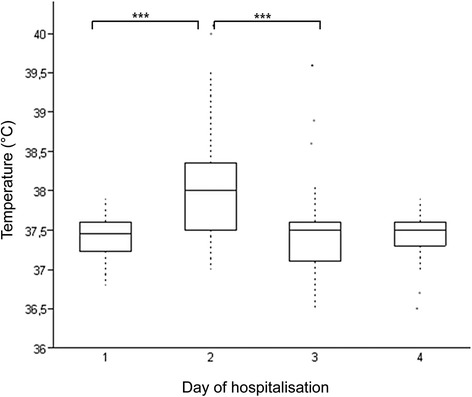
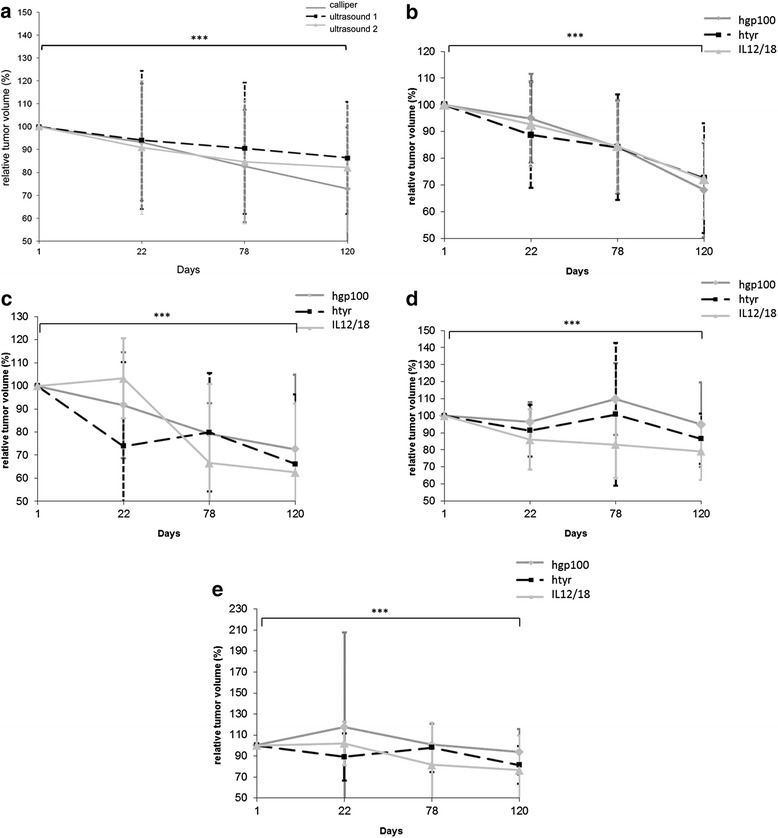
In all groups, the relative tumor volume decreased significantly to 79.1 ± 26.91% by day 120 (p < 0.0001, Tukey-Kramer Multiple-Comparison Test). Affiliation to treatment group, local treatment and examination modality had no significant influence on the results (ANOVA for repeated measurements). Neither a cellular nor a humoral immune response directed against htyr or hgp100 was detected. Horses had an increased body temperature on the day after vaccination.
This is the first clinical report on a systemic effect against equine melanoma following treatment with DNA vectors encoding eqIL12 and eqIL18 and formulated with a transfection reagent. Addition of DNA vectors encoding hgp100 respectively htyr did not potentiate this effect.
马黑色素瘤在灰色马匹中发病率很高。异种DNA疫苗接种可能是一种有前景的治疗马黑色素瘤的方法,因为它在其他患黑色素瘤的物种以及健康马匹中成功诱导了免疫反应。在一项临床研究中,27匹患有黑色素瘤的灰色马匹被分为三组(每组n = 9),并在第1天、第22天和第78天分别接种编码马(eq)白细胞介素-12(IL-12)和白细胞介素-18(IL-18)的DNA载体,单独接种或与人类糖蛋白(hgp)100或人类酪氨酸酶(htyr)联合接种。马匹通过肌肉注射进行疫苗接种,对一个选定的黑色素瘤通过瘤周皮内注射进行局部治疗。在每次注射前以及第120天,用卡尺和超声测量每匹马多达9个黑色素瘤病灶的大小。使用基于细胞的流式细胞术检测针对hgp100和htyr的特异性血清抗体。进行重复测量方差分析(ANOVA)以确定对相对肿瘤体积的统计学显著影响。对于事后检验,进行Tukey-Kramer多重比较检验以比较不同检查日期的相对体积。进行重复测量方差分析以分析体温随时间的变化。使用单因素方差分析评估各组之间体温的差异。对于所有应用的统计检验,p值<0.05被认为具有显著性。
在所有组中,到第120天时,相对肿瘤体积显著下降至79.1±26.91%(p<0.0001,Tukey-Kramer多重比较检验)。治疗组归属、局部治疗和检查方式对结果无显著影响(重复测量方差分析)。未检测到针对htyr或hgp100的细胞免疫或体液免疫反应。马匹在接种疫苗后的第二天体温升高。
这是关于用编码eqIL12和eqIL18并与转染试剂配制的DNA载体治疗后对马黑色素瘤产生全身效应的首份临床报告。添加编码hgp100或htyr的DNA载体并未增强这种效应。