Russano Marco, Vincenzi Bruno, Venditti Olga, D'Onofrio Loretta, Ratta Raffaele, Guida Francesco M, Tonini Giuseppe, Santini Daniele
Department of Medical Oncology, Campus Bio-Medico University of Rome, Via Alvaro del Portillo 200, 00128, Rome, Italy.
BMC Res Notes. 2015 May 14;8:196. doi: 10.1186/s13104-015-1154-4.
Pazopanib is an oral multitargeted tyrosine-kinase inhibitor, used as a single agent to treat advanced renal cell carcinoma. Treatment with other tyrosine-kinase inhibitors is known to be associated with asymptomatic elevations of serum amylase and lipase levels. As regards the pazopanib, data are lacking in literature.
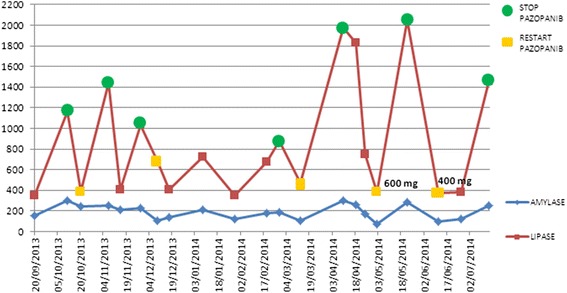
We report one case of pancreatic toxicity associated with pazopanib administration. Before starting treatment, patient had no risk factors for pancreatitis. The patient, an Italian 68 years old woman, started pazopanib at doses of 800 mg daily as first-line therapy for metastatic renal cell carcinoma. Six months after the start of treatment, blood tests showed for the first time a significant increase in serum lipase and amylase in the absence of symptoms and radiological findings of pancreatitis. The patient continued treatment without interruptions or dose reductions. However, the continuation of the treatment led to a further increase of pancreatic enzymes. We tried to continue the treatment by reducing the dose but only the discontinuation was associated with normalization of amylase and lipase's levels. On the other hand the treatment with pazopanib got prolonged response of the disease in the absence of signs of pancreatitis. We therefore decided to continue treatment with pazopanib 400 mg daily with close monitoring of blood levels of pancreatic enzymes.
We hypothesize that the increase of pancreatic enzymes is not a dose-dependent event. The mechanism for pancreatic toxicity induced by tyrosine-kinase inhibitors is unknown and no predictive factors have been identified. There are no clear guidelines on the management of the drug in the presence of pancreatic enzyme increase. In any case, we believe that a careful monitoring of pancreatic enzymes during treatment with pazopanib is advisable.
帕唑帕尼是一种口服多靶点酪氨酸激酶抑制剂,作为单一药物用于治疗晚期肾细胞癌。已知使用其他酪氨酸激酶抑制剂治疗会导致血清淀粉酶和脂肪酶水平无症状升高。关于帕唑帕尼,文献中缺乏相关数据。
我们报告一例与帕唑帕尼给药相关的胰腺毒性病例。在开始治疗前,患者没有胰腺炎的危险因素。该患者是一名68岁的意大利女性,开始以每日800毫克的剂量服用帕唑帕尼,作为转移性肾细胞癌的一线治疗。治疗开始六个月后,血液检查首次显示血清脂肪酶和淀粉酶显著升高,且无胰腺炎的症状和影像学表现。患者继续治疗,未中断或减量。然而,继续治疗导致胰腺酶进一步升高。我们试图通过降低剂量继续治疗,但只有停药才使淀粉酶和脂肪酶水平恢复正常。另一方面,在没有胰腺炎迹象的情况下,帕唑帕尼治疗使疾病获得了延长的缓解期。因此,我们决定继续每日400毫克的帕唑帕尼治疗,并密切监测胰腺酶的血液水平。
我们推测胰腺酶升高不是剂量依赖性事件。酪氨酸激酶抑制剂诱导胰腺毒性的机制尚不清楚,且未发现预测因素。在胰腺酶升高的情况下,对于该药物的管理尚无明确指南。无论如何,我们认为在帕唑帕尼治疗期间仔细监测胰腺酶是可取的。