Chakraborty Satabdi, Thomas Pramod, Bhatia Triptish, Nimgaonkar Vishwajit L, Deshpande Smita N
Department of Psychiatry, Post Graduate Institute of Medical Sciences, Rohtak, Haryana, India.
Department of Biostatistics, Dr. Somervell Memorial CSI Medical College, Karakonam, Thiruvananthapuram, Kerala, India.
Indian J Psychol Med. 2015 Apr-Jun;37(2):169-74. doi: 10.4103/0253-7176.155616.
The Indian Scale for Assessment of Autism (ISAA) was developed to assess the severity of autism among Indian cases.
The present study evaluated the ISAA in relation to the Childhood Autism Rating Scale (CARS) and the Developmental Disability- Children Global Assessment Scale (DD-CGAS).
Indian children with ICD 10 diagnoses of Autistic disorder (AD, n = 50), Intellectual Disability (ID, n = 50), Attention Deficit Hyperactivity Disorder (ADHD, n = 26), other psychiatric disorders (PD-N=25) and control children without psychiatric disorders (n = 65) were evaluated using the ISAA, DD-CGAS and the CARS (total n = 216).
In addition to descriptive statistics and correlation, analysis of variance (ANOVA) was used to assess whether the ISAA scores were significantly different across diagnostic groups.
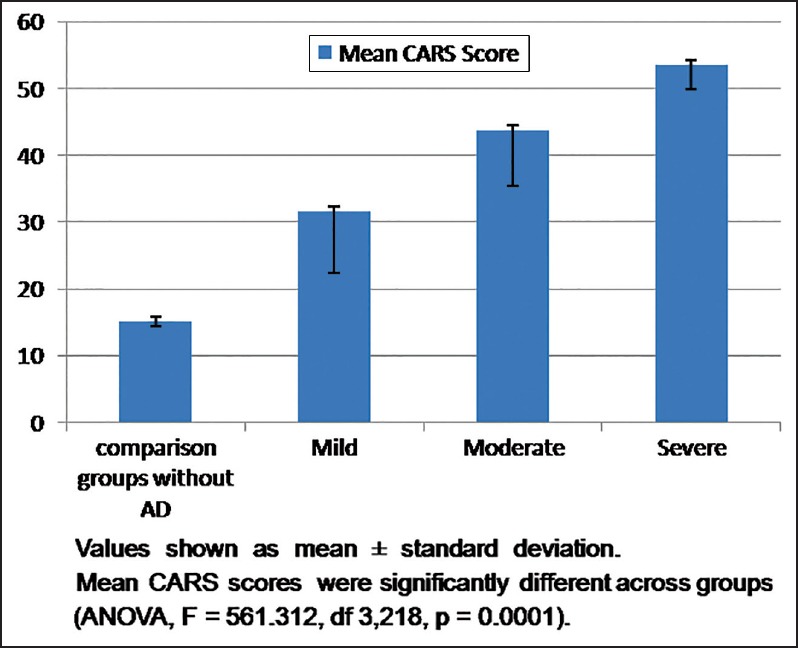
Total ISAA scores were significantly higher among children diagnosed with autistic disorder compared to four other diagnostic groups. Total ISAA scores were significantly correlated with CARS scores and DD-CGAS scores. Groups sub-divided on the basis of recommended ISAA cutoff points of severity showed significant differences in CARS scores.
The ISAA can thus be used to assess severity of AD among Indian children.
印度自闭症评估量表(ISAA)旨在评估印度自闭症患者的严重程度。
本研究评估了ISAA与儿童自闭症评定量表(CARS)和发育障碍儿童总体评定量表(DD-CGAS)的相关性。
使用ISAA、DD-CGAS和CARS对216名儿童进行评估,这些儿童包括:被国际疾病分类第10版诊断为自闭症谱系障碍(AD,n = 50)、智力障碍(ID,n = 50)、注意力缺陷多动障碍(ADHD,n = 26)、其他精神障碍(PD,n = 25)的印度儿童,以及无精神障碍的对照儿童(n = 65)。
除描述性统计和相关性分析外,采用方差分析(ANOVA)评估不同诊断组的ISAA得分是否存在显著差异。
与其他四个诊断组相比,被诊断为自闭症谱系障碍的儿童的ISAA总分显著更高。ISAA总分与CARS得分和DD-CGAS得分显著相关。根据ISAA推荐的严重程度分界点细分的组在CARS得分上存在显著差异。
因此,ISAA可用于评估印度儿童自闭症谱系障碍的严重程度。