Chi Thomas, Kim Man Su, Lang Sven, Bose Neelanjan, Kahn Arnold, Flechner Lawrence, Blaschko Sarah D, Zee Tiffany, Muteliefu Gulinuer, Bond Nichole, Kolipinski Marysia, Fakra Sirine C, Mandel Neil, Miller Joe, Ramanathan Arvind, Killilea David W, Brückner Katja, Kapahi Pankaj, Stoller Marshall L
Department of Urology, University of California San Francisco, San Francisco, California, United States of America.
College of Pharmacy, Inje University, Gimhae, Republic of Korea; The Buck Institute for Research on Aging, Novato, California, United States of America.
PLoS One. 2015 May 13;10(5):e0124150. doi: 10.1371/journal.pone.0124150. eCollection 2015.
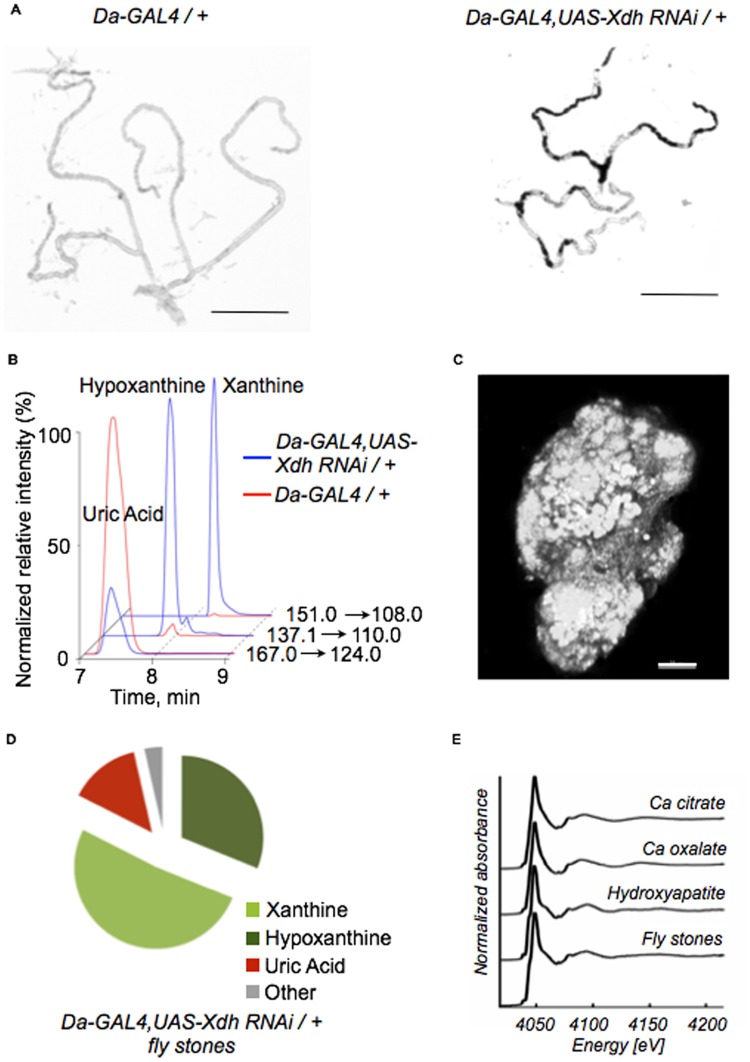
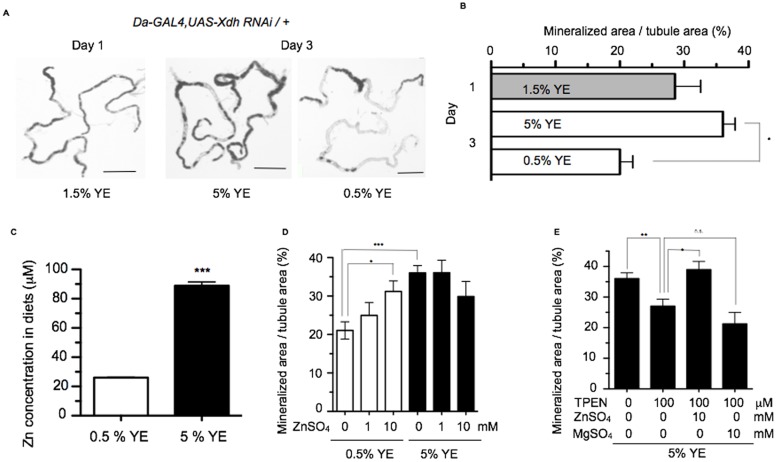
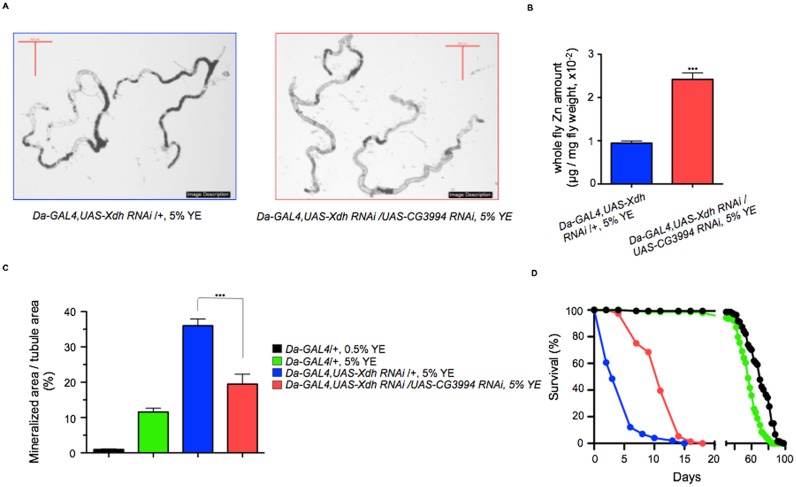
Ectopic calcification is a driving force for a variety of diseases, including kidney stones and atherosclerosis, but initiating factors remain largely unknown. Given its importance in seemingly divergent disease processes, identifying fundamental principal actors for ectopic calcification may have broad translational significance. Here we establish a Drosophila melanogaster model for ectopic calcification by inhibiting xanthine dehydrogenase whose deficiency leads to kidney stones in humans and dogs. Micro X-ray absorption near edge spectroscopy (μXANES) synchrotron analyses revealed high enrichment of zinc in the Drosophila equivalent of kidney stones, which was also observed in human kidney stones and Randall's plaques (early calcifications seen in human kidneys thought to be the precursor for renal stones). To further test the role of zinc in driving mineralization, we inhibited zinc transporter genes in the ZnT family and observed suppression of Drosophila stone formation. Taken together, genetic, dietary, and pharmacologic interventions to lower zinc confirm a critical role for zinc in driving the process of heterogeneous nucleation that eventually leads to stone formation. Our findings open a novel perspective on the etiology of urinary stones and related diseases, which may lead to the identification of new preventive and therapeutic approaches.
异位钙化是包括肾结石和动脉粥样硬化在内的多种疾病的驱动因素,但引发因素在很大程度上仍不清楚。鉴于其在看似不同的疾病过程中的重要性,确定异位钙化的基本主要因素可能具有广泛的转化意义。在这里,我们通过抑制黄嘌呤脱氢酶建立了一个果蝇异位钙化模型,该酶的缺乏会导致人类和犬类患肾结石。微X射线吸收近边光谱(μXANES)同步加速器分析显示,果蝇肾结石中锌高度富集,在人类肾结石和兰德尔斑(在人类肾脏中发现的早期钙化,被认为是肾结石的前体)中也观察到了这种情况。为了进一步测试锌在驱动矿化中的作用,我们抑制了锌转运蛋白家族中的锌转运基因,并观察到果蝇结石形成受到抑制。综合来看,降低锌的遗传、饮食和药物干预证实了锌在驱动最终导致结石形成的异质成核过程中起着关键作用。我们的发现为尿路结石及相关疾病的病因学开辟了一个新视角,这可能会带来新的预防和治疗方法的发现。