Kuo Yuan-Hung, Chen Pao-Fei, Wang Jing-Houng, Chang Kuo-Chin, Kee Kwong-Ming, Tsai Ming-Chao, Lin Chun-Yin, Lin Sheng-Che, Tsai Lin-San, Chen Shu-Chuan, Lu Sheng-Nan
Division of Hepato-Gastroenterology, Department of Internal Medicine, Kaohsiung Chang Gung Memorial Hospital and Chang Gung University College of Medicine, Kaohsiung, Taiwan.
Health Center of Yanpu Township, Pingtung, Taiwan.
PLoS One. 2015 May 13;10(5):e0126031. doi: 10.1371/journal.pone.0126031. eCollection 2015.
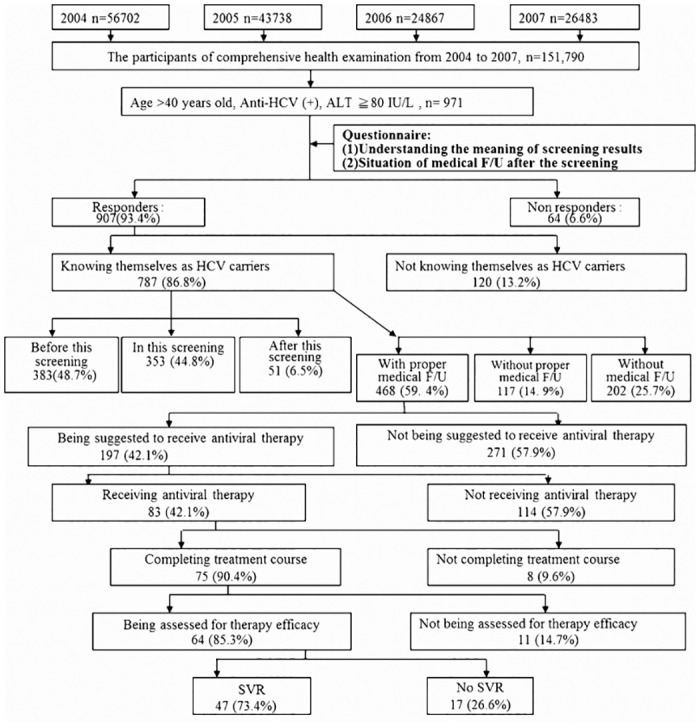
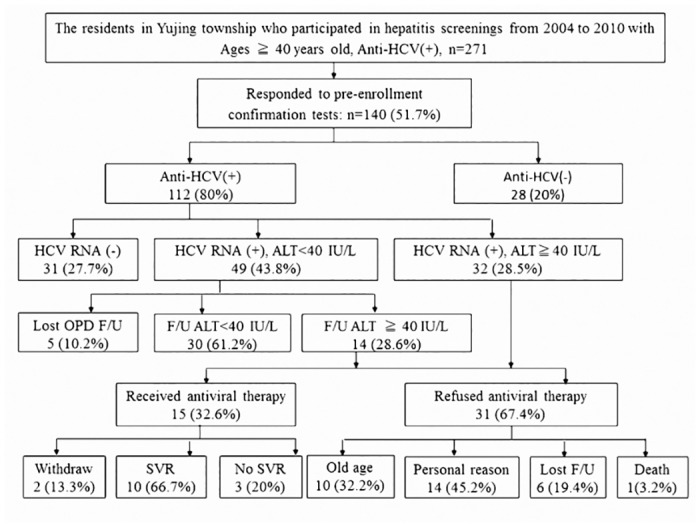
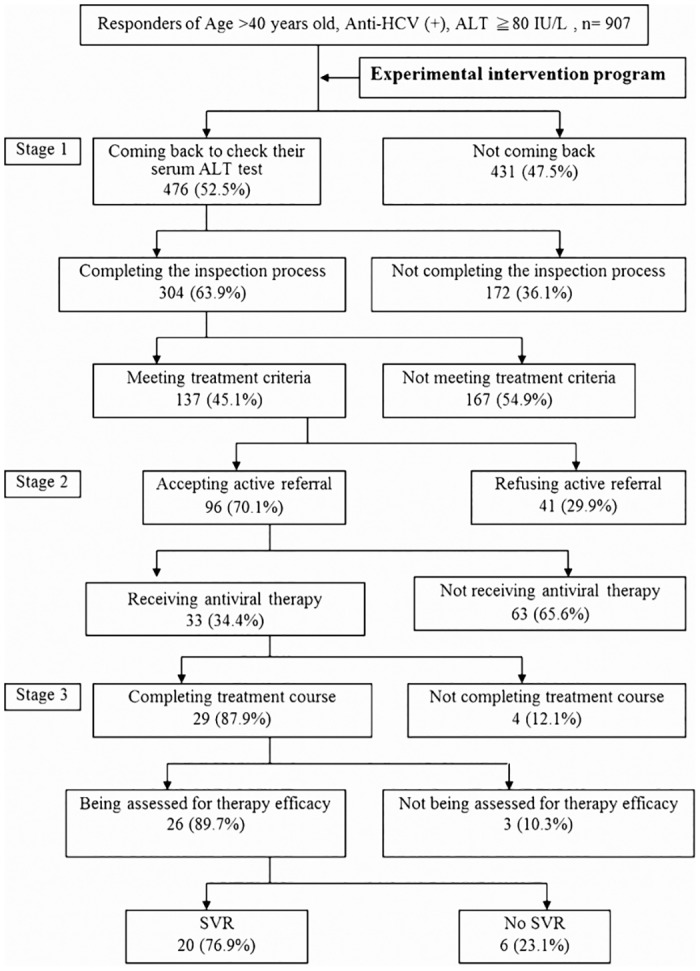
To elucidate the results of post-screening care stratagems for anti-hepatitis C virus (HCV)-positive subjects in the community. Part I methods: The intervention program: A total of 151,790 subjects underwent a large-scale healthcare screening. Subjects aged less than 65 years, with anti-HCV-positive and alanine aminotransferase (ALT) level more than 80 IU/L were followed-up to answer a structured questionnaire. Those responders who met the reimbursement criteria of Taiwan's National Health Insurance for anti-HCV treatment were referred for treatment. Part II: The accessible medical care program: In Yujing township, 271 HCV residents who have been screened before were invited to a bi-weekly hepatitis clinic in Yujing health center. Part-I results: A total of 907 anti-HCV-positive subjects responded and 197(21.7%) were advised the treatment, but only 83(9.2%) did. Finally, 47 patients achieved a sustained virological response (SVR). After this intervention program, 96(10.6%) additional patients were encouraged to be referred, 33(3.6%) received treatment and 20 obtained a SVR. Part II: A total of 140(51.7%) subjects responded and 112 were anti-HCV-positive including 31(27.7%) HCV RNA-negative, 49(43.8%) HCV RNA-positive plus ALT less than 40 IU/L and 32(28.5%) HCV RNA-positive plus ALT more than 40 IU/L. During the follow-up, 14 of 49 patients had ALT more than 40 IU/L. Among 46 eligible HCV patients, 15(32.6%) received treatment and 10 achieved a SVR. Simple notification only made 9.2% of the screened HCV patients treat. Active referral could encourage additional 3.6% to be treated. Additionally, accessible medical care program could result in treatment of 32.6% elderly eligible patients.
为阐明社区中抗丙型肝炎病毒(HCV)阳性受试者筛查后护理策略的结果。第一部分方法:干预计划:共有151,790名受试者接受了大规模医疗筛查。年龄小于65岁、抗HCV阳性且丙氨酸转氨酶(ALT)水平高于80 IU/L的受试者接受随访以回答结构化问卷。那些符合台湾全民健康保险抗HCV治疗报销标准的应答者被转诊接受治疗。第二部分:可及医疗计划:在玉井乡,271名之前已接受筛查的HCV感染者被邀请到玉井健康中心每两周一次的肝炎门诊。第一部分结果:共有907名抗HCV阳性受试者作出应答,其中197名(21.7%)被建议接受治疗,但只有83名(9.2%)接受了治疗。最终,47例患者实现了持续病毒学应答(SVR)。在该干预计划实施后,另外96名(10.6%)患者被鼓励转诊,33名(3.6%)接受了治疗,20例实现了SVR。第二部分:共有140名(51.7%)受试者作出应答,其中112名抗HCV阳性,包括31名(27.7%)HCV RNA阴性、49名(43.8%)HCV RNA阳性且ALT低于40 IU/L以及32名(28.5%)HCV RNA阳性且ALT高于40 IU/L。在随访期间,49例患者中有14例ALT高于40 IU/L。在46例符合条件的HCV患者中,15例(32.6%)接受了治疗,10例实现了SVR。单纯通知仅使9.2%的筛查出的HCV患者接受治疗。积极转诊可促使另外3.6%的患者接受治疗。此外,可及医疗计划可使32.6%符合条件的老年患者接受治疗。