Goodwin Victoria A, Pickering Ruth, Ballinger Claire, Roberts Helen, McIntosh Emma, Lamb Sarah, Nieuwboer Alice, Rochester Lynn, Ashburn Ann
University of Exeter, Exeter, UK.
University of Southampton, Southampton, UK.
BMC Neurol. 2015 May 15;15:81. doi: 10.1186/s12883-015-0332-2.
Falls amongst people with Parkinson's (PwP) result in significant disability and reduced quality of life. There is emerging evidence that exercise-based and physiotherapeutic interventions are of benefit for improving fall risk factors, such as balance. However, the benefit, in terms of preventing falls, is mixed. The development of effective interventions has been identified as the highest research priority for this population. The aim of this trial is to establish the effectiveness and cost-effectiveness of a novel, home-based physiotherapy programme, compared with usual care, on falls amongst PwP.
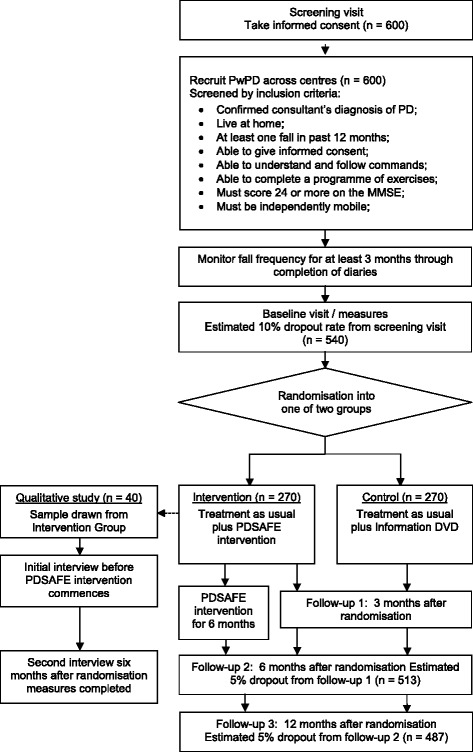
METHODS/DESIGN: A UK multi-centre, community-based, single blind, randomised controlled trial with twelve month follow-up, and nested economic evaluation and qualitative studies will be undertaken. Six hundred PwP who live in their own home, have had one or more falls in the previous year and an MMSE score of ≥24 will be recruited. Those living in care homes and those needing assistance from another person to walk indoors will not be eligible. The intervention is a physiotherapist delivered, individually tailored and progressive, home-based programme (PDSAFE) comprising task orientated movement strategy training, functional lower limb strengthening and balance training, of six months duration. Unsupervised daily home exercises and strategies will be practised and supported using technology. Control participants will receive usual care. Data collection will include falls, cognitive state, balance and mobility, fear of falling, freezing of gait, mood, quality of life, carer quality of life and resource use. Data will be collected at baseline, three, six and twelve months. Longitudinal semi-structured interviews will be undertaken with forty participants to explore the expectations and experiences of participants. The primary outcome is risk of repeat falling at six months post-randomisation.
The aims of this trial are to establish the effectiveness and cost-effectiveness of a novel, home-delivered physiotherapy intervention (PDSAFE) compared with usual care on risk of falling for PwP who have a history of falling. PDSAFE is a novel intervention that builds upon the existing literature and targeting known risk factors, being the first study that uses a novel delivery modus (technology) in conjunction with traditional physiotherapeutic approaches.
Current Controlled Trials ISRCTN48152791.
帕金森病患者(PwP)跌倒会导致严重残疾并降低生活质量。越来越多的证据表明,基于运动和物理治疗的干预措施有助于改善跌倒风险因素,如平衡能力。然而,在预防跌倒方面的益处并不一致。开发有效的干预措施已被确定为该人群的最高研究优先级。本试验的目的是确定一种新型的居家物理治疗方案与常规护理相比,对帕金森病患者跌倒的有效性和成本效益。
方法/设计:一项英国多中心、基于社区的单盲随机对照试验,将进行为期十二个月的随访,并开展嵌套式经济评估和定性研究。将招募600名居住在自己家中、上一年有过一次或多次跌倒且简易精神状态检查表(MMSE)评分≥24的帕金森病患者。住在养老院的患者以及在室内行走需要他人协助的患者不符合条件。干预措施是由物理治疗师提供的、个性化定制且循序渐进的居家方案(PDSAFE),为期六个月,包括任务导向性运动策略训练、功能性下肢强化训练和平衡训练。将利用技术对无监督的日常家庭锻炼和策略进行练习和支持。对照组参与者将接受常规护理。数据收集将包括跌倒情况、认知状态、平衡和活动能力、害怕跌倒、步态冻结、情绪、生活质量、照顾者生活质量和资源使用情况。数据将在基线、三个月、六个月和十二个月时收集。将对40名参与者进行纵向半结构化访谈,以探讨参与者的期望和经历。主要结局是随机分组后六个月再次跌倒的风险。
本试验的目的是确定一种新型的居家物理治疗干预措施(PDSAFE)与常规护理相比,对有跌倒史的帕金森病患者跌倒风险的有效性和成本效益。PDSAFE是一种基于现有文献并针对已知风险因素的新型干预措施,是第一项将新型交付方式(技术)与传统物理治疗方法相结合的研究。
当前受控试验ISRCTN48152791。