School of Health Sciences, University of Southampton, Southampton, UK.
Faculty of Medicine, University of Southampton, Southampton, UK.
J Neurol Neurosurg Psychiatry. 2019 Jul;90(7):774-782. doi: 10.1136/jnnp-2018-319448. Epub 2019 Apr 3.
To estimate the effect of a physiotherapist-delivered fall prevention programme for people with Parkinson's (PwP).
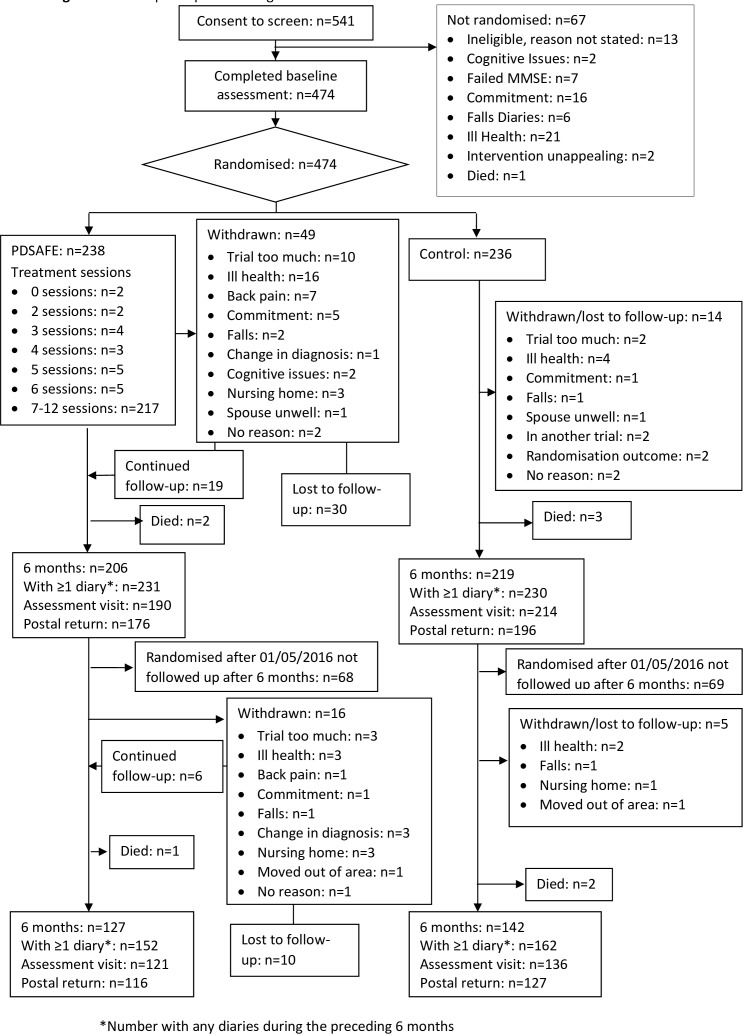
People at risk of falls with confirmed Parkinson's were recruited to this multicentre, pragmatic, investigator blind, individually randomised controlled trial with prespecified subgroup analyses. 474 PwP (Hoehn and Yahr 1-4) were randomised: 238 allocated to a physiotherapy programme and 236 to control. All participants had routine care; the control group received a DVD about Parkinson's and single advice session at trial completion. The intervention group (PDSAFE) had an individually tailored, progressive home-based fall avoidance strategy training programme with balance and strengthening exercises. The primary outcome was risk of repeat falling, collected by self-report monthly diaries, 0-6 months after randomisation. Secondary outcomes included Mini-BESTest for balance, chair stand test, falls efficacy, freezing of gait, health-related quality of life (EuroQol EQ-5D), Geriatric Depression Scale, Physical Activity Scale for the Elderly and Parkinson's Disease Questionnaire, fractures and rate of near falling.
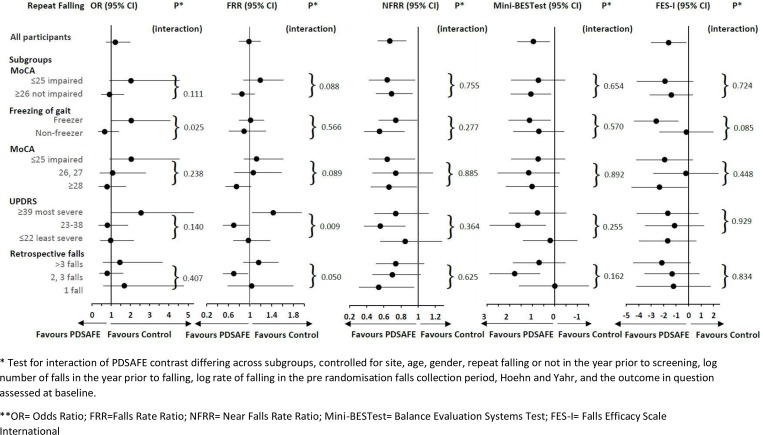
Average age is 72 years and 266 (56%) were men. By 6 months, 116 (55%) of the control group and 125 (61.5%) of the intervention group reported repeat falls (controlled OR 1.21, 95% CI 0.74 to 1.98, p=0.447). Secondary subgroup analyses suggested a different response to the intervention between moderate and severe disease severity groups. Balance, falls efficacy and chair stand time improved with near falls reduced in the intervention arm.
PDSAFE did not reduce falling in this pragmatic trial of PwP. Other functional tasks improved and reduced fall rates were apparent among those with moderate disease.
ISRCTN48152791.
评估物理治疗师提供的预防帕金森病患者跌倒的方案的效果。
这项多中心、实用、研究者盲法、个体随机对照试验纳入了有跌倒风险且确诊为帕金森病的患者,并进行了预设亚组分析。共招募了 474 名帕金森病患者(Hoehn 和 Yahr 1-4 级):238 名分配到物理治疗组,236 名分配到对照组。所有参与者均接受常规护理;对照组在试验结束时接受关于帕金森病的 DVD 和单次咨询。干预组(PDSAFE)接受了个性化、渐进的居家跌倒预防策略训练计划,包括平衡和力量训练。主要结局是在随机分组后 0-6 个月时通过自我报告的每月日记收集的再次跌倒风险。次要结局包括 Mini-BESTest 平衡测试、椅子站立测试、跌倒效能感、冻结步态、健康相关生活质量(EuroQol EQ-5D)、老年抑郁量表、老年人身体活动量表和帕金森病问卷、骨折和近乎跌倒的发生率。
平均年龄为 72 岁,266 名(56%)为男性。6 个月时,对照组 116 名(55%)和干预组 125 名(61.5%)报告再次跌倒(校正 OR 1.21,95%CI 0.74-1.98,p=0.447)。二次亚组分析表明,在中度和重度疾病严重程度组中,干预的反应不同。干预组的平衡、跌倒效能感和椅子站立时间有所改善,近乎跌倒的次数减少。
在这项针对帕金森病患者的实用试验中,PDSAFE 并未降低跌倒率。在疾病程度中度的患者中,其他功能任务得到改善,跌倒率降低。
ISRCTN48152791。