Ogbonna Andrea C, Clark Anna K, Malcangio Marzia
Wolfson Centre for Age-Related Diseases, King's College London, Guy's Campus, London Bridge, London, SE1 1UL, UK.
Age (Dordr). 2015 Jun;37(3):9792. doi: 10.1007/s11357-015-9792-y. Epub 2015 May 14.
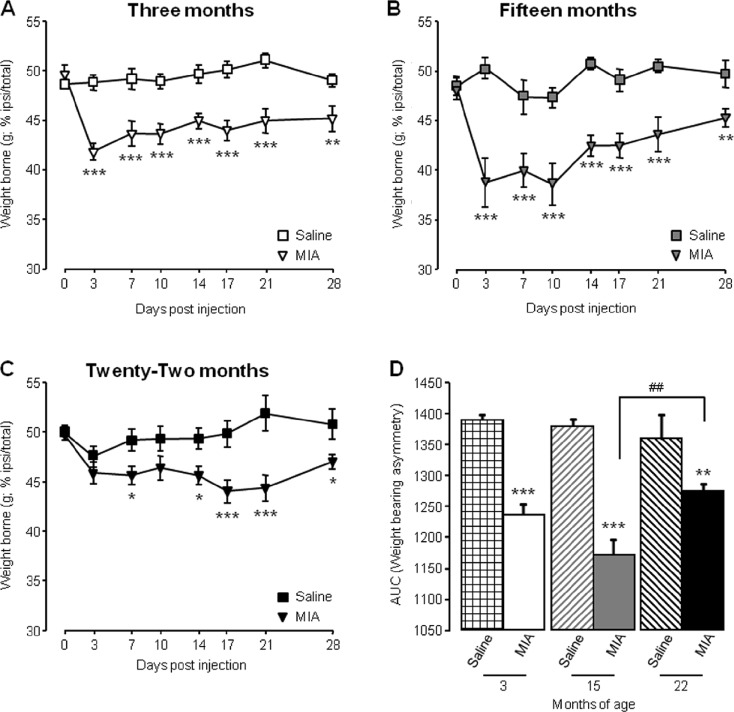
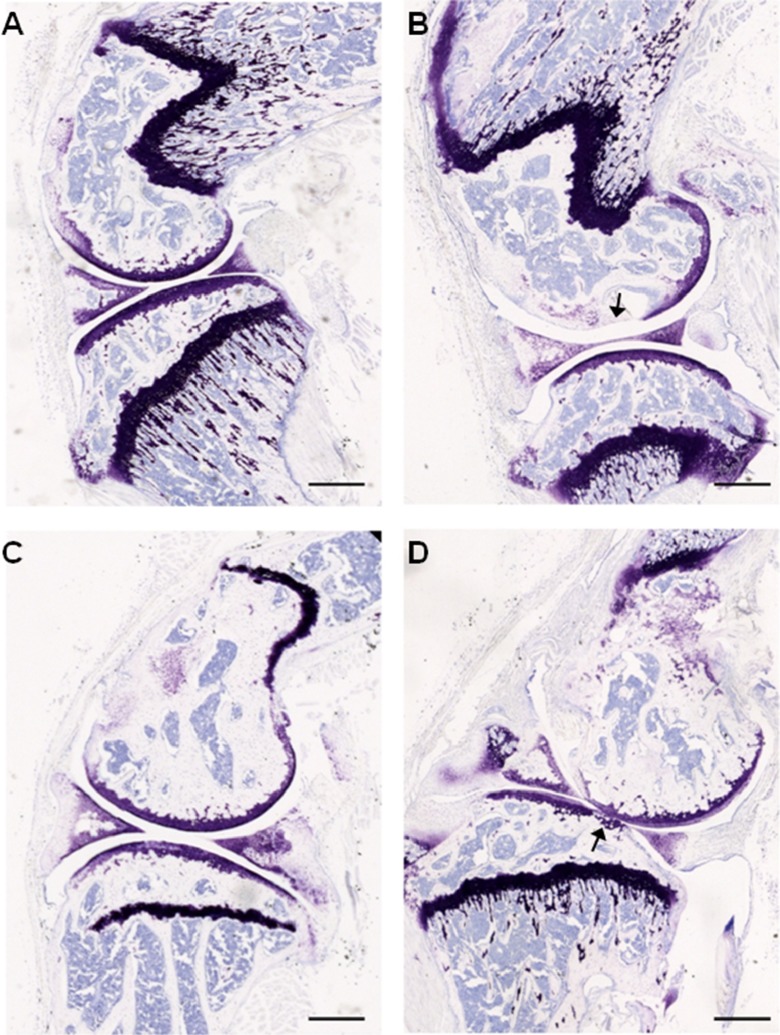
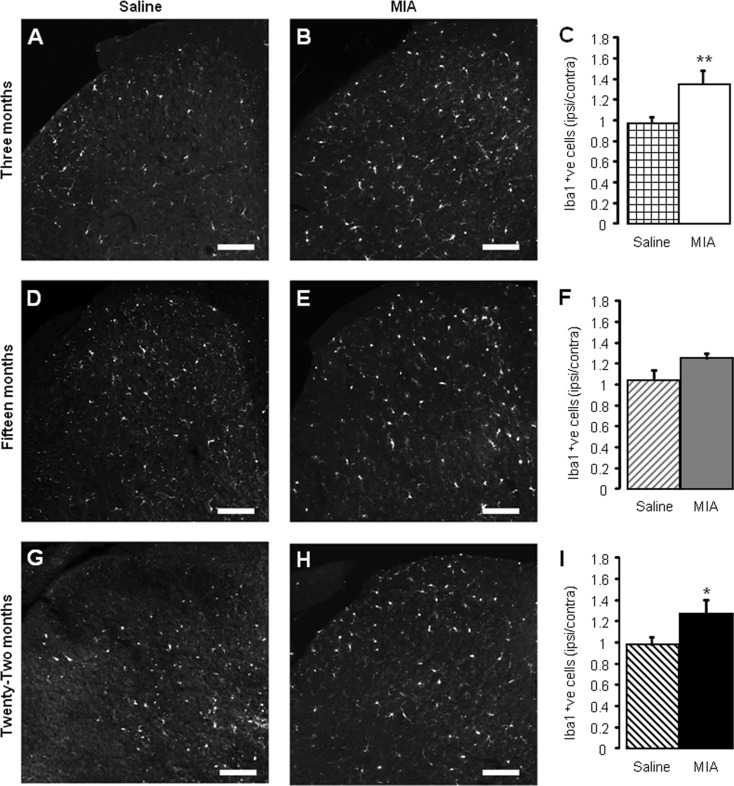
Most conditions associated with ageing result from an age-related loss in the function of cells and tissues that maintain body homeostasis. In osteoarthritis (OA) patients, an inadequate response to stress or joint injury can lead to tissue destruction which can result in chronic pain. Here, we evaluated the development of monoiodoacetate (MIA)-induced OA in 3-, 15- and 22-month-old mice and assessed the pain-like behaviours and the spinal microglial changes associated with MIA administration. We observed that in aged mice, nocifensive behaviour was significantly attenuated in comparison to young adults despite similar knee joint pathology. Specifically referred mechanical allodynia associated with the MIA initial inflammatory phase (0-10 days) was significantly attenuated in 22-month-old mice. In contrast, the late phase of MIA-induced mechanical allodynia was comparable between age groups. Significant increase of microglia cell numbers was detected in 3, but not 15- and 22-month-old spinal cords. Furthermore, in the zymosan model of acute inflammation, mechanical allodynia was attenuated, and microglial response was less robust in 22 compared to 3-month-old mice. This study suggests that nocifensive responses to damaging stimuli are altered with advancing age and microglial response to peripheral damage is less robust.
大多数与衰老相关的病症是由于维持身体内稳态的细胞和组织功能出现与年龄相关的衰退所致。在骨关节炎(OA)患者中,对应激或关节损伤的反应不足会导致组织破坏,进而引发慢性疼痛。在此,我们评估了单碘乙酸盐(MIA)诱导的骨关节炎在3个月、15个月和22个月大的小鼠中的发展情况,并评估了与MIA给药相关的疼痛样行为和脊髓小胶质细胞变化。我们观察到,在老年小鼠中,尽管膝关节病理情况相似,但与年轻成年小鼠相比,伤害防御行为明显减弱。具体而言,与MIA初始炎症期(0 - 10天)相关的机械性异常性疼痛在22个月大的小鼠中明显减弱。相比之下,MIA诱导的机械性异常性疼痛的后期在各年龄组之间相当。在3个月大的小鼠脊髓中检测到小胶质细胞数量显著增加,但在15个月和22个月大的小鼠中未检测到。此外,在酵母聚糖急性炎症模型中,与3个月大的小鼠相比,22个月大的小鼠机械性异常性疼痛减弱,小胶质细胞反应也较弱。这项研究表明,随着年龄的增长,对损伤性刺激的伤害防御反应会发生改变,并且小胶质细胞对外周损伤的反应也较弱。