Young Juan I, Züchner Stephan, Wang Gaofeng
John P. Hussman Institute for Human Genomics.
Annu Rev Nutr. 2015;35:545-64. doi: 10.1146/annurev-nutr-071714-034228. Epub 2015 May 6.
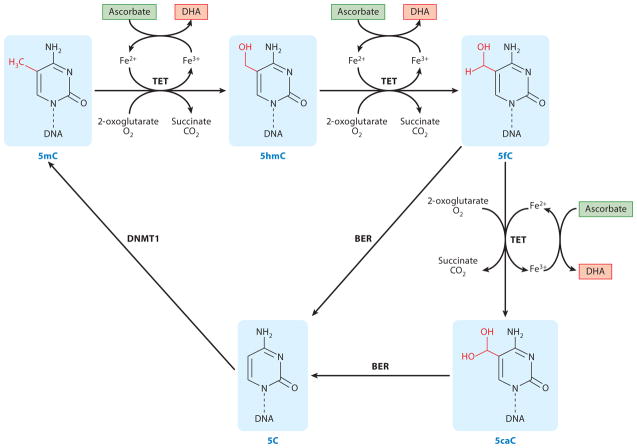
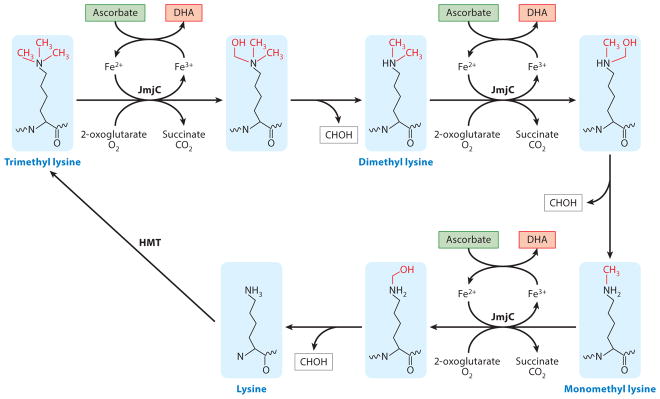
Emerging evidence suggests that ascorbate, the dominant form of vitamin C under physiological pH conditions, influences activity of the genome via regulating epigenomic processes. Ascorbate serves as a cofactor for Ten-eleven translocation (TET) dioxygenases that catalyze the oxidation of 5-methylcytosine (5mC) into 5-hydroxymethylcytosine (5hmC), and further to 5-formylcytosine (5fC) and to 5-carboxylcytosine (5caC), which are ultimately replaced by unmodified cytosine. The Jumonji C (JmjC)-domain-containing histone demethylases also require ascorbate as a cofactor for histone demethylation. Thus, by primarily participating in the demethylation of both DNA and histones, ascorbate appears to be a mediator of the interface between the genome and environment. Furthermore, redox status has a profound impact on the bioavailability of ascorbate in the nucleus. In order to bridge the gap between redox biology and genomics, we suggest an interdisciplinary research field that can be termed redox genomics to study dynamic redox processes in health and diseases. This review examines the evidence and potential molecular mechanism of ascorbate in the demethylation of the genome, and it highlights potential epigenetic roles of ascorbate in various diseases.
新出现的证据表明,在生理pH条件下维生素C的主要形式抗坏血酸盐,通过调节表观基因组过程影响基因组的活性。抗坏血酸盐作为双加氧酶(TET)的辅助因子,催化5-甲基胞嘧啶(5mC)氧化为5-羟甲基胞嘧啶(5hmC),并进一步氧化为5-甲酰基胞嘧啶(5fC)和5-羧基胞嘧啶(5caC),最终被未修饰的胞嘧啶取代。含Jumonji C(JmjC)结构域的组蛋白去甲基化酶也需要抗坏血酸盐作为组蛋白去甲基化的辅助因子。因此,通过主要参与DNA和组蛋白的去甲基化,抗坏血酸盐似乎是基因组与环境之间界面的介质。此外,氧化还原状态对细胞核中抗坏血酸盐的生物利用度有深远影响。为了弥合氧化还原生物学与基因组学之间的差距,我们建议一个可称为氧化还原基因组学的跨学科研究领域,以研究健康和疾病中的动态氧化还原过程。本综述研究了抗坏血酸盐在基因组去甲基化中的证据和潜在分子机制,并强调了抗坏血酸盐在各种疾病中的潜在表观遗传作用。