Huesa Carmen, Staines Katherine A, Millán Jose Luis, MacRae Vicky E
Roslin Institute and R(D)SVS, The University of Edinburgh, Edinburgh, UK.
Sanford Children's Health Research Center, Sanford-Burnham Medical Research Institute, La Jolla, CA, USA.
Int J Mol Med. 2015 Jul;36(1):159-65. doi: 10.3892/ijmm.2015.2212. Epub 2015 May 15.
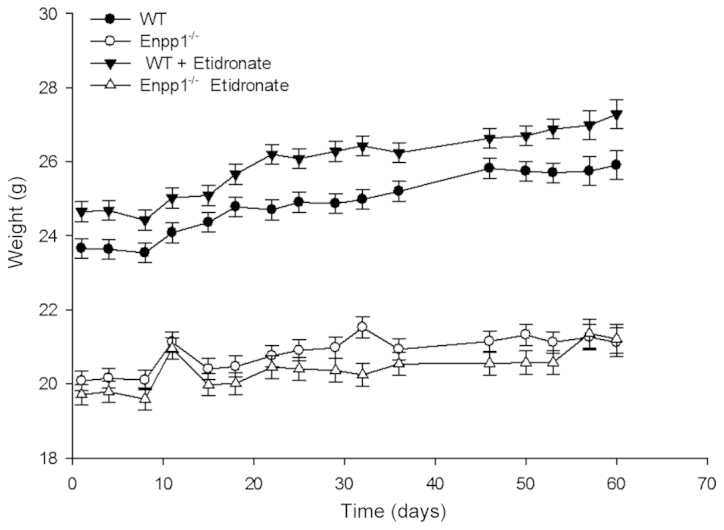
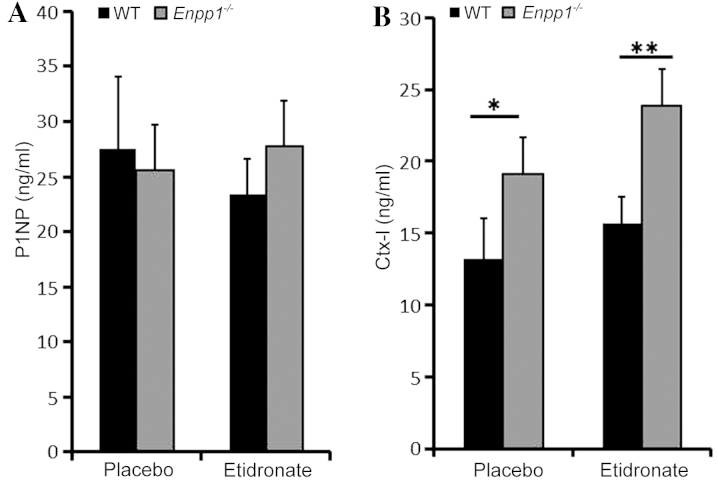
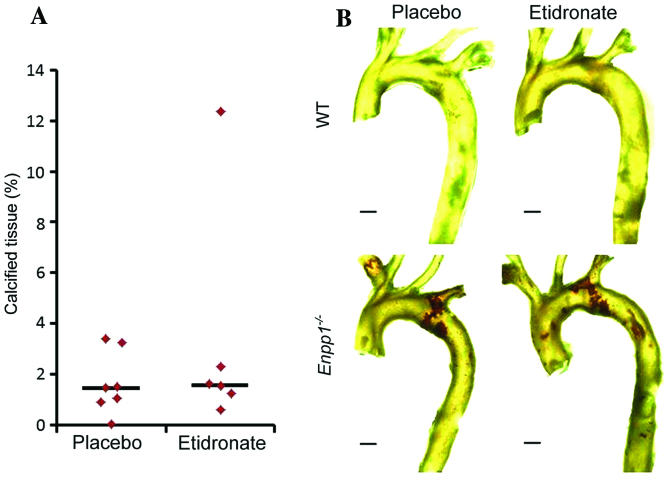
Generalized arterial calcification of infancy (GACI) is an autosomal recessive disorder of spontaneous infantile arterial and periarticular calcification which is attributed to mutations in the ectonucleotide pyrophosphatase/phosphodiesterase 1 (Enpp1) gene. Whilst the bisphosphonate, etidronate, is currently used off-label for the treatment for GACI, recent studies have highlighted its detrimental effects on bone mineralisation. In the present study, we used the Enpp1-/- mouse model of GACI to examine the effects of etidronate treatment (100 µg/kg), on vascular and skeletal calcification. Micro-computed tomography (µCT) analysis revealed a significant decrease in trabecular bone mass, as reflected by the decrease in trabecular bone volume/tissue volume (BV/TV; %), trabecular thickness, trabecular separation, trabecular number and pattern factor (P<0.05) in the Enpp1-/- mice in comparison to the wild-type (WT) mice. Mechanical testing revealed that in the WT mice, treatment with etidronate significantly improved work to fracture and increased work post-failure (P<0.05, in comparison to the vehicle-treated WT mice). This significant increase, however, was not observed in the Enpp1-/- mice. Treatment with etidronate had no effect on bone parameters in the WT mice; however, the Enpp1-/- mice displayed an increased structural model index (SMI; P<0.05). We used a recently developed 3D µCT protocol to reconstruct and quantify the extensive aortic calcification in Enpp1-/- mice in comparison to the WT mice. However, treatment with etidronate did not prevent de novo calcification, and did not arrest the progression of established calcification of the aorta.
婴儿期全身性动脉钙化(GACI)是一种常染色体隐性疾病,表现为婴儿期自发性动脉和关节周围钙化,这是由胞外核苷酸焦磷酸酶/磷酸二酯酶1(Enpp1)基因突变所致。虽然双膦酸盐依替膦酸目前被用于GACI的非标签治疗,但最近的研究强调了其对骨矿化的有害影响。在本研究中,我们使用GACI的Enpp1-/-小鼠模型来研究依替膦酸治疗(100μg/kg)对血管和骨骼钙化的影响。微计算机断层扫描(µCT)分析显示,与野生型(WT)小鼠相比,Enpp1-/-小鼠的小梁骨量显著减少,表现为小梁骨体积/组织体积(BV/TV;%)、小梁厚度、小梁间距、小梁数量和模式因子降低(P<0.05)。力学测试显示,在WT小鼠中,依替膦酸治疗显著改善了骨折功,并增加了失效后功(与载体处理的WT小鼠相比,P<0.05)。然而,在Enpp1-/-小鼠中未观察到这种显著增加。依替膦酸治疗对WT小鼠的骨参数没有影响;然而,Enpp1-/-小鼠的结构模型指数增加(SMI;P<0.05)。我们使用最近开发的3D µCT方案来重建和量化Enpp1-/-小鼠与WT小鼠相比广泛的主动脉钙化。然而,依替膦酸治疗并不能预防新生钙化,也不能阻止已形成的主动脉钙化的进展。