Siu Sarah Y, Dyment Nathaniel A, Rowe David W, Sundberg John P, Uitto Jouni, Li Qiaoli
Department of Dermatology and Cutaneous Biology, The Sidney Kimmel Medical College and The PXE International Center of Excellence in Research and Clinical Care, Thomas Jefferson University, Philadelphia, PA, USA.
Center for Regenerative Medicine and Skeletal Development, University of Connecticut Health Center, Farmington, CT, USA.
Oncotarget. 2016 Dec 20;7(51):83837-83842. doi: 10.18632/oncotarget.13335.
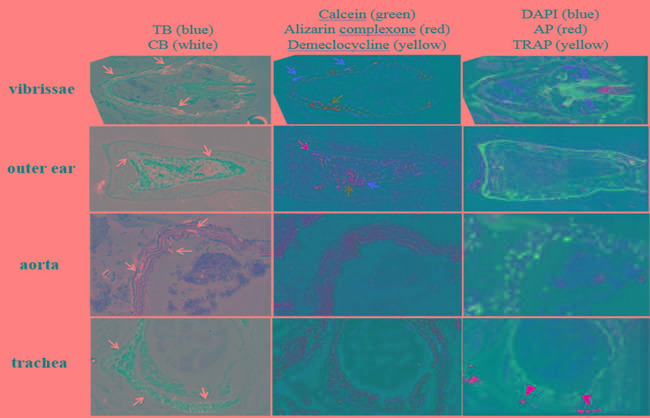
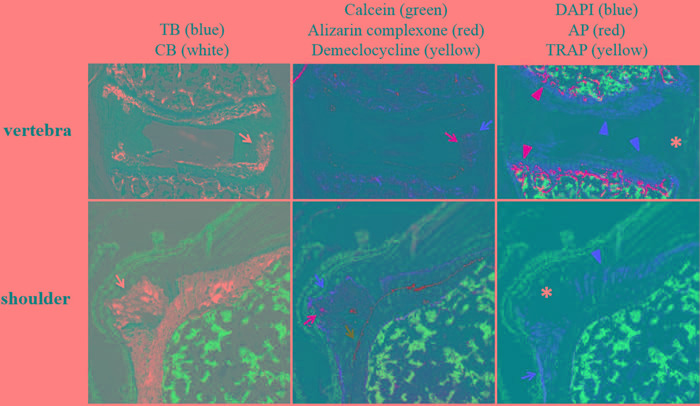
Generalized arterial calcification of infancy (GACI) is an autosomal recessive disorder characterized by early onset of extensive mineralization of the cardiovascular system. The classical forms of GACI are caused by mutations in the ENPP1 gene, encoding a membrane-bound pyrophosphatase/phosphodiesterase that hydrolyzes ATP to AMP and inorganic pyrophosphate. The asj-2J mouse harboring a spontaneous mutation in the Enpp1 gene has been characterized as a model for GACI. These mutant mice develop ectopic mineralization in skin and vascular connective tissues as well as in cartilage and collagen-rich tendons and ligaments. This study examined in detail the temporal ectopic mineralization phenotype of connective tissues in this mouse model, utilizing a novel cryo-histological method that does not require decalcification of bones. The wild type, heterozygous, and homozygous mice were administered fluorescent mineralization labels at 4 weeks (calcein), 10 weeks (alizarin complexone), and 11 weeks of age (demeclocycline). Twenty-four hours later, outer ears, muzzle skin, trachea, aorta, shoulders, and vertebrae were collected from these mice and examined for progression of mineralization. The results revealed differential timeline for disease initiation and progression in various tissues of this mouse model. It also highlights the advantages of cryo-histological fluorescent imaging technique to study mineral deposition in mouse models of ectopic mineralization disorders.
婴儿全身性动脉钙化(GACI)是一种常染色体隐性疾病,其特征为心血管系统早期出现广泛矿化。GACI的典型形式由ENPP1基因突变引起,该基因编码一种膜结合焦磷酸酶/磷酸二酯酶,可将ATP水解为AMP和无机焦磷酸。携带Enpp1基因自发突变的asj-2J小鼠已被表征为GACI模型。这些突变小鼠在皮肤和血管结缔组织以及软骨和富含胶原蛋白的肌腱和韧带中出现异位矿化。本研究利用一种无需对骨骼进行脱钙的新型冷冻组织学方法,详细研究了该小鼠模型中结缔组织的时间性异位矿化表型。在4周龄(钙黄绿素)、10周龄(茜素络合物)和11周龄(地美环素)时,对野生型、杂合子和纯合子小鼠施用荧光矿化标记物。24小时后,从这些小鼠身上采集外耳、口鼻部皮肤、气管、主动脉、肩部和椎骨,并检查矿化进展情况。结果揭示了该小鼠模型不同组织中疾病起始和进展的不同时间线。这也凸显了冷冻组织学荧光成像技术在研究异位矿化疾病小鼠模型中矿物质沉积方面的优势。