Cornell University, Department of Information Science, Ithaca, NY, United States.
JMIR Mhealth Uhealth. 2015 May 14;3(2):e42. doi: 10.2196/mhealth.4160.
A dramatic rise in health-tracking apps for mobile phones has occurred recently. Rich user interfaces make manual logging of users' behaviors easier and more pleasant, and sensors make tracking effortless. To date, however, feedback technologies have been limited to providing overall statistics, attractive visualization of tracked data, or simple tailoring based on age, gender, and overall calorie or activity information. There are a lack of systems that can perform automated translation of behavioral data into specific actionable suggestions that promote healthier lifestyle without any human involvement.
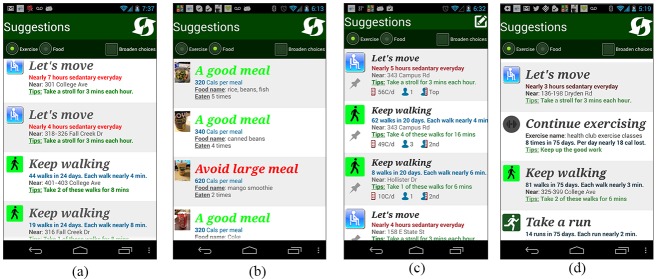
MyBehavior, a mobile phone app, was designed to process tracked physical activity and eating behavior data in order to provide personalized, actionable, low-effort suggestions that are contextualized to the user's environment and previous behavior. This study investigated the technical feasibility of implementing an automated feedback system, the impact of the suggestions on user physical activity and eating behavior, and user perceptions of the automatically generated suggestions.
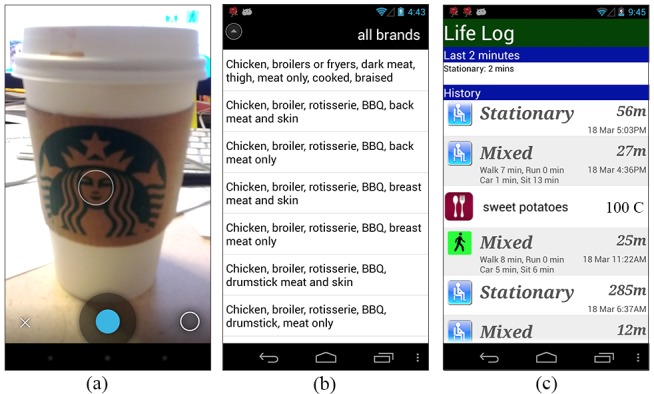
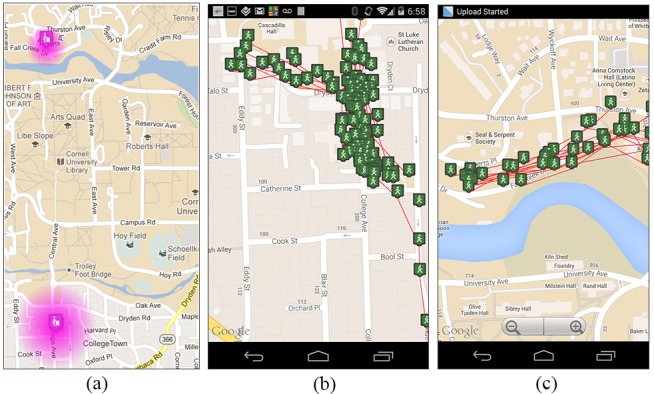
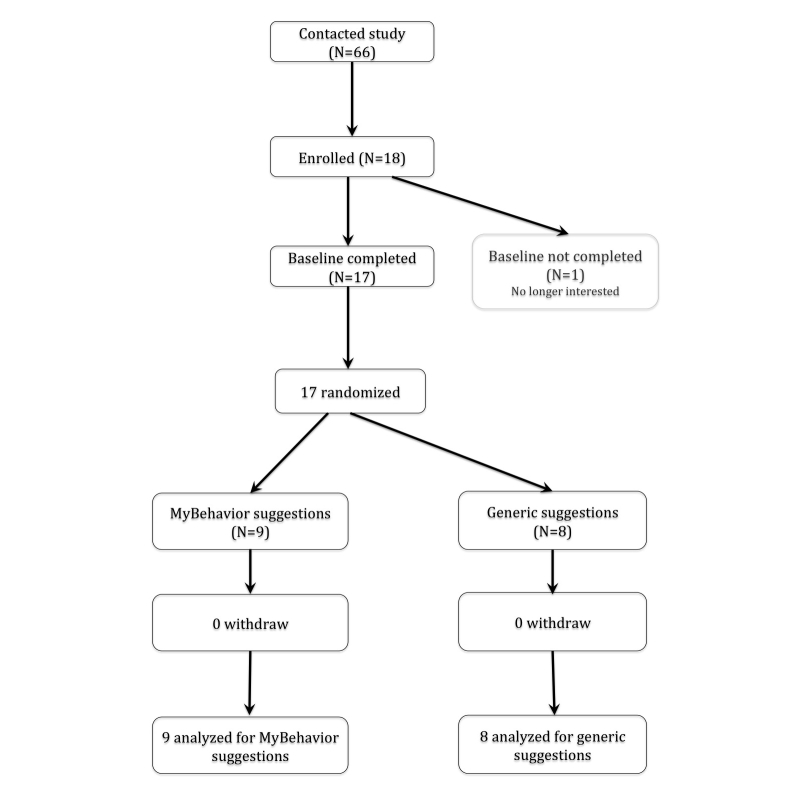
MyBehavior was designed to (1) use a combination of automatic and manual logging to track physical activity (eg, walking, running, gym), user location, and food, (2) automatically analyze activity and food logs to identify frequent and nonfrequent behaviors, and (3) use a standard machine-learning, decision-making algorithm, called multi-armed bandit (MAB), to generate personalized suggestions that ask users to either continue, avoid, or make small changes to existing behaviors to help users reach behavioral goals. We enrolled 17 participants, all motivated to self-monitor and improve their fitness, in a pilot study of MyBehavior. In a randomized two-group trial, investigators randomly assigned participants to receive either MyBehavior's personalized suggestions (n=9) or nonpersonalized suggestions (n=8), created by professionals, from a mobile phone app over 3 weeks. Daily activity level and dietary intake was monitored from logged data. At the end of the study, an in-person survey was conducted that asked users to subjectively rate their intention to follow MyBehavior suggestions.
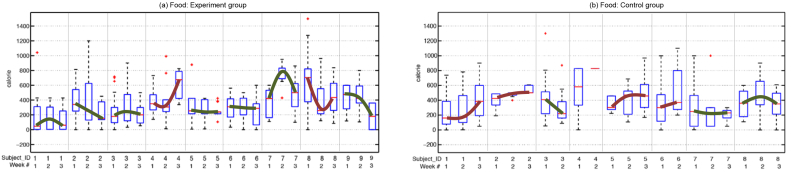
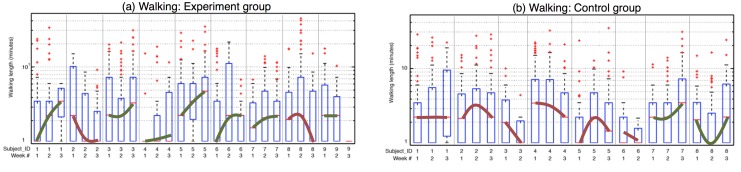
In qualitative daily diary, interview, and survey data, users reported MyBehavior suggestions to be highly actionable and stated that they intended to follow the suggestions. MyBehavior users walked significantly more than the control group over the 3 weeks of the study (P=.05). Although some MyBehavior users chose lower-calorie foods, the between-group difference was not significant (P=.15). In a poststudy survey, users rated MyBehavior's personalized suggestions more positively than the nonpersonalized, generic suggestions created by professionals (P<.001).
MyBehavior is a simple-to-use mobile phone app with preliminary evidence of efficacy. To the best of our knowledge, MyBehavior represents the first attempt to create personalized, contextualized, actionable suggestions automatically from self-tracked information (ie, manual food logging and automatic tracking of activity). Lessons learned about the difficulty of manual logging and usability concerns, as well as future directions, are discussed.
ClinicalTrials.gov NCT02359981; https://clinicaltrials.gov/ct2/show/NCT02359981 (Archived by WebCite at http://www.webcitation.org/6YCeoN8nv).
最近,手机健康追踪应用程序数量急剧增加。丰富的用户界面使手动记录用户行为变得更加容易和愉快,而传感器则使追踪变得毫不费力。然而,到目前为止,反馈技术仅限于提供总体统计数据、跟踪数据的有吸引力的可视化,或者基于年龄、性别和总体卡路里或活动信息的简单定制。缺乏能够将行为数据自动翻译成特定可操作建议的系统,这些建议可以在不涉及任何人的情况下促进更健康的生活方式。
MyBehavior 是一款手机应用程序,旨在处理跟踪的身体活动和饮食行为数据,以提供个性化、可操作、低投入的建议,这些建议针对用户的环境和以往行为进行了上下文化处理。本研究调查了实施自动化反馈系统的技术可行性、建议对用户身体活动和饮食行为的影响,以及用户对自动生成建议的看法。
MyBehavior 旨在(1)使用自动和手动记录的组合来跟踪身体活动(例如,步行、跑步、健身房)、用户位置和食物,(2)自动分析活动和食物日志以识别频繁和非频繁行为,以及(3)使用一种称为多臂赌博机(MAB)的标准机器学习、决策算法生成个性化建议,要求用户继续、避免或对现有行为进行小的改变,以帮助用户达到行为目标。我们招募了 17 名参与者,他们都有自我监控和提高健身水平的动机,参与了 MyBehavior 的试点研究。在一项随机两组成员试验中,研究人员随机将参与者分配到接收 MyBehavior 的个性化建议(n=9)或非个性化建议(n=8),这些建议是由专业人员从一款手机应用程序中创建的,持续 3 周。日常活动水平和饮食摄入量是从记录的数据中监测到的。在研究结束时,进行了一次面对面的调查,要求用户主观评估他们遵循 MyBehavior 建议的意愿。
在定性的日常日记、访谈和调查数据中,用户报告 MyBehavior 建议非常可行,并表示他们打算遵循这些建议。与对照组相比,MyBehavior 用户在 3 周的研究中步行明显更多(P=.05)。尽管一些 MyBehavior 用户选择了低热量的食物,但组间差异并不显著(P=.15)。在一项研究后的调查中,用户对 MyBehavior 的个性化建议的评价明显高于专业人员创建的非个性化、通用建议(P<.001)。
MyBehavior 是一款易于使用的手机应用程序,具有初步的疗效证据。据我们所知,MyBehavior 是第一款尝试从自我跟踪信息(即手动食物记录和活动的自动跟踪)中自动创建个性化、情境化、可操作建议的应用程序。讨论了手动记录的困难和可用性问题方面的经验教训,以及未来的方向。
ClinicalTrials.gov NCT02359981;https://clinicaltrials.gov/ct2/show/NCT02359981(由 WebCite 存档,http://www.webcitation.org/6YCeoN8nv)。