
初产母猪能量负平衡对卵泡发育和卵母细胞质量的影响†。
Consequences of negative energy balance on follicular development and oocyte quality in primiparous sows†.
机构信息
Human and Animal Physiology, Wageningen University and Research, Wageningen, The Netherlands.
Adaptation Physiology, Wageningen University and Research, Wageningen, The Netherlands.
出版信息
Biol Reprod. 2020 Feb 14;102(2):388-398. doi: 10.1093/biolre/ioz175.
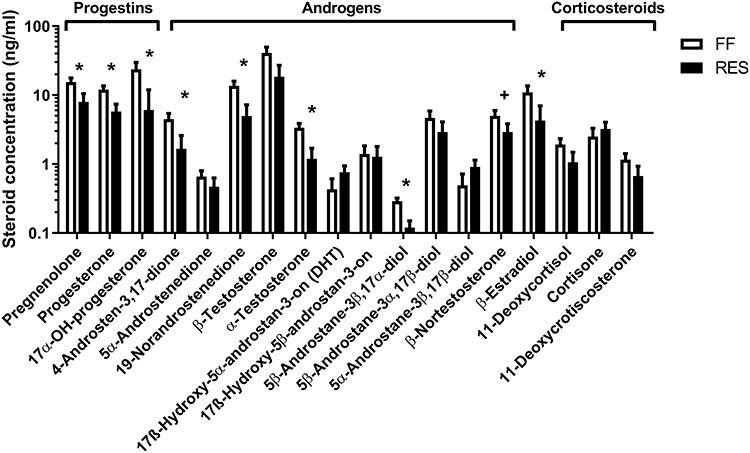
Metabolic demands of modern hybrid sows have increased over the years, which increases the chance that sows enter a substantial negative energy balance (NEB) during lactation. This NEB can influence the development of follicles and oocytes that will give rise to the next litter. To study effects of a lactational NEB on follicular development, we used 36 primiparous sows of which 18 were subjected to feed restriction (3.25 kg/day) and 18 were full-fed (6.5 kg/day) during the last 2 weeks of a 24.1 ± 0.3 day lactation. Feed restriction resulted in a 70% larger lactational body weight loss and 76% higher longissimus dorsi depth loss, but similar amounts of backfat loss compared to the full fed sows. These changes were accompanied by lower plasma insulin-like growth factor 1 (IGF1) and higher plasma creatinine levels in the restricted sows from the last week of lactation onward. Ovaries were collected 48 h after weaning. Restricted sows had a lower average size of the 15 largest follicles (-26%) and cumulus-oocyte complexes showed less expansion after 22 h in vitro maturation (-26%). Less zygotes of restricted sows reached the metaphase stage 24 h after in vitro fertilization and showed a higher incidence of polyspermy (+89%). This shows that feed restriction had severe consequences on oocyte developmental competence. Follicular fluid of restricted sows had lower IGF1 (-56%) and steroid levels (e.g., β-estradiol, progestins, and androgens), which indicated that follicles of restricted sows were less competent to produce steroids and growth factors needed for oocytes to obtain full developmental competence.
多年来,现代杂交母猪的代谢需求增加,这增加了母猪在哺乳期进入实质性负能量平衡(NEB)的机会。这种 NEB 会影响下一窝的卵泡和卵母细胞的发育。为了研究哺乳期 NEB 对卵泡发育的影响,我们使用了 36 头初产母猪,其中 18 头在哺乳期的最后 2 周进行限饲(3.25kg/天),18 头自由采食(6.5kg/天)。限饲导致母猪哺乳期体重损失增加 70%,背最长肌深度损失增加 76%,但与自由采食母猪相比,背脂损失相似。这些变化伴随着母猪从哺乳期最后一周开始血浆胰岛素样生长因子 1(IGF1)水平降低和血浆肌酐水平升高。断奶后 48 小时收集卵巢。限饲母猪的 15 个最大卵泡平均大小降低(-26%),体外成熟 22 小时后卵丘-卵母细胞复合物扩张减少(-26%)。限饲母猪的受精卵较少在体外受精 24 小时后达到中期 II 期,并且多精受精的发生率更高(+89%)。这表明限饲对卵母细胞发育能力有严重影响。限饲母猪的卵泡液 IGF1 水平降低(-56%),类固醇水平(如β-雌二醇、孕激素和雄激素)降低,这表明限饲母猪的卵泡产生卵母细胞获得完全发育能力所需的类固醇和生长因子的能力降低。



 Zotero 插件