Weickert T W, Weinberg D, Lenroot R, Catts S V, Wells R, Vercammen A, O'Donnell M, Galletly C, Liu D, Balzan R, Short B, Pellen D, Curtis J, Carr V J, Kulkarni J, Schofield P R, Weickert C S
1] School of Psychiatry, University of New South Wales, Kensington, New South Wales, Australia [2] Neuroscience Research Australia, Randwick, New South Wales, Australia [3] Schizophrenia Research Institute, Darlinghurst, New South Wales, Australia.
Neuroscience Research Australia, Randwick, New South Wales, Australia.
Mol Psychiatry. 2015 Jun;20(6):685-94. doi: 10.1038/mp.2015.11. Epub 2015 May 18.
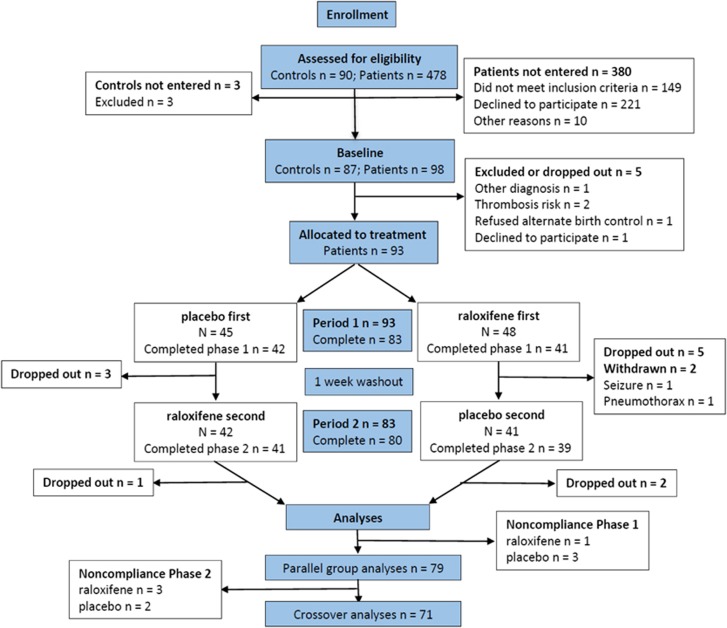
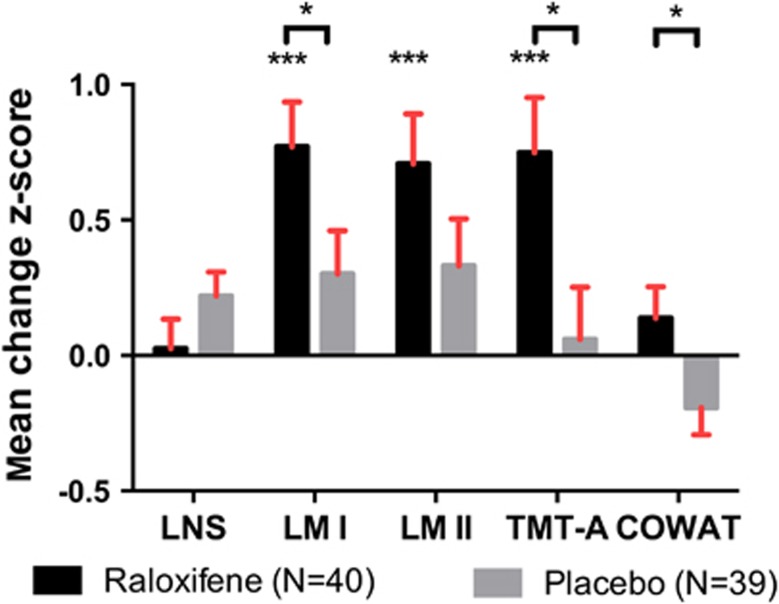
There is increasing clinical and molecular evidence for the role of hormones and specifically estrogen and its receptor in schizophrenia. A selective estrogen receptor modulator, raloxifene, stimulates estrogen-like activity in brain and can improve cognition in older adults. The present study tested the extent to which adjunctive raloxifene treatment improved cognition and reduced symptoms in young to middle-age men and women with schizophrenia. Ninety-eight patients with a diagnosis of schizophrenia or schizoaffective disorder were recruited into a dual-site, thirteen-week, randomized, double-blind, placebo-controlled, crossover trial of adjunctive raloxifene treatment in addition to their usual antipsychotic medications. Symptom severity and cognition in the domains of working memory, attention/processing speed, language and verbal memory were assessed at baseline, 6 and 13 weeks. Analyses of the initial 6-week phase of the study using a parallel groups design (with 39 patients receiving placebo and 40 receiving raloxifene) revealed that participants receiving adjunctive raloxifene treatment showed significant improvement relative to placebo in memory and attention/processing speed. There was no reduction in symptom severity with treatment compared with placebo. There were significant carryover effects, suggesting some cognitive benefits are sustained even after raloxifene withdrawal. Analysis of the 13-week crossover data revealed significant improvement with raloxifene only in attention/processing speed. This is the first study to show that daily, oral adjunctive raloxifene treatment at 120 mg per day has beneficial effects on attention/processing speed and memory for both men and women with schizophrenia. Thus, raloxifene may be useful as an adjunctive treatment for cognitive deficits associated with schizophrenia.
越来越多的临床和分子证据表明,激素尤其是雌激素及其受体在精神分裂症中发挥着作用。一种选择性雌激素受体调节剂雷洛昔芬可刺激大脑中的雌激素样活性,并能改善老年人的认知能力。本研究测试了辅助使用雷洛昔芬治疗对患有精神分裂症的年轻至中年男性和女性的认知改善程度以及症状减轻程度。98名被诊断为精神分裂症或分裂情感性障碍的患者被纳入一项双中心、为期13周的随机、双盲、安慰剂对照、交叉试验,除了常规抗精神病药物治疗外,还辅助使用雷洛昔芬治疗。在基线、第6周和第13周评估了工作记忆、注意力/处理速度、语言和言语记忆等领域的症状严重程度和认知情况。使用平行组设计(39名患者接受安慰剂,40名患者接受雷洛昔芬)对研究的初始6周阶段进行分析发现,接受辅助雷洛昔芬治疗的参与者在记忆和注意力/处理速度方面相对于安慰剂有显著改善。与安慰剂相比,治疗后症状严重程度没有降低。存在显著的遗留效应,表明即使在停用雷洛昔芬后,一些认知益处仍能持续。对13周交叉数据的分析显示,仅雷洛昔芬在注意力/处理速度方面有显著改善。这是第一项表明每天口服120毫克辅助雷洛昔芬治疗对患有精神分裂症的男性和女性的注意力/处理速度和记忆有有益影响的研究。因此,雷洛昔芬可能作为与精神分裂症相关的认知缺陷的辅助治疗药物有用。