Wohlfahrt G, Amelynck C, Ammann C, Arneth A, Bamberger I, Goldstein A H, Gu L, Guenther A, Hansel A, Heinesch B, Holst T, Hörtnagl L, Karl T, Laffineur Q, Neftel A, McKinney K, Munger J W, Pallardy S G, Schade G W, Seco R, Schoon N
Institute of Ecology, University of Innsbruck, Innsbruck, Austria ; European Academy of Bolzano, Bolzano, Italy.
Belgian Institute for Space Aeronomy, Brussels, Belgium.
Atmos Chem Phys. 2015 Jan 27;15(2):2577-2613. doi: 10.5194/acpd-15-2577-2015.
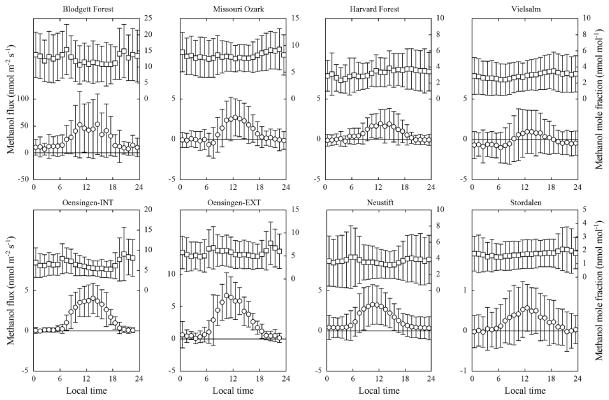
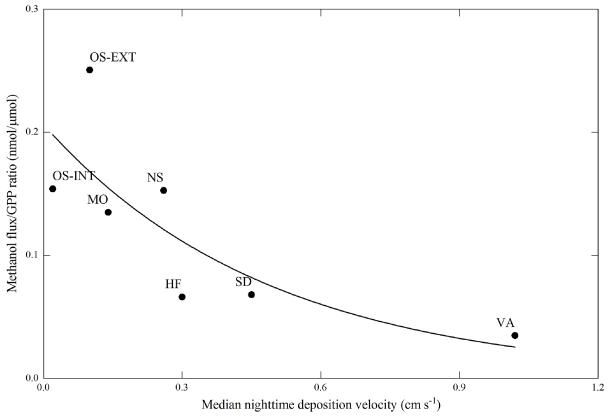
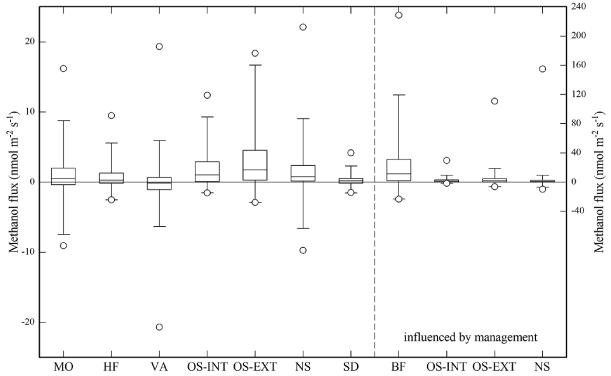
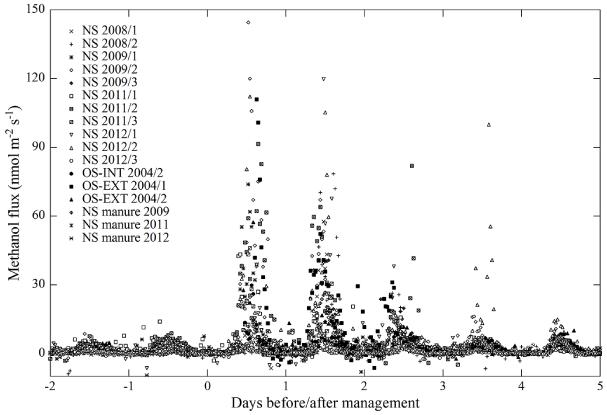
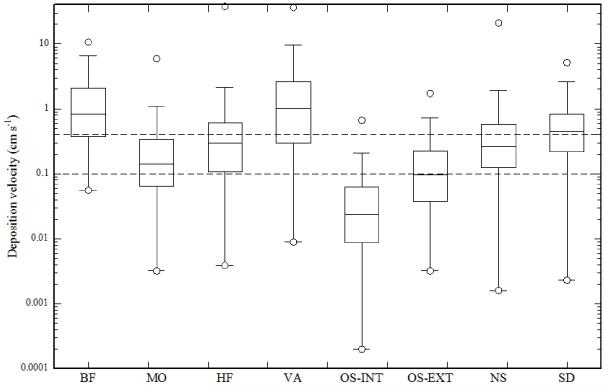
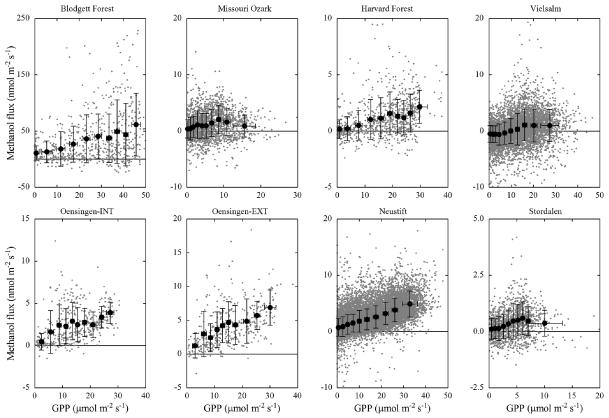
Methanol is the second most abundant volatile organic compound in the troposphere and plays a significant role in atmospheric chemistry. While there is consensus about the dominant role of living plants as the major source and the reaction with OH as the major sink of methanol, global methanol budgets diverge considerably in terms of source/sink estimates reflecting uncertainties in the approaches used to model, and the empirical data used to separately constrain these terms. Here we compiled micrometeorological methanol flux data from eight different study sites and reviewed the corresponding literature in order to provide a first cross-site synthesis of the terrestrial ecosystem-scale methanol exchange and present an independent data-driven view of the land-atmosphere methanol exchange. Our study shows that the controls of plant growth on the production, and thus the methanol emission magnitude, and stomatal conductance on the hourly methanol emission variability, established at the leaf level, hold across sites at the ecosystem-level. Unequivocal evidence for bi-directional methanol exchange at the ecosystem scale is presented. Deposition, which at some sites even exceeds methanol emissions, represents an emerging feature of ecosystem-scale measurements and is likely related to environmental factors favouring the formation of surface wetness. Methanol may adsorb to or dissolve in this surface water and eventually be chemically or biologically removed from it. Management activities in agriculture and forestry are shown to increase local methanol emission by orders of magnitude; they are however neglected at present in global budgets. While contemporary net land methanol budgets are overall consistent with the grand mean of the micrometeorological methanol flux measurements, we caution that the present approach of simulating methanol emission and deposition separately is prone to opposing systematic errors and does not allow taking full advantage of the rich information content of micrometeorological flux measurements.
甲醇是对流层中第二丰富的挥发性有机化合物,在大气化学中起着重要作用。虽然关于活体植物作为甲醇主要来源的主导作用以及与OH反应作为甲醇主要汇的观点已达成共识,但全球甲醇收支在源/汇估计方面存在很大差异,这反映了用于建模的方法以及用于分别约束这些项的经验数据存在不确定性。在此,我们汇编了来自八个不同研究地点的微气象甲醇通量数据,并回顾了相应文献,以便首次对陆地生态系统尺度的甲醇交换进行跨地点综合分析,并呈现陆地 - 大气甲醇交换的独立数据驱动观点。我们的研究表明,在叶片水平上确定的植物生长对甲醇产生(进而对甲醇排放幅度)的控制,以及气孔导度对每小时甲醇排放变异性的控制,在生态系统水平的各个地点都成立。本文提供了生态系统尺度双向甲醇交换的确凿证据。在某些地点,沉降甚至超过甲醇排放,这是生态系统尺度测量中一个新出现的特征,并且可能与有利于形成表面湿度的环境因素有关。甲醇可能吸附到这种地表水或溶解在其中,并最终从水中通过化学或生物方式去除。农业和林业中的管理活动会使局部甲醇排放量增加几个数量级;然而,目前全球收支中却忽略了这些活动。虽然当代陆地甲醇净收支总体上与微气象甲醇通量测量的总体平均值一致,但我们提醒,目前分别模拟甲醇排放和沉降的方法容易出现相反的系统误差,并且无法充分利用微气象通量测量中丰富的信息内容。