Lin Jinpiao, Li Ningli, Chen Huijuan, Liu Can, Yang Bin, Ou Qishui
From the Department of Laboratory Medicine, The First Affiliated Hospital of Fujian Medical University (JL, HC, CL, BY, QO); The Genetic Diagnostic Laboratory, The First Affiliated Hospital of Fujian Medical University (JL, HC, CL, BY, QO); Shanghai Institute of Immunology, Institute of medical sciences, Shanghai Jiao Tong University School of Medicine, Shanghai, China (NL).
Medicine (Baltimore). 2015 May;94(19):e834. doi: 10.1097/MD.0000000000000834.
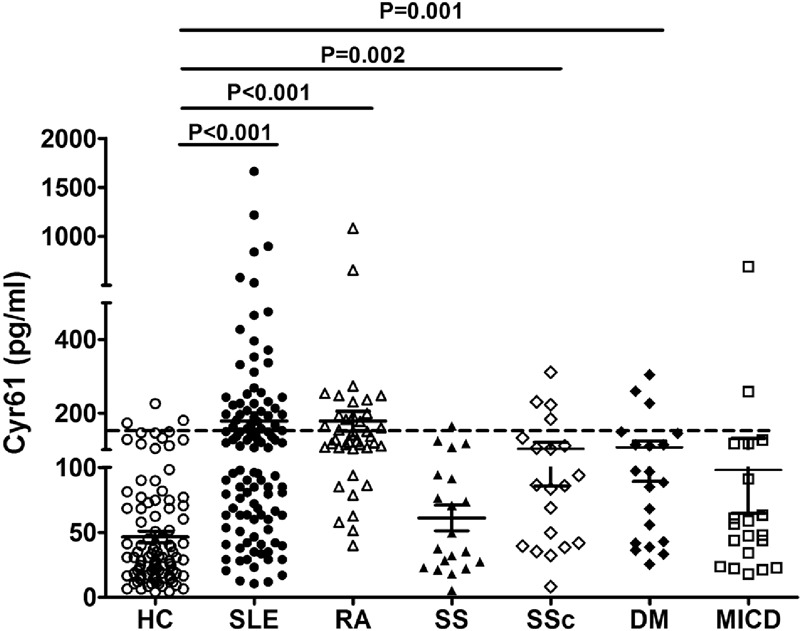
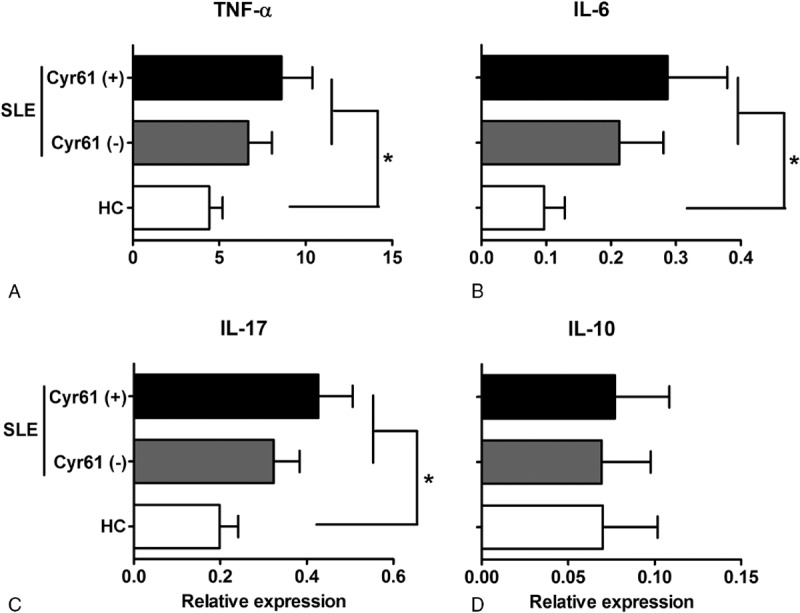
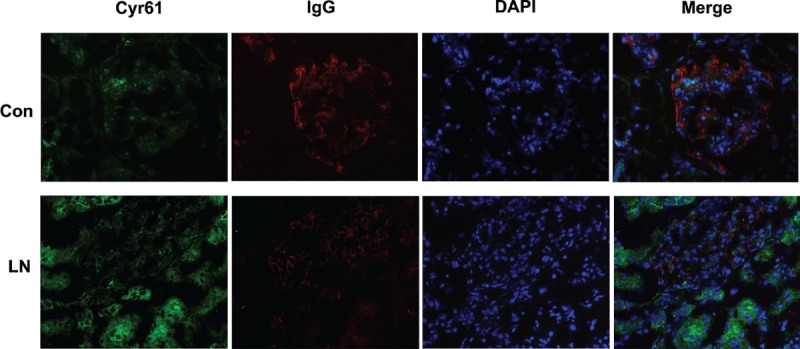
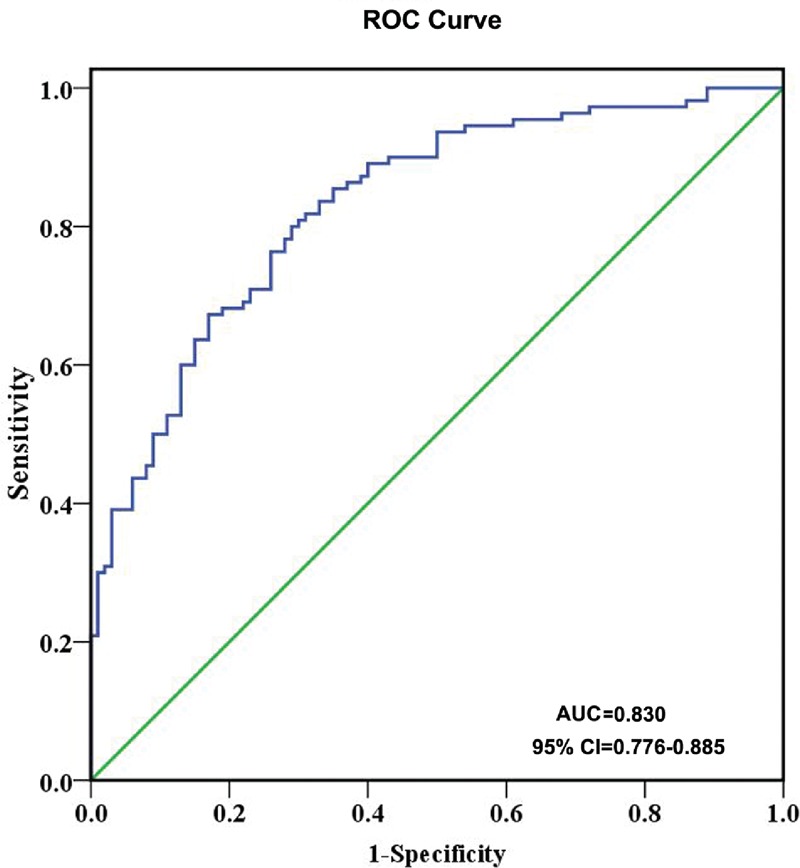
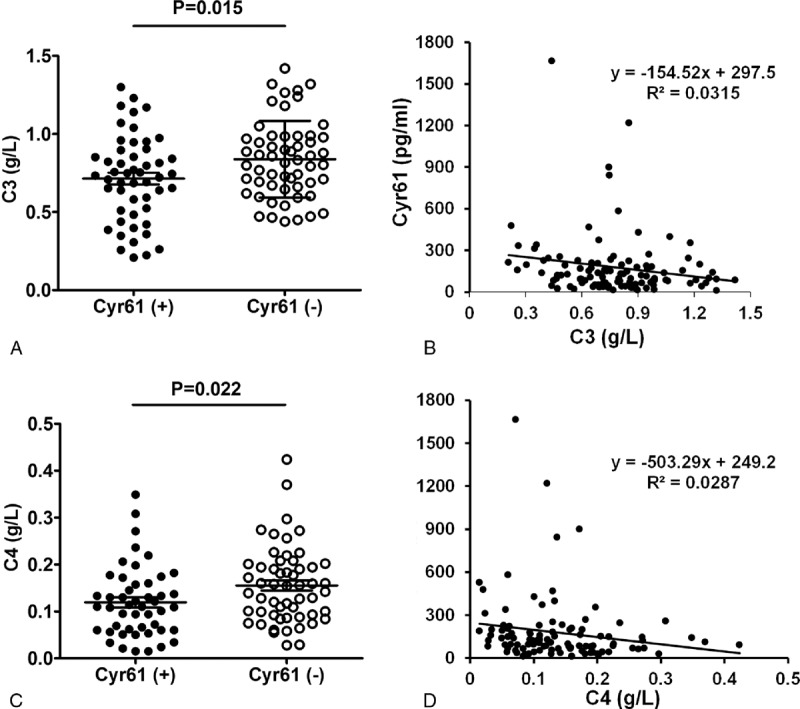
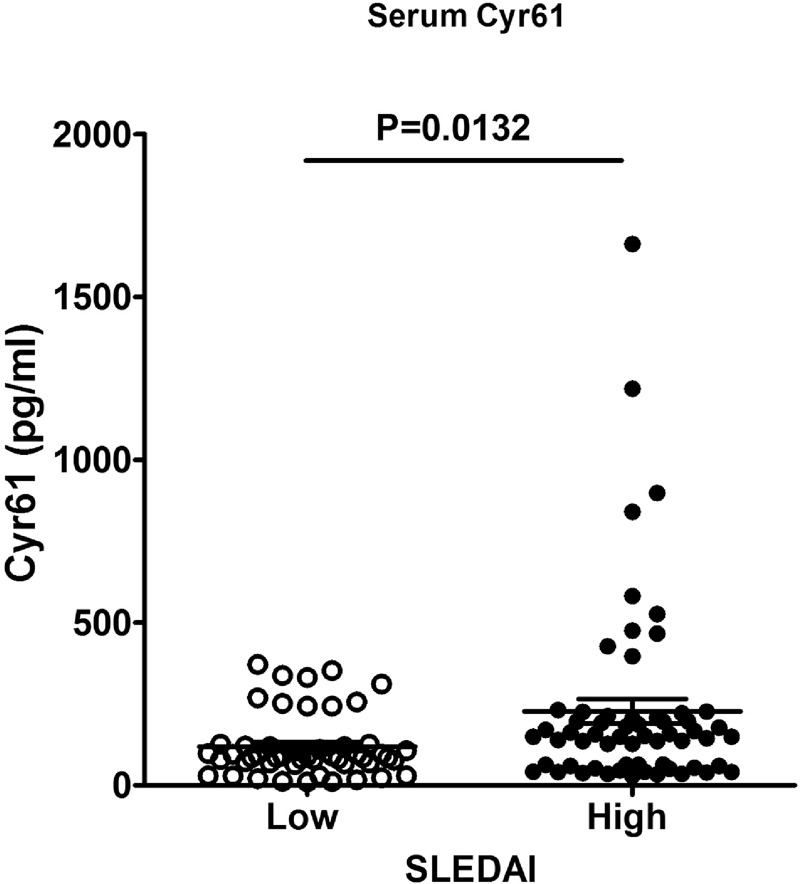
Our previous studies have shown that secreted extracellular matrix-associated protein Cysteine rich angiogenic inducer 61 (Cyr61), a novel proinflammatory factor, is involved in the pathogenesis of rheumatoid arthritis (RA). However, whether Cyr61 has any effect in systemic lupus erythematosus (SLE) remains unknown. This study aims to assess the level of serum Cyr61 and to investigate the association of serum Cyr61 and clinical disease activity in SLE. We found the level of serum Cyr61 in patients with SLE was significantly higher than healthy controls (P < 0.001), and Cyr61 was high expressed in renal tubule of lupus nephritis compared to control. The sensitivity of Cyr61 in diagnosis of SLE was 47.3%. In receiver operating characteristic (ROC) curve analysis, the area under the curve (AUC) was 0.830, with a 95% confidence interval (CI) from 0.776 to 0.885. Cyr61 was present in 60.0%, 54.5%, and 41.5% of anti-double stranded DNA (dsDNA), anti-antinuclear antibodies (ANA), and anti-Sm negative SLE patients, respectively. Serum Cyr61 levels were significantly higher in high systemic lupus erythematosus disease activity index (SLEDAI) group than that in low SLEDAI group (P = 0.003). Correlation analyzes showed a significant negative correlation between serum Cyr61 and complements (C3) (P = 0.015), C4 (P = 0.04). Moreover, increased Cyr61 level in SLE was associated with serum level of TNF-α, interleukin 6 (IL-6), and IL-17. In conclusion, serum Cyr61 was increased in patients with SLE which was associated with clinical disease activity and inflammation in SLE, suggesting Cyr61 may be a novel potential auxiliary marker for the diagnosis of SLE.
我们之前的研究表明,分泌型细胞外基质相关蛋白富含半胱氨酸的血管生成诱导因子61(Cyr61)是一种新型促炎因子,参与类风湿关节炎(RA)的发病机制。然而,Cyr61在系统性红斑狼疮(SLE)中是否有任何作用仍不清楚。本研究旨在评估血清Cyr61水平,并探讨血清Cyr61与SLE临床疾病活动度的相关性。我们发现SLE患者血清Cyr61水平显著高于健康对照(P<0.001),与对照相比,狼疮性肾炎肾小管中Cyr61高表达。Cyr61诊断SLE的敏感性为47.3%。在受试者工作特征(ROC)曲线分析中,曲线下面积(AUC)为0.830,95%置信区间(CI)为0.776至0.885。抗双链DNA(dsDNA)、抗核抗体(ANA)和抗Sm阴性的SLE患者中,Cyr61阳性率分别为60.0%、54.5%和41.5%。高系统性红斑狼疮疾病活动指数(SLEDAI)组血清Cyr61水平显著高于低SLEDAI组(P=0.003)。相关性分析显示血清Cyr61与补体(C3)(P=0.015)、C4(P=0.04)呈显著负相关。此外,SLE中Cyr61水平升高与血清肿瘤坏死因子-α、白细胞介素6(IL-6)和IL-17水平相关。总之,SLE患者血清Cyr61升高,这与SLE的临床疾病活动度和炎症相关,提示Cyr61可能是诊断SLE的一种新型潜在辅助标志物。