Quesnel Katherine, Shi-Wen Xu, Hutchenreuther James, Xiao Yizhi, Liu Shangxi, Peidl Alexander, Naskar Deboki, Siqueira Walter L, O'Gorman David B, Hinz Boris, Stratton Richard J, Leask Andrew
Department of Dentistry, University of Western Ontario, London, ON, N6A 5C1, Canada.
Centre for Rheumatology, University College London (Royal Free Campus), London, NW3 2PF, UK.
Matrix Biol Plus. 2019 Jul 6;3:100009. doi: 10.1016/j.mbplus.2019.100009. eCollection 2019 Aug.
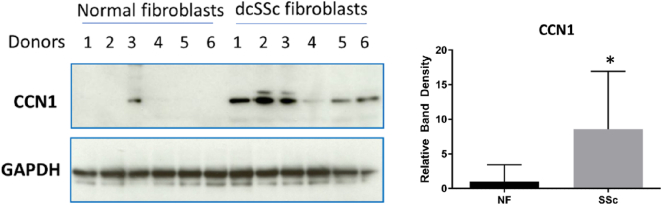
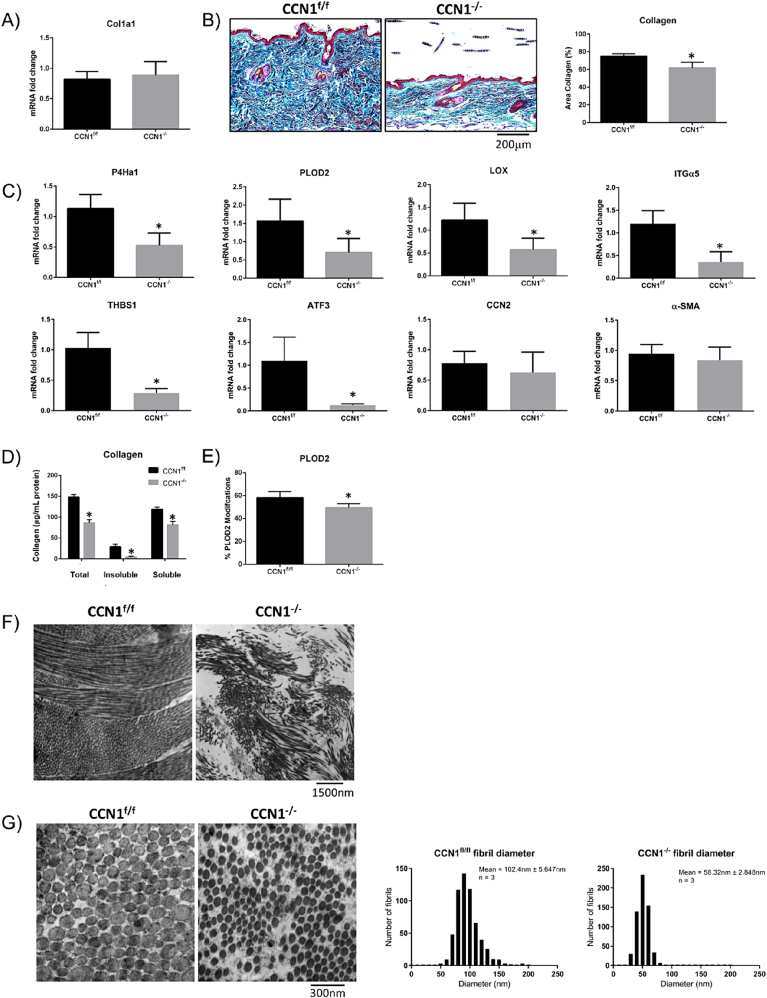
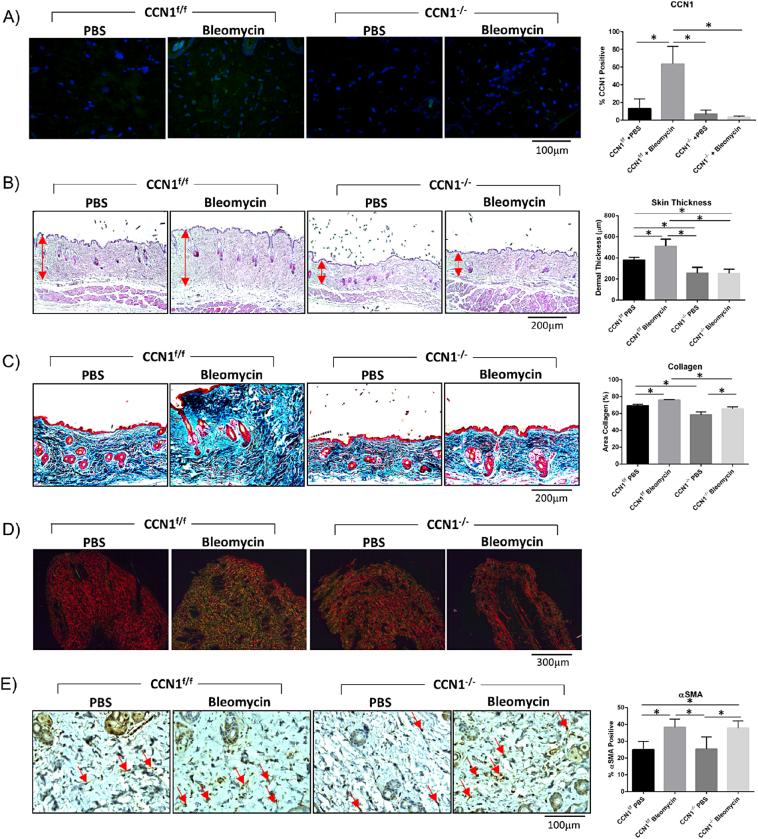
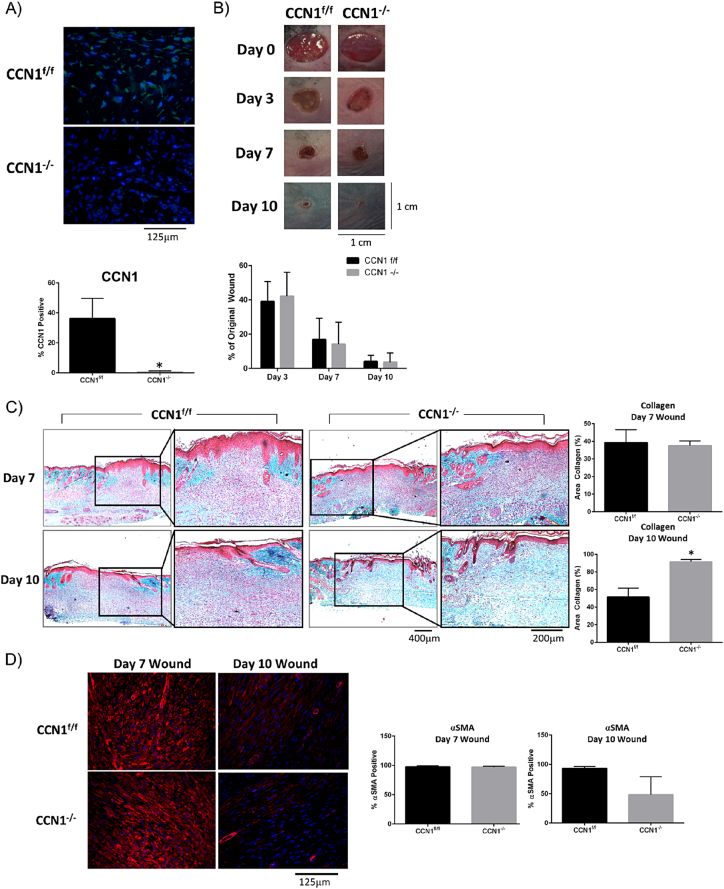
The microenvironment contributes to the excessive connective tissue deposition that characterizes fibrosis. Members of the CCN family of matricellular proteins are secreted by fibroblasts into the fibrotic microenvironment; however, the role of endogenous CCN1 in skin fibrosis is unknown. Mice harboring a fibroblast-specific deletion for CCN1 were used to assess if CCN1 contributes to dermal homeostasis, wound healing, and skin fibrosis. Mice with a fibroblast-specific CCN1 deletion showed progressive skin thinning and reduced accumulation of type I collagen; however, the overall mechanical property of skin (Young's modulus) was not significantly reduced. Real time-polymerase chain reaction analysis revealed that CCN1-deficient skin displayed reduced expression of mRNAs encoding enzymes that promote collagen stability (including prolyl-4-hydroxylase and PLOD2), although expression of COL1A1 mRNA was unaltered. CCN1-deficent skin showed reduced hydroxyproline levels. Electron microscopy revealed that collagen fibers were disorganized in CCN1-deficient skin. CCN1-deficient mice were resistant to bleomycin-induced skin fibrosis, as visualized by reduced collagen accumulation and skin thickness suggesting that deposition/accumulation of collagen is impaired in the absence of CCN1. Conversely, CCN1-deficient mice showed unaltered wound closure kinetics, suggesting de novo collagen production in response to injury did not require CCN1. In response to either wounding or bleomycin, induction of α-smooth muscle actin-positive myofibroblasts was unaffected by loss of CCN1. CCN1 protein was overexpressed by dermal fibroblasts isolated from lesional (i.e., fibrotic) areas of patients with early onset diffuse scleroderma. Thus, CCN1 expression by fibroblasts, being essential for skin fibrosis, is a viable anti-fibrotic target.
微环境导致了以纤维化特征的过度结缔组织沉积。基质细胞蛋白CCN家族的成员由成纤维细胞分泌到纤维化微环境中;然而,内源性CCN1在皮肤纤维化中的作用尚不清楚。利用携带CCN1成纤维细胞特异性缺失的小鼠来评估CCN1是否有助于皮肤稳态、伤口愈合和皮肤纤维化。成纤维细胞特异性CCN1缺失的小鼠表现出皮肤逐渐变薄和I型胶原蛋白积累减少;然而,皮肤的整体力学性能(杨氏模量)没有显著降低。实时聚合酶链反应分析显示,CCN1缺陷皮肤中编码促进胶原蛋白稳定性的酶(包括脯氨酰-4-羟化酶和PLOD2)的mRNA表达降低,尽管COL1A1 mRNA的表达未改变。CCN1缺陷皮肤的羟脯氨酸水平降低。电子显微镜显示,CCN1缺陷皮肤中的胶原纤维排列紊乱。CCN1缺陷小鼠对博来霉素诱导的皮肤纤维化具有抗性,通过减少的胶原蛋白积累和皮肤厚度可见,这表明在没有CCN1的情况下胶原蛋白的沉积/积累受损。相反,CCN1缺陷小鼠的伤口闭合动力学未改变,表明对损伤的新生胶原蛋白产生不需要CCN1。对伤口或博来霉素的反应中,α-平滑肌肌动蛋白阳性肌成纤维细胞的诱导不受CCN1缺失的影响。从早发性弥漫性硬皮病患者的病变(即纤维化)区域分离的真皮成纤维细胞中CCN1蛋白过表达。因此,成纤维细胞表达的CCN1对皮肤纤维化至关重要,是一个可行的抗纤维化靶点。