Bossen Claudia, Murre Caroline S, Chang Aaron N, Mansson Robert, Rodewald Hans-Reimer, Murre Cornelis
Department of Molecular Biology, University of California, San Diego, La Jolla, California, USA.
Center for Computational Biology, Institute for Genomic Medicine, University of California, San Diego, La Jolla, California, USA.
Nat Immunol. 2015 Jul;16(7):775-84. doi: 10.1038/ni.3170. Epub 2015 May 18.
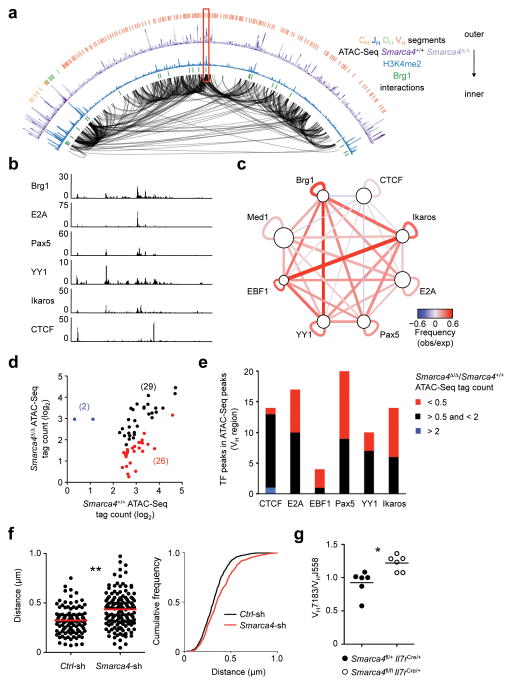
Early B cell development is orchestrated by the combined activities of the transcriptional regulators E2A, EBF1, Foxo1 and Ikaros. However, how the genome-wide binding patterns of these regulators are modulated during B lineage development remains to be determined. Here we found that in lymphoid progenitor cells, the chromatin remodeler Brg1 specified the B cell fate. In committed pro-B cells, Brg1 regulated contraction of the locus encoding the immunoglobulin heavy chain (Igh) and controlled expression of the gene encoding the transcription factor c-Myc (Myc) to modulate the expression of genes encoding products that regulate ribosome biogenesis. In committed pro-B cells, Brg1 suppressed a pre-B lineage-specific pattern of gene expression. Finally, we found that Brg1 acted mechanistically to establish B cell fate and modulate cell growth by facilitating access of lineage-specific transcription factors to enhancer repertoires.
早期B细胞发育由转录调节因子E2A、EBF1、Foxo1和Ikaros的联合活性精心编排。然而,在B细胞谱系发育过程中,这些调节因子的全基因组结合模式是如何被调控的仍有待确定。在这里,我们发现,在淋巴祖细胞中,染色质重塑因子Brg1决定了B细胞命运。在定向祖B细胞中,Brg1调节编码免疫球蛋白重链(Igh)的基因座的收缩,并控制编码转录因子c-Myc(Myc)的基因的表达,以调节编码参与核糖体生物发生产物的基因的表达。在定向祖B细胞中,Brg1抑制了前B细胞谱系特异性的基因表达模式。最后,我们发现Brg1通过促进谱系特异性转录因子与增强子库的结合,在机制上发挥作用以确立B细胞命运并调节细胞生长。