Tian Yongsheng, Jiang Jing, Wang Na, Qi Wenshan, Zhai Jieming, Li Bo, Liang You, Chen Youming, Yang Chuanjun, Chen Songlin
Key Laboratory of Sustainable Development of Marine Fisheries, Ministry of Agriculture, Yellow Sea Fisheries Research Institute, Chinese Academy of Fishery Sciences, Qingdao 266071, China.
J Reprod Dev. 2015;61(4):333-9. doi: 10.1262/jrd.2014-087. Epub 2015 May 18.
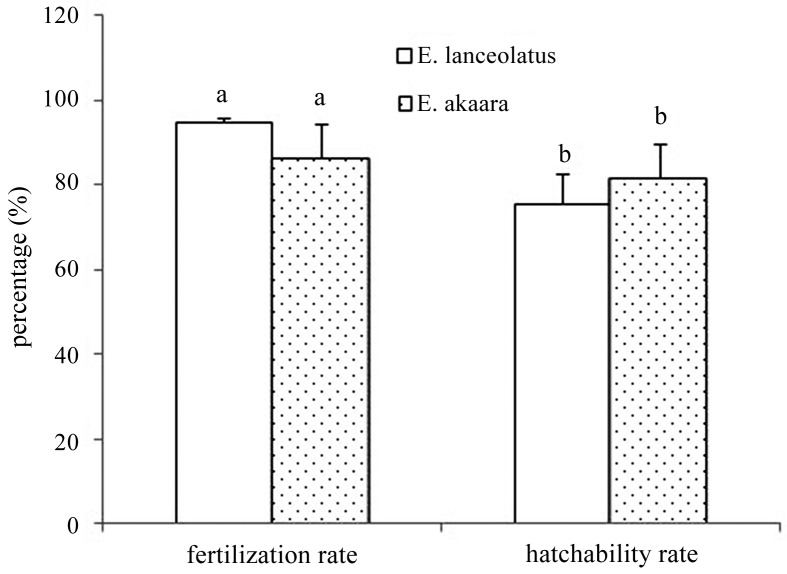
In order to develop excellent germplasm resources for giant grouper (Epinephelus lanceolatus), cryopreservation of giant grouper sperm was examined in the present study. Firstly, 13 kinds of sperm dilution (ELS1-3, EM1-2, TS-2, MPRS, ELRS0-6) were prepared with physiological salt, sucrose, glucose and fetal bovine serum. The physiological parameters of ELRS3 (ratio of fast motion, ratio of slow motion, time of fast motion, time of slow motion, lifespan and motility) and ELS3 (sperm ratio of slow motion, time of slow motion and motility) were significantly higher than those of the other dilutions (P < 0.05). Secondly, after adding 15% DMSO and 10% FBS to ELRS3 and ELS3, most physiological parameters of frozen sperm were also significantly higher than the other gradients (P < 0.05), and sperm motility was as high as 63.68 ± 4.16% to74.75 ± 12.71% (fresh sperm motility, 80.70 ± 1.37% to 80.71 ± 1.49%). Mixed with the above dilutions, a final volume of 105 ml semen was cryopreserved. Finally, the sperm of giant grouper cryopreserved with cryoprotectants (ELRS3 + 15% DMSO + 10% FBS) was used for electron-microscopic observation and crossbreeding with red-spotted groupers (Epinephelus akaara). The electron-microscopic observation revealed that part of the frozen-thawed sperm was cryodamaged, e.g., flagellum fracturing and mitochondria falling out, while the ultrastructure of sperm membrane, mitochondria and flagellum remained intact. Also, the fertilization and hatchability rates of giant grouper frozen sperm and red-spotted grouper eggs were as high as 94.56% and 75.56%, respectively. Thus, a technique for cryopreservation of giant grouper sperm was successfully developed and applied to crossbreeding with red-spotted grouper eggs.
为了开发鞍带石斑鱼(Epinephelus lanceolatus)的优良种质资源,本研究对鞍带石斑鱼精子的冷冻保存进行了研究。首先,用生理盐水、蔗糖、葡萄糖和胎牛血清制备了13种精子稀释液(ELS1 - 3、EM1 - 2、TS - 2、MPRS、ELRS0 - 6)。ELRS3(快速运动比例、慢速运动比例、快速运动时间、慢速运动时间、寿命和活力)和ELS3(慢速运动精子比例、慢速运动时间和活力)的生理参数显著高于其他稀释液(P < 0.05)。其次,在ELRS3和ELS3中添加15%二甲基亚砜(DMSO)和10%胎牛血清(FBS)后,冷冻精子的大多数生理参数也显著高于其他梯度(P < 0.05),精子活力高达63.68±4.16%至74.75±12.71%(新鲜精子活力为80.70±1.37%至80.71±1.49%)。与上述稀释液混合,最终冷冻保存了105毫升精液。最后,用冷冻保护剂(ELRS3 + 15% DMSO + 10% FBS)冷冻保存的鞍带石斑鱼精子用于电子显微镜观察以及与赤点石斑鱼(Epinephelus akaara)进行杂交。电子显微镜观察显示,部分冻融精子受到冷冻损伤,如鞭毛断裂和线粒体脱落,而精子膜、线粒体和鞭毛的超微结构保持完整。此外,鞍带石斑鱼冷冻精子与赤点石斑鱼卵的受精率和孵化率分别高达94.56%和75.56%。因此,成功开发了鞍带石斑鱼精子冷冻保存技术,并将其应用于与赤点石斑鱼卵的杂交。