Austin Paul J, Berglund Annika M, Siu Sherman, Fiore Nathan T, Gerke-Duncan Michelle B, Ollerenshaw Suzanne L, Leigh Sarah-Jane, Kunjan Priya A, Kang James W M, Keay Kevin A
Discipline of Anatomy and Histology, School of Medical Sciences, The University of Sydney, Room E511, Anderson Stuart Building F13, Sydney, NSW, 2006, Australia.
J Neuroinflammation. 2015 May 20;12:96. doi: 10.1186/s12974-015-0318-4.
Chronic neuropathic pain is a neuro-immune disorder, characterised by allodynia, hyperalgesia and spontaneous pain, as well as debilitating affective-motivational disturbances (e.g., reduced social interactions, sleep-wake cycle disruption, anhedonia, and depression). The role of the immune system in altered sensation following nerve injury is well documented. However, its role in the development of affective-motivational disturbances remains largely unknown. Here, we aimed to characterise changes in the immune response at peripheral and spinal sites in a rat model of neuropathic pain and disability.
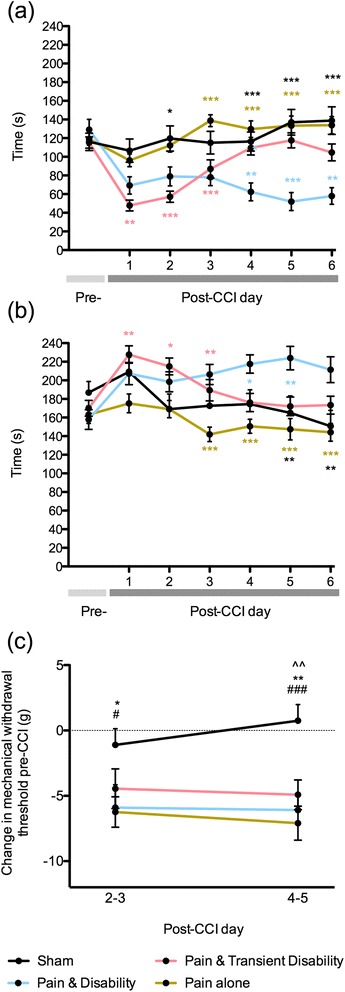
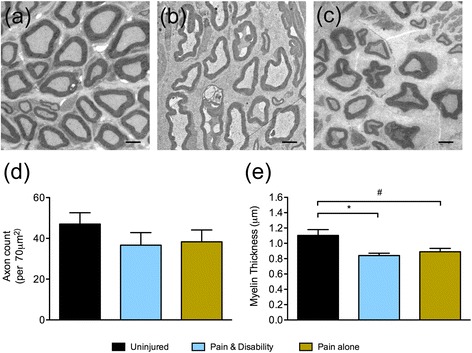
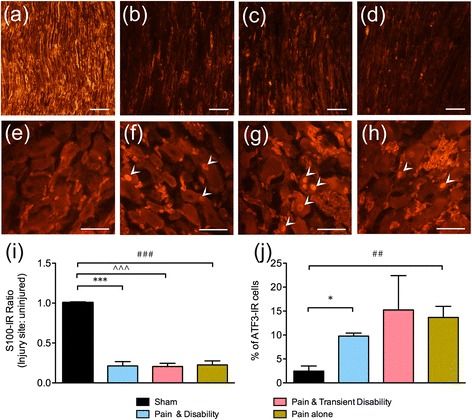
Sixty-two rats underwent sciatic nerve chronic constriction injury (CCI) and were characterised as either Pain and disability, Pain and transient disability or Pain alone on the basis of sensory threshold testing and changes in post-CCI dominance behaviour in resident-intruder interactions. Nerve ultrastructure was assessed and the number of T lymphocytes and macrophages were quantified at the site of injury on day six post-CCI. ATF3 expression was quantified in the dorsal root ganglia (DRG). Using a multiplex assay, eight cytokines were quantified in the sciatic nerve, DRG and spinal cord.
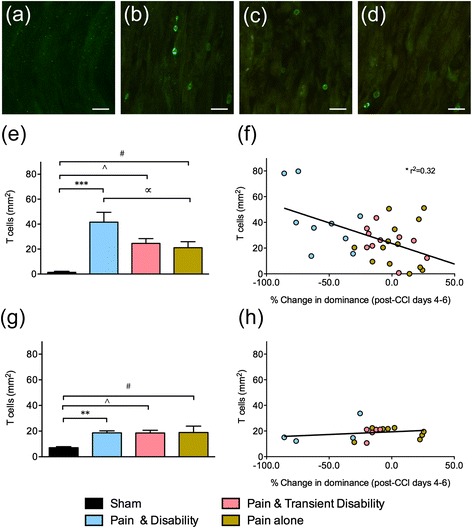
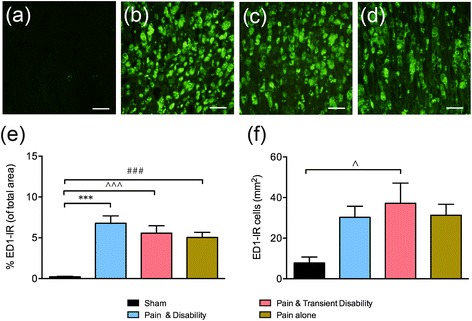
All CCI rats displayed equal levels of mechanical allodynia, structural nerve damage, and reorganisation. All CCI rats had significant infiltration of macrophages and T lymphocytes to both the injury site and the DRG. Pain and disability rats had significantly greater numbers of T lymphocytes. CCI increased IL-6 and MCP-1 in the sciatic nerve. Examination of disability subgroups revealed increases in IL-6 and MCP-1 were restricted to Pain and disability rats. Conversely, CCI led to a decrease in IL-17, which was restricted to Pain and transient disability and Pain alone rats. CCI significantly increased IL-6 and MCP-1 in the DRG, with IL-6 restricted to Pain and disability rats. CCI rats had increased IL-1β, IL-6 and MCP-1 in the spinal cord. Amongst subgroups, only Pain and disability rats had increased IL-1β.
This study has defined individual differences in the immune response at peripheral and spinal sites following CCI in rats. These changes correlated with the degree of disability. Our data suggest that individual immune signatures play a significant role in the different behavioural trajectories following nerve injury, and in some cases may lead to persistent affective-motivational disturbances.
慢性神经性疼痛是一种神经免疫紊乱疾病,其特征为痛觉过敏、痛觉超敏和自发痛,以及使人衰弱的情感动机障碍(如社交互动减少、睡眠-觉醒周期紊乱、快感缺失和抑郁)。免疫系统在神经损伤后感觉改变中的作用已有充分记录。然而,其在情感动机障碍发展中的作用仍 largely 未知。在此,我们旨在描述神经性疼痛和残疾大鼠模型中外周和脊髓部位免疫反应的变化。
62 只大鼠接受坐骨神经慢性压迫损伤(CCI),并根据感觉阈值测试和 CCI 后在居住者-入侵者互动中优势行为的变化,分为疼痛和残疾组、疼痛和短暂残疾组或仅疼痛组。评估神经超微结构,并在 CCI 后第 6 天对损伤部位的 T 淋巴细胞和巨噬细胞数量进行定量。对背根神经节(DRG)中的 ATF3 表达进行定量。使用多重检测法,对坐骨神经、DRG 和脊髓中的 8 种细胞因子进行定量。
所有 CCI 大鼠均表现出同等程度的机械性痛觉过敏、神经结构损伤和重组。所有 CCI 大鼠的巨噬细胞和 T 淋巴细胞均显著浸润至损伤部位和 DRG。疼痛和残疾大鼠的 T 淋巴细胞数量显著更多。CCI 使坐骨神经中的 IL-6 和 MCP-1 增加。对残疾亚组的检查显示,IL-6 和 MCP-1 的增加仅限于疼痛和残疾大鼠。相反,CCI 导致 IL-17 减少,这仅限于疼痛和短暂残疾组以及仅疼痛组大鼠。CCI 显著增加了 DRG 中的 IL-6 和 MCP-1,其中 IL-6 仅限于疼痛和残疾大鼠。CCI 大鼠脊髓中的 IL-1β、IL-6 和 MCP-1 增加。在亚组中,只有疼痛和残疾大鼠的 IL-1β 增加。
本研究确定了大鼠 CCI 后外周和脊髓部位免疫反应的个体差异。这些变化与残疾程度相关。我们的数据表明,个体免疫特征在神经损伤后的不同行为轨迹中起重要作用,在某些情况下可能导致持续的情感动机障碍。