Department of Physiology, Faculty of Medicine, Bozok University, Yozgat, Turkey.
Libyan J Med. 2020 Dec;15(1):1741904. doi: 10.1080/19932820.2020.1741904.
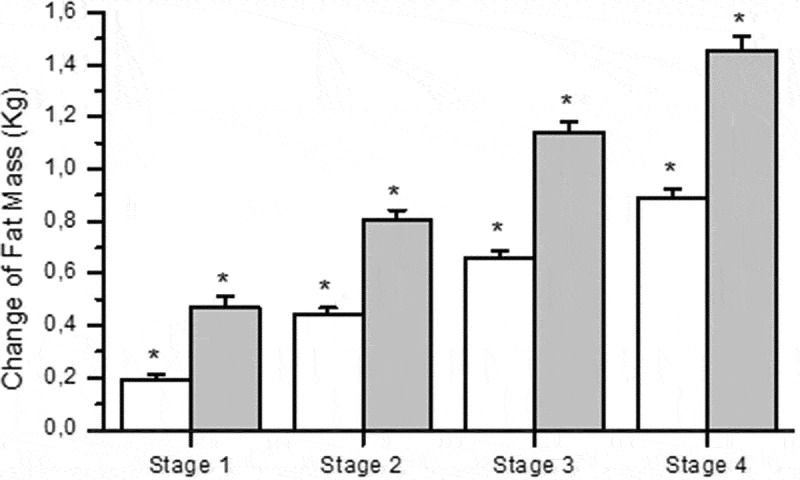
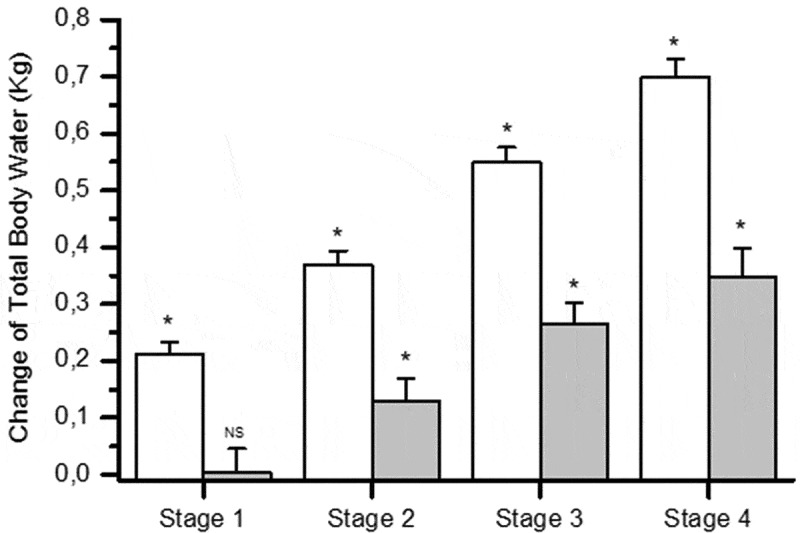
Body composition analysis may provide valuable information about the assessment of balance between fluid, fat, and fat-free mass. The present study assessed whether the regular increase in water consumption has any significant effects on measurements of body composition using BIA. A total of 140 subjects participated in this study. Body composition analyses of the subjects were performed for five times using foot to foot BIA; first at baseline and four times, after 15 minutes of each 500 mL water intakes. There was overestimation in body fat mass compared to the baseline and increased significantly after water intakes in males (2.08% in 500 mL, 3.80% in 1000 mL, 5.88% in 1500 mL, and 7.92% in 2000 mL, p < 0.05) and in females (3.4% in 500 mL, 5.7% in 1000 mL, 7.8% in 1500 mL, and 9.4% in 2000 mL, p < 0.05). In contrast, there was markedly underestimation of total body water and fat-free mass in males (35% and 50%) and females (17% and 22%), respectively, at the end of the study. Thus, overestimation of body fat mass and lower estimation of total body water and fat-free mass with closely to the amount of water retention using BIA application should be considered in health-related clinical practice.
身体成分分析可能提供关于液体、脂肪和无脂肪质量之间平衡评估的有价值信息。本研究评估了定期增加水的摄入量是否对 BIA 测量的身体成分有任何显著影响。共有 140 名受试者参加了这项研究。使用足对足 BIA 对受试者的身体成分进行了五次分析;第一次在基线时,然后在每次摄入 500 毫升水后 15 分钟进行四次。与基线相比,男性的体脂肪量存在高估,并且在摄入水分后显著增加(500 毫升增加 2.08%,1000 毫升增加 3.80%,1500 毫升增加 5.88%,2000 毫升增加 7.92%,p < 0.05),女性也是如此(500 毫升增加 3.4%,1000 毫升增加 5.7%,1500 毫升增加 7.8%,2000 毫升增加 9.4%,p < 0.05)。相反,在研究结束时,男性(35%和 50%)和女性(17%和 22%)的总体水和无脂肪质量明显低估。因此,在与健康相关的临床实践中,应该考虑 BIA 应用中与水保留量密切相关的体脂肪量高估和总体水和无脂肪质量低估。