Department of Cell Biology and Immunology, Institute of Parasitology and Biomedicine "López-Neyra," Consejo Superior de Investigaciones Científicas Granada, Spain ; Department of Mathematics, University of the Basque Country, UPV/Euskal Herriko Unibertsitatea Leioa, Spain.
Front Mol Biosci. 2015 Apr 28;2:16. doi: 10.3389/fmolb.2015.00016. eCollection 2015.
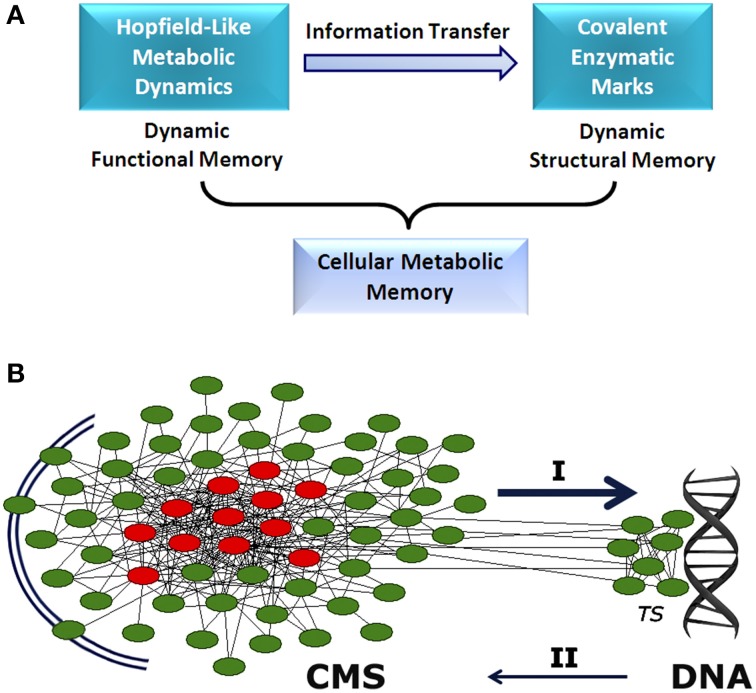
A large number of studies have demonstrated the existence of metabolic covalent modifications in different molecular structures, which are able to store biochemical information that is not encoded by DNA. Some of these covalent mark patterns can be transmitted across generations (epigenetic changes). Recently, the emergence of Hopfield-like attractor dynamics has been observed in self-organized enzymatic networks, which have the capacity to store functional catalytic patterns that can be correctly recovered by specific input stimuli. Hopfield-like metabolic dynamics are stable and can be maintained as a long-term biochemical memory. In addition, specific molecular information can be transferred from the functional dynamics of the metabolic networks to the enzymatic activity involved in covalent post-translational modulation, so that determined functional memory can be embedded in multiple stable molecular marks. The metabolic dynamics governed by Hopfield-type attractors (functional processes), as well as the enzymatic covalent modifications of specific molecules (structural dynamic processes) seem to represent the two stages of the dynamical memory of cellular metabolism (metabolic memory). Epigenetic processes appear to be the structural manifestation of this cellular metabolic memory. Here, a new framework for molecular information storage in the cell is presented, which is characterized by two functionally and molecularly interrelated systems: a dynamic, flexible and adaptive system (metabolic memory) and an essentially conservative system (genetic memory). The molecular information of both systems seems to coordinate the physiological development of the whole cell.
大量研究表明,在不同的分子结构中存在代谢共价修饰,这些修饰能够存储未被 DNA 编码的生化信息。其中一些共价标记模式可以在代际间传递(表观遗传变化)。最近,在自组织酶网络中观察到了类似于 Hopfield 的吸引子动力学的出现,这些酶网络具有存储功能催化模式的能力,这些模式可以通过特定的输入刺激正确恢复。类似于 Hopfield 的代谢动力学是稳定的,可以作为长期的生化记忆维持。此外,特定的分子信息可以从代谢网络的功能动力学传递到涉及共价翻译后修饰的酶活性,从而将确定的功能记忆嵌入到多个稳定的分子标记中。由 Hopfield 型吸引子(功能过程)控制的代谢动力学,以及特定分子的酶共价修饰(结构动态过程),似乎代表了细胞代谢动力学记忆的两个阶段(代谢记忆)。表观遗传过程似乎是这种细胞代谢记忆的结构表现。在这里,提出了一种细胞内分子信息存储的新框架,其特征是两个在功能和分子上相互关联的系统:动态、灵活和自适应系统(代谢记忆)和本质上保守的系统(遗传记忆)。两个系统的分子信息似乎协调整个细胞的生理发育。