Zhang Hang, Huang Changxin, Wang Yan, Lu Zhe, Zhuang Ningtong, Zhao Dongjiu, He Jianqin, Shi Liyun
Department of Basic Medical Science, Key Lab of Immunology and Molecular Medicine, School of Medicine, Hangzhou Normal University, Hangzhou, Zhejiang 310036, China.
Department of Oncology, Affiliated Hospital of School of Medicine, Hangzhou Normal University, Hangzhou, Zhejiang 310036, China.
PLoS One. 2015 May 20;10(5):e0127329. doi: 10.1371/journal.pone.0127329. eCollection 2015.
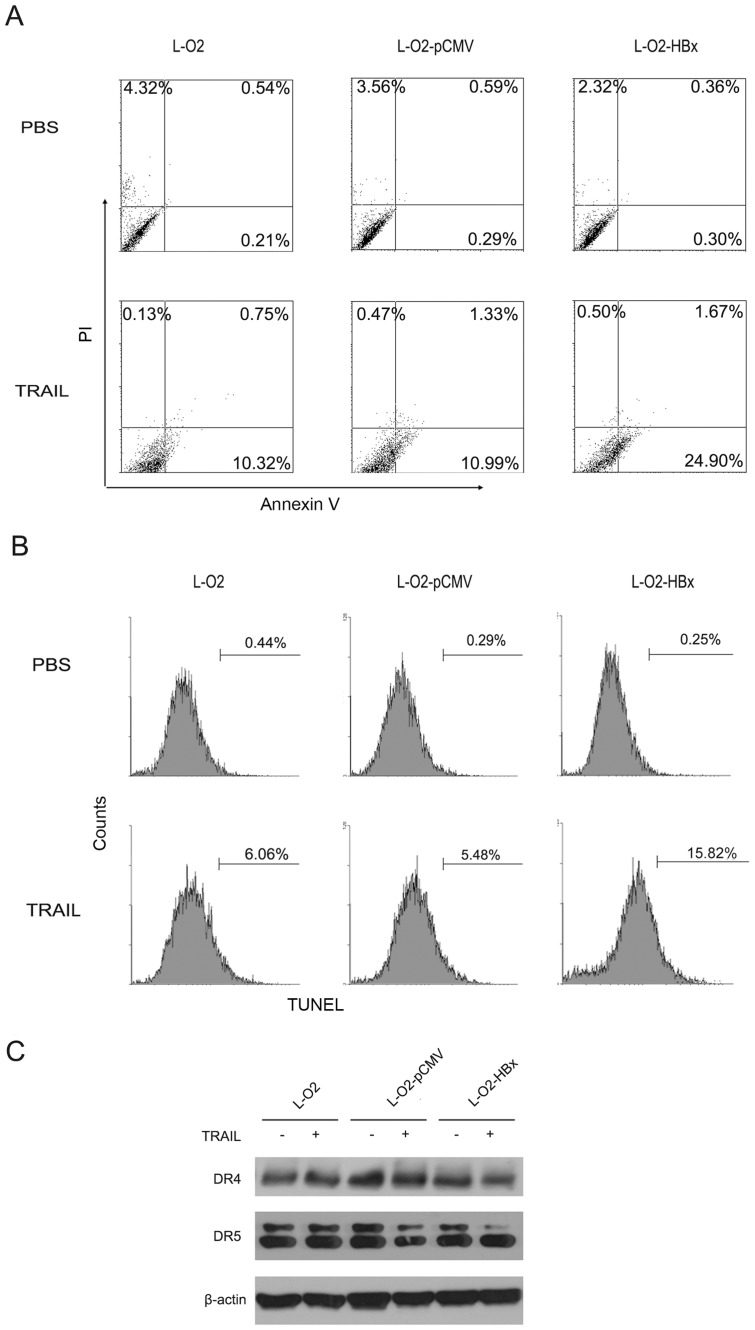
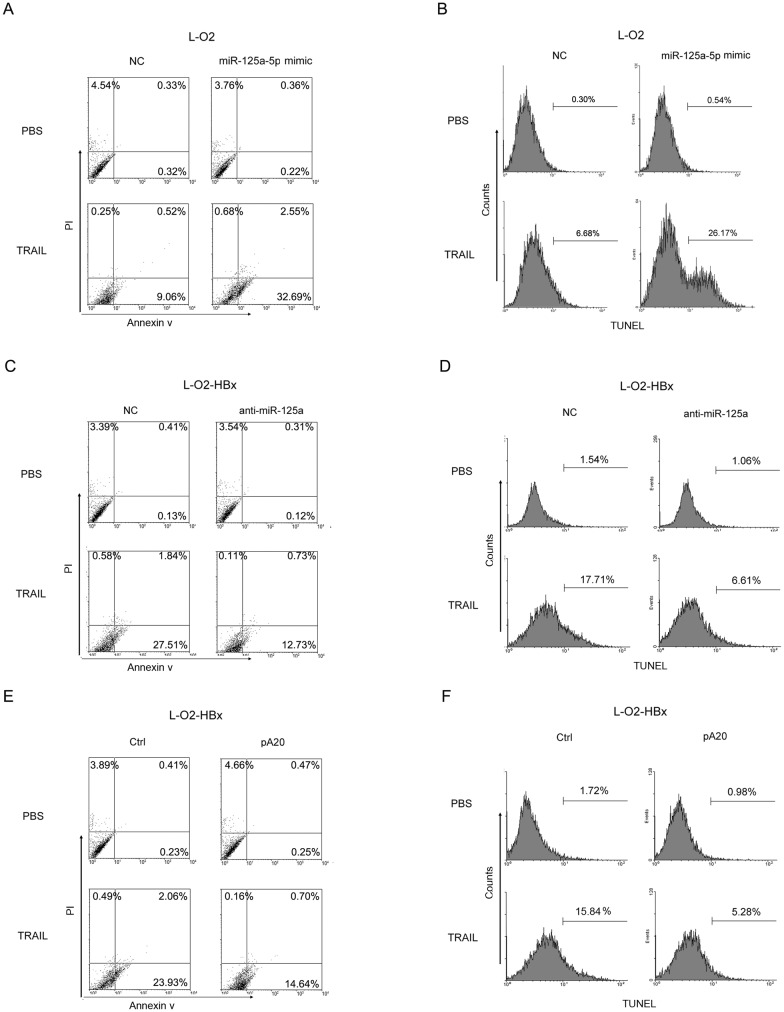
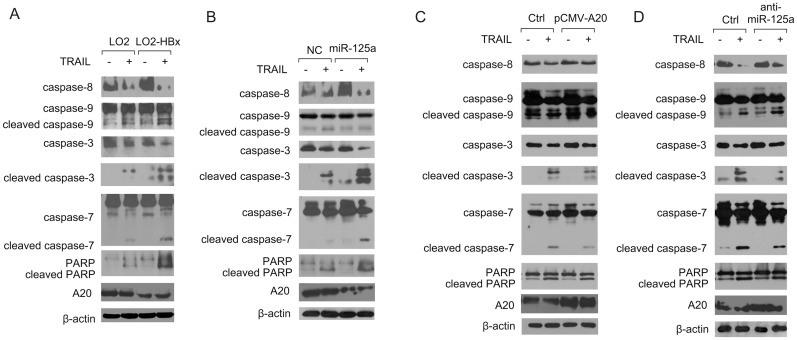
Hepatitis B virus (HBV) infection causes hepatocyte death and liver damage, which may eventually lead to cirrhosis and liver cancer. Hepatitis B virus X protein (HBx) is a key antigen that is critically involved in HBV-associated liver diseases. However, the molecular basis for its pathogenesis, particularly in liver damage, has not been well defined. Herein, we report that HBx was able to enhance the susceptibility of hepatocytes to TNF-related apoptosis-inducing ligand (TRAIL)-induced apoptosis. Increased sensitivity to TRAIL was associated with HBx-induced upregulation of miR-125a, which, in turn, suppressed the expression of its putative target gene, A20 E3 ligase. Importantly, we demonstrate that the defective expression of A20 impaired the K63-linked polyubiquitination of caspase-8, which reciprocally enhanced the activation of caspase-8, the recruitment of Fas-associated death domain (FADD), and the formation of death-inducing signaling complex (DISC), thereby promoting HBx-mediated apoptotic signaling. Accordingly, antagonizing miR-125a or ectopically expressing A20 in hepatocytes abolished the pro-apoptotic effect of HBx. Conversely, the overexpression of miR-125a or knockdown of A20 mimicked HBx to enhance TRAIL susceptibility in hepatocytes. Thus, we establish, for the first time, a miR-125a/A20-initiated and caspase-8-targeted mechanism by which HBx modulates apoptotic signaling and increases hepatic susceptibility to the damaging agent, which might provide novel insight into HBV-related liver pathology.
乙型肝炎病毒(HBV)感染会导致肝细胞死亡和肝损伤,最终可能引发肝硬化和肝癌。乙型肝炎病毒X蛋白(HBx)是一种关键抗原,在HBV相关肝病中起关键作用。然而,其发病机制的分子基础,尤其是在肝损伤方面,尚未完全明确。在此,我们报告HBx能够增强肝细胞对肿瘤坏死因子相关凋亡诱导配体(TRAIL)诱导的凋亡的敏感性。对TRAIL敏感性的增加与HBx诱导的miR-125a上调有关,而miR-125a反过来又抑制了其假定靶基因A20 E3连接酶的表达。重要的是,我们证明A20的缺陷表达损害了半胱天冬酶-8的K63连接的多聚泛素化,这反过来增强了半胱天冬酶-8的激活、Fas相关死亡结构域(FADD)的募集以及死亡诱导信号复合物(DISC)的形成,从而促进了HBx介导的凋亡信号传导。因此,在肝细胞中拮抗miR-125a或异位表达A20可消除HBx的促凋亡作用。相反,miR-125a的过表达或A20的敲低模拟了HBx,增强了肝细胞对TRAIL的敏感性。因此,我们首次建立了一种由miR-125a/A20启动并以半胱天冬酶-8为靶点的机制,通过该机制HBx调节凋亡信号并增加肝脏对损伤因子的易感性,这可能为HBV相关肝脏病理学提供新的见解。