LaPallo Brandon K, Wolpaw Jonathan R, Chen Xiang Yang, Carp Jonathan S
School of Public Health, SUNY at Albany, Rensselaer, New York.
New York State Department of Health, Wadsworth Center, Albany, New York.
Neurourol Urodyn. 2016 Aug;35(6):696-702. doi: 10.1002/nau.22789. Epub 2015 May 20.
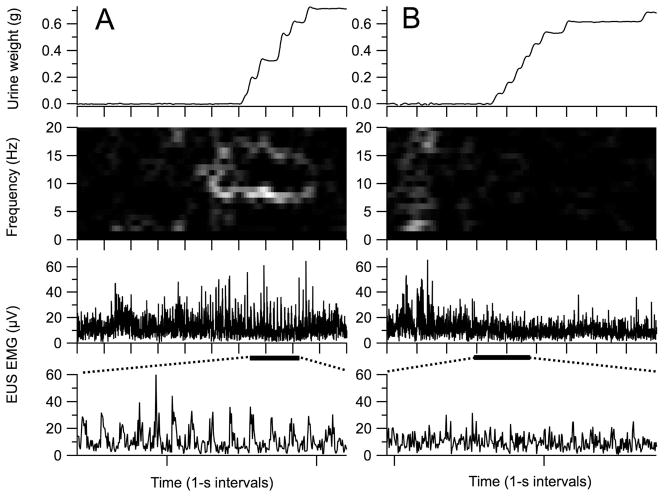
In anesthetized rats, voiding is typically associated with phasic activation (bursting) of the external urethral sphincter (EUS). During spontaneous voiding in unanesthetized, unrestrained rats, EUS bursting is the most common form of EUS activity exhibited, but it is not necessary for productive voiding to occur. The aim of the present study was to determine which aspects of EUS activity contributed to void size during bursting and non-bursting voiding in conscious, freely moving rats.
Female rats were implanted with electrodes adjacent to the EUS for recording electromyographic activity (EMG). EUS EMG recordings were performed during 24-hr sessions in a metabolic cage while voided urine was continuously collected and weighed.
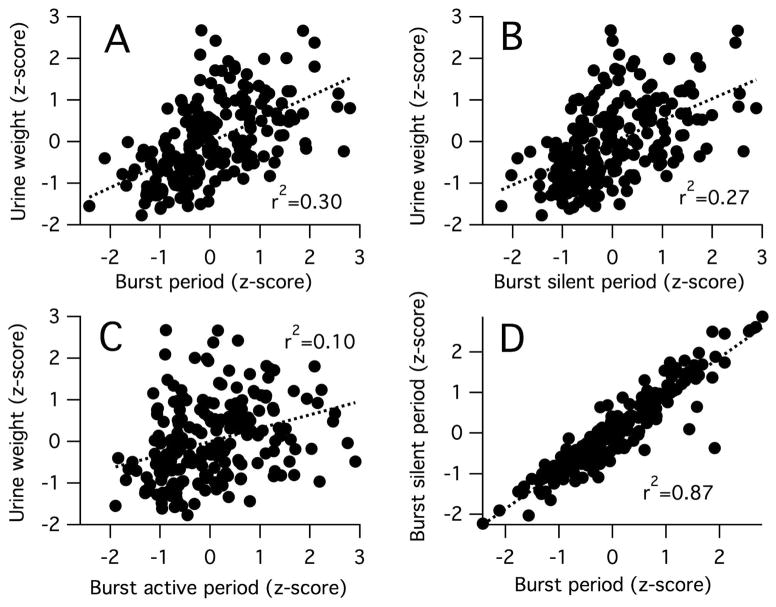
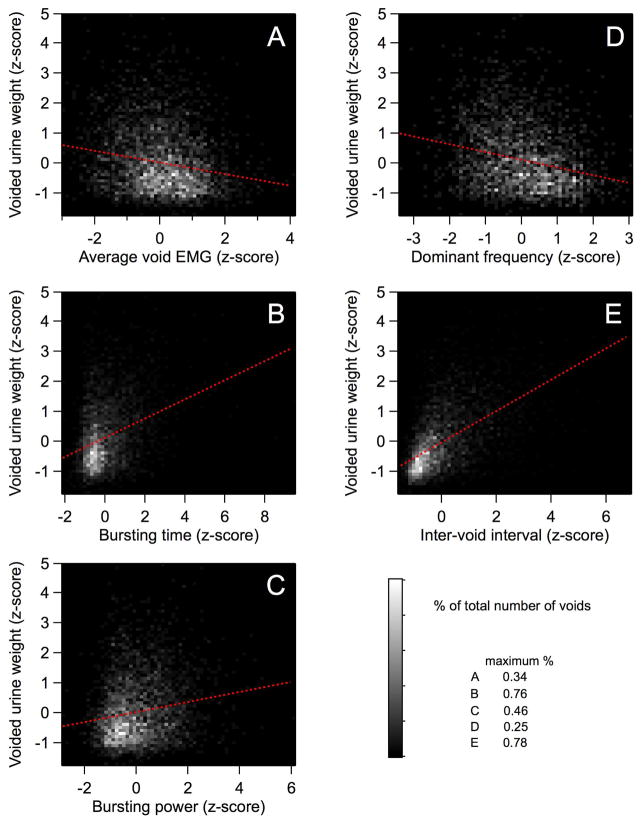
Void size was positively correlated with the duration of the intra-burst silent and active periods and variables reflecting the overall intensity and duration of bursting, particularly at lower frequencies within the 3-10 Hz range of EUS bursting. In addition, void size was inversely related to the frequency of bursting and to the average EMG amplitude during voiding, both in voids with and without bursting.
EUS bursting contributes to productive voiding when bursting is present. Lower bursting frequencies elicit more productive voiding than do higher frequencies. In the absence of bursting, the association of increased void size with smaller average EUS EMG amplitude suggests that conscious rats can perform synergic voiding (i.e., bladder contraction with EUS relaxation) that is comparable to that seen in humans and other typically non-bursting species. Neurourol. Urodynam. 35:696-702, 2016. © 2015 Wiley Periodicals, Inc.
在麻醉大鼠中,排尿通常与尿道外括约肌(EUS)的阶段性激活(爆发)相关。在未麻醉、不受限制的大鼠自发排尿过程中,EUS爆发是EUS活动最常见的形式,但并非有效排尿发生所必需。本研究的目的是确定在清醒、自由活动的大鼠中,EUS活动的哪些方面在爆发性和非爆发性排尿过程中对排尿量有贡献。
将雌性大鼠植入靠近EUS的电极以记录肌电图活动(EMG)。在代谢笼中进行24小时的EUS EMG记录,同时持续收集并称重排出的尿液。
排尿量与爆发内静息期和活动期的持续时间以及反映爆发总体强度和持续时间的变量呈正相关,特别是在EUS爆发的3-10Hz范围内的较低频率时。此外,无论有无爆发,排尿量与爆发频率以及排尿期间的平均EMG幅度均呈负相关。
当存在爆发时,EUS爆发有助于有效排尿。较低的爆发频率比较高的频率能引发更有效的排尿。在没有爆发的情况下,排尿量增加与较小的平均EUS EMG幅度相关,这表明清醒大鼠可以进行与人类和其他典型非爆发性物种中所见类似的协同排尿(即膀胱收缩伴EUS松弛)。《神经泌尿学与尿动力学》35:696-702,2016年。©2015威利期刊公司。