Lalonde Lyne, Choinière Manon, Martin Elisabeth, Lévesque Lise, Hudon Eveline, Bélanger Danielle, Perreault Sylvie, Lacasse Anaïs, Laliberté Marie-Claude
Faculty of Pharmacy, Université de Montréal, Montreal, QC, Canada ; Équipe de recherche en soins de première ligne, Centre de santé et de services sociaux de Laval, Laval, QC, Canada ; Centre de recherche, Centre hospitalier de l'Université de Montréal (CRCHUM), Montreal, QC, Canada ; Sanofi Aventis Endowment Chair in Ambulatory Pharmaceutical Care, Faculty of Pharmacy Université de Montréal and Centre de santé et de services sociaux de Laval, QC, Canada.
Centre de recherche, Centre hospitalier de l'Université de Montréal (CRCHUM), Montreal, QC, Canada ; Department of Anesthesiology Faculty of Medicine, Université de Montréal, Montreal, QC, Canada.
J Pain Res. 2015 Apr 30;8:203-15. doi: 10.2147/JPR.S78177. eCollection 2015.
There is evidence that the management of chronic non-cancer pain (CNCP) in primary care is far from being optimal. A 1-day workshop was held to explore the perceptions of key actors regarding the challenges and priority interventions to improve CNCP management in primary care.
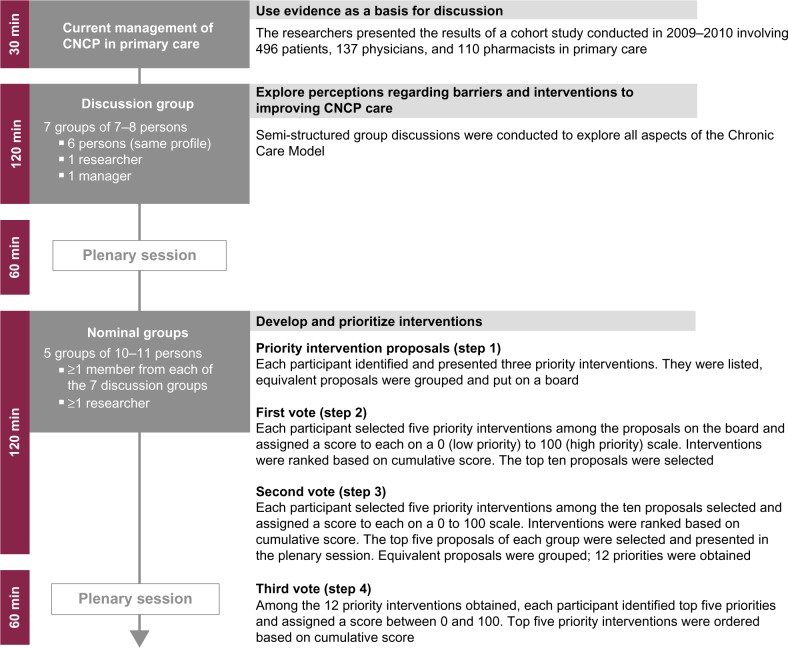
Using the Chronic Care Model as a conceptual framework, physicians (n=6), pharmacists (n=6), nurses (n=6), physiotherapists (n=6), psychologists (n=6), pain specialists (n=6), patients (n=3), family members (n=3), decision makers and managers (n=4), and pain researchers (n=7) took part in seven focus groups and five nominal groups.
Challenges identified in focus group discussions were related to five dimensions: knowledge gap, "work in silos", lack of awareness that CNCP represents an important clinical problem, difficulties in access to health professionals and services, and patient empowerment needs. Based on the nominal group discussions, the following priority interventions were identified: interdisciplinary continuing education, interdisciplinary treatment approach, regional expert leadership, creation and definition of care paths, and patient education programs.
Barriers to optimal management of CNCP in primary care are numerous. Improving its management cannot be envisioned without considering multifaceted interventions targeting several dimensions of the Chronic Care Model and focusing on both clinicians and patients.
有证据表明,初级保健中慢性非癌性疼痛(CNCP)的管理远未达到最佳状态。举办了为期一天的研讨会,以探讨关键参与者对改善初级保健中CNCP管理的挑战和优先干预措施的看法。
以慢性病护理模型为概念框架,医生(n = 6)、药剂师(n = 6)、护士(n = 6)、物理治疗师(n = 6)、心理学家(n = 6)、疼痛专家(n = 6)、患者(n = 3)、家庭成员(n = 3)、决策者和管理人员(n = 4)以及疼痛研究人员(n = 7)参加了七个焦点小组和五个名义小组。
焦点小组讨论中确定的挑战与五个维度相关:知识差距、“各自为政”、缺乏对CNCP是一个重要临床问题的认识、获得卫生专业人员和服务的困难以及患者赋权需求。基于名义小组讨论,确定了以下优先干预措施:跨学科继续教育、跨学科治疗方法、区域专家领导、护理路径的创建和定义以及患者教育计划。
初级保健中CNCP最佳管理的障碍众多。如果不考虑针对慢性病护理模型多个维度并同时关注临床医生和患者的多方面干预措施,就无法设想改善其管理。