Janssen Bram G, Byun Hyang-Min, Gyselaers Wilfried, Lefebvre Wouter, Baccarelli Andrea A, Nawrot Tim S
a Centre for Environmental Sciences; Hasselt University ; Diepenbeek , Belgium.
Epigenetics. 2015;10(6):536-44. doi: 10.1080/15592294.2015.1048412.
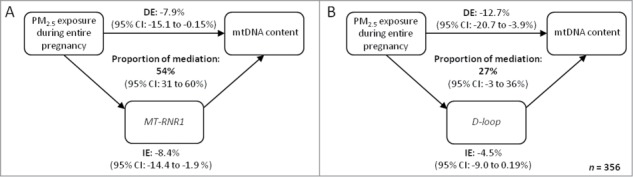
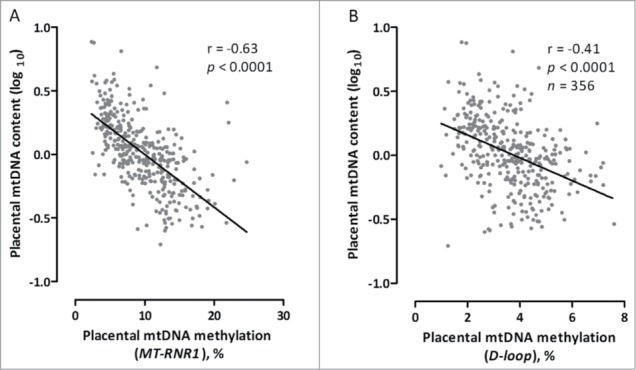
Most research to date has focused on epigenetic modifications in the nuclear genome, with little attention devoted to mitochondrial DNA (mtDNA). Placental mtDNA content has been shown to respond to environmental exposures that induce oxidative stress, including airborne particulate matter (PM). Damaged or non-functioning mitochondria are specifically degraded through mitophagy, exemplified by lower mtDNA content, and could be primed by epigenetic modifications in the mtDNA. We studied placental mtDNA methylation in the context of the early life exposome. We investigated placental tissue from 381 mother-newborn pairs that were enrolled in the ENVIRONAGE birth cohort. We determined mtDNA methylation by bisulfite-pyrosequencing in 2 regions, i.e., the D-loop control region and 12S rRNA (MT-RNR1), and measured mtDNA content by qPCR. PM2.5 exposure was calculated for each participant's home address using a dispersion model. An interquartile range (IQR) increment in PM2.5 exposure over the entire pregnancy was positively associated with mtDNA methylation (MT-RNR1: +0.91%, P = 0.01 and D-loop: +0.21%, P = 0.05) and inversely associated with mtDNA content (relative change of -15.60%, P = 0.001) in placental tissue. mtDNA methylation was estimated to mediate 54% [P = 0.01 (MT-RNR1)] and 27% [P = 0.06 (D-loop)] of the inverse association between PM2.5 exposure and mtDNA content. This study provides new insight into the mechanisms of altered mitochondrial function in the early life environment. Epigenetic modifications in the mitochondrial genome, especially in the MT-RNR1 region, substantially mediate the association between PM2.5 exposure during gestation and placental mtDNA content, which could reflect signs of mitophagy and mitochondrial death.
迄今为止,大多数研究都集中在核基因组中的表观遗传修饰上,而对线粒体DNA(mtDNA)的关注较少。胎盘mtDNA含量已被证明会对诱导氧化应激的环境暴露作出反应,包括空气中的颗粒物(PM)。受损或功能失调的线粒体通过线粒体自噬被特异性降解,其表现为mtDNA含量较低,并且可能由mtDNA中的表观遗传修饰引发。我们在早期生活暴露组的背景下研究了胎盘mtDNA甲基化。我们调查了参与ENVIRONAGE出生队列研究的381对母婴的胎盘组织。我们通过亚硫酸氢盐焦磷酸测序法测定了2个区域(即D环控制区和12S rRNA,MT-RNR1)的mtDNA甲基化,并通过qPCR测量了mtDNA含量。使用扩散模型计算了每个参与者家庭住址的PM2.5暴露量。整个孕期PM2.5暴露量的四分位数间距(IQR)增加与胎盘组织中mtDNA甲基化呈正相关(MT-RNR1:+0.91%,P = 0.01;D环:+0.21%,P = 0.05),与mtDNA含量呈负相关(相对变化为-15.60%,P = 0.001)。据估计,mtDNA甲基化介导了PM2.5暴露与mtDNA含量之间负相关的54%[P = 0.01(MT-RNR1)]和27%[P = 0.06(D环)]。这项研究为早期生活环境中线粒体功能改变的机制提供了新的见解。线粒体基因组中的表观遗传修饰,尤其是在MT-RNR1区域,在很大程度上介导了孕期PM2.5暴露与胎盘mtDNA含量之间的关联,这可能反映了线粒体自噬和线粒体死亡的迹象。