Saenen Nelly D, Vrijens Karen, Janssen Bram G, Roels Harry A, Neven Kristof Y, Vanden Berghe Wim, Gyselaers Wilfried, Vanpoucke Charlotte, Lefebvre Wouter, De Boever Patrick, Nawrot Tim S
Centre for Environmental Sciences, Hasselt University, Hasselt, Belgium.
Environ Health Perspect. 2017 Feb;125(2):262-268. doi: 10.1289/EHP38. Epub 2016 Sep 13.
Particulate matter with a diameter ≤ 2.5 μm (PM2.5) affects human fetal development during pregnancy. Oxidative stress is a putative mechanism by which PM2.5 may exert its effects. Leptin (LEP) is an energy-regulating hormone involved in fetal growth and development.
We investigated in placental tissue whether DNA methylation of the LEP promoter is associated with PM2.5 and whether the oxidative/nitrosative stress biomarker 3-nitrotyrosine (3-NTp) is involved.
LEP DNA methylation status of 361 placentas from the ENVIRONAGE birth cohort was assessed using bisulfite-PCR-pyrosequencing. Placental 3-NTp (n = 313) was determined with an ELISA assay. Daily PM2.5 exposure levels were estimated for each mother's residence, accounting for residential mobility during pregnancy, using a spatiotemporal interpolation model.
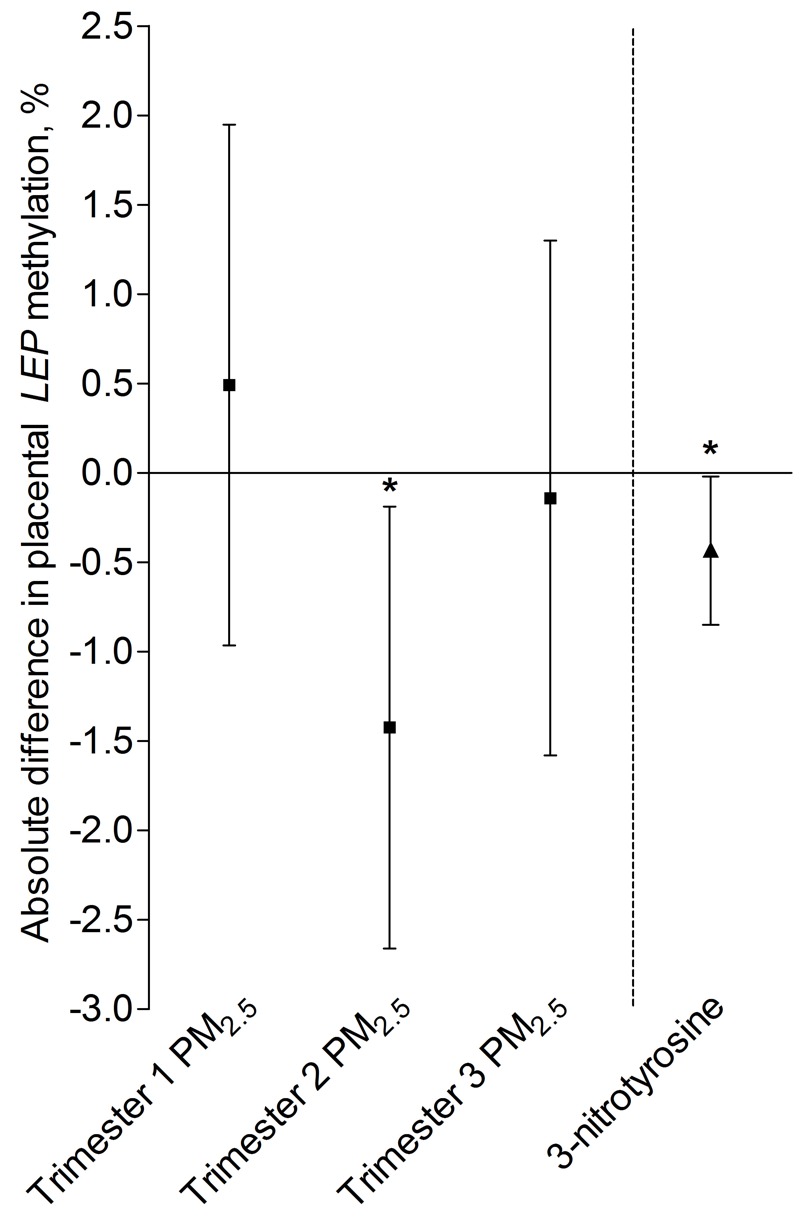
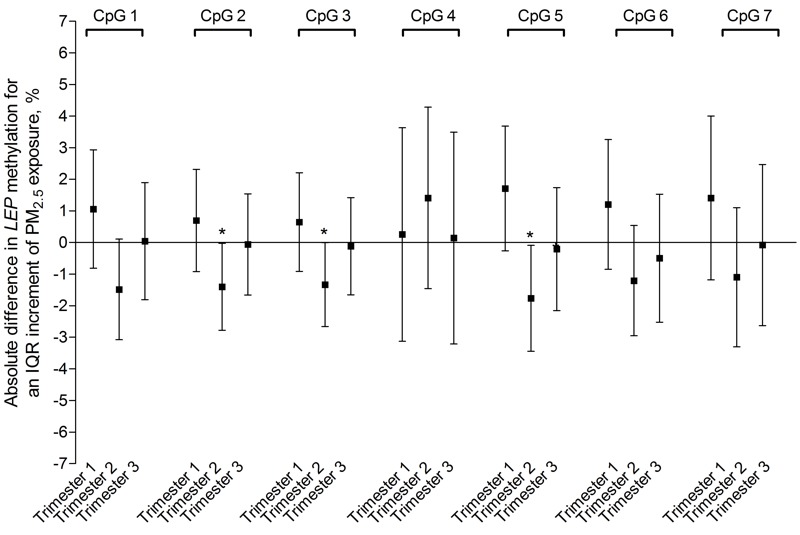
After adjustment for a priori chosen covariates, placental LEP methylation was 1.4% lower (95% CI: -2.7, -0.19%) in association with an interquartile range increment (7.5 μg/m3) in second-trimester PM2.5 exposure and 0.43% lower (95% CI: -0.85, -0.02%) in association with a doubling of placental 3-NTp content.
LEP methylation status in the placenta was negatively associated with PM2.5 exposure during the second trimester, and with placental 3-NTp, a marker of oxidative/nitrosative stress. Additional research is needed to confirm our findings and to assess whether oxidative/nitrosative stress might contribute to associations between PM2.5 and placental epigenetic events. Potential consequences for health during the neonatal period and later in life warrant further exploration. Citation: Saenen ND, Vrijens K, Janssen BG, Roels HA, Neven KY, Vanden Berghe W, Gyselaers W, Vanpoucke C, Lefebvre W, De Boever P, Nawrot TS. 2017. Lower placental leptin promoter methylation in association with fine particulate matter air pollution during pregnancy and placental nitrosative stress at birth in the ENVIRONAGE cohort. Environ Health Perspect 125:262-268; http://dx.doi.org/10.1289/EHP38.
直径≤2.5μm的颗粒物(PM2.5)会影响孕期人类胎儿的发育。氧化应激是PM2.5可能发挥其作用的一种假定机制。瘦素(LEP)是一种参与胎儿生长发育的能量调节激素。
我们在胎盘组织中研究了LEP启动子的DNA甲基化是否与PM2.5相关,以及氧化/亚硝化应激生物标志物3-硝基酪氨酸(3-NTp)是否参与其中。
使用亚硫酸氢盐-PCR-焦磷酸测序法评估了ENVIRONAGE出生队列中361份胎盘的LEP DNA甲基化状态。用ELISA法测定胎盘3-NTp(n = 313)。使用时空插值模型估算每位母亲居住地的每日PM2.5暴露水平,并考虑孕期的居住流动性。
在对预先选定的协变量进行调整后,孕中期PM2.5暴露的四分位间距增量(7.5μg/m3)与胎盘LEP甲基化降低1.4%(95%CI:-2.7,-0.19%)相关,胎盘3-NTp含量翻倍与胎盘LEP甲基化降低0.43%(95%CI:-0.85,-0.02%)相关。
胎盘中LEP甲基化状态与孕中期的PM2.5暴露以及胎盘氧化/亚硝化应激标志物3-NTp呈负相关。需要进一步研究以证实我们的发现,并评估氧化/亚硝化应激是否可能导致PM2.5与胎盘表观遗传事件之间的关联。新生儿期及以后生命阶段对健康的潜在影响值得进一步探索。引文:Saenen ND, Vrijens K, Janssen BG, Roels HA, Neven KY, Vanden Berghe W, Gyselaers W, Vanpoucke C, Lefebvre W, De Boever P, Nawrot TS. 2017. Lower placental leptin promoter methylation in association with fine particulate matter air pollution during pregnancy and placental nitrosative stress at birth in the ENVIRONAGE cohort. Environ Health Perspect 125:262-268; http://dx.doi.org/10.1289/EHP38.