van Diepen Hester C, Foster Russell G, Meijer Johanna H
Laboratory for Neurophysiology, Department of Molecular Cell Biology, Leiden University medical School, Leiden, The Netherlands; Nuffield Laboratory of Ophthalmology; Sleep and Circadian Neuroscience Institute (SCNi) Nuffield Department of Clinical Neurosciences, University of Oxford, John Radcliffe Hospital, Oxford, United Kingdom.
Nuffield Laboratory of Ophthalmology; Sleep and Circadian Neuroscience Institute (SCNi) Nuffield Department of Clinical Neurosciences, University of Oxford, John Radcliffe Hospital, Oxford, United Kingdom.
PLoS Biol. 2015 May 21;13(5):e1002160. doi: 10.1371/journal.pbio.1002160. eCollection 2015 May.
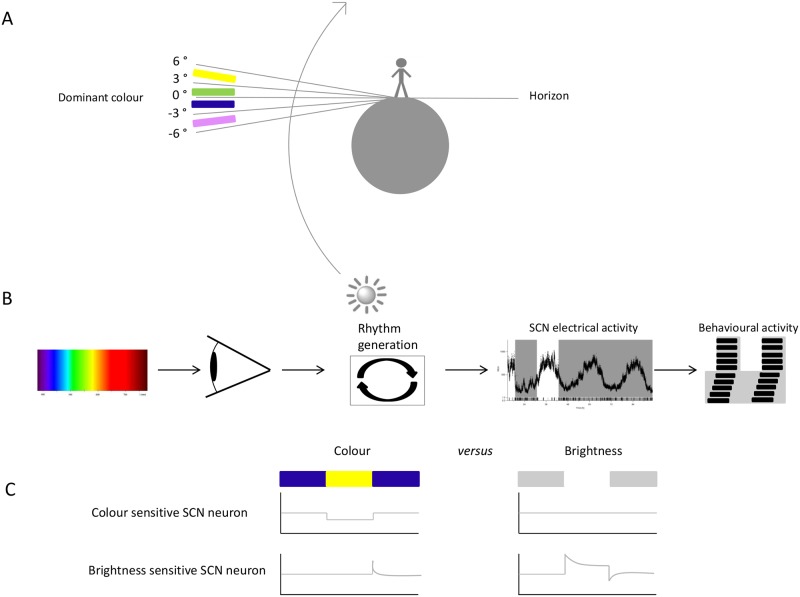
Circadian rhythms are an essential property of life on Earth. In mammals, these rhythms are coordinated by a small set of neurons, located in the suprachiasmatic nuclei (SCN). The environmental light/dark cycle synchronizes (entrains) the SCN via a distinct pathway, originating in a subset of photosensitive retinal ganglion cells (pRGCs) that utilize the photopigment melanopsin (OPN4). The pRGCs are also innervated by rods and cones and, so, are both endogenously and exogenously light sensitive. Accumulating evidence has shown that the circadian system is sensitive to ultraviolet (UV), blue, and green wavelengths of light. However, it was unclear whether colour perception itself can help entrain the SCN. By utilizing both behavioural and electrophysiological recording techniques, Walmsley and colleagues show that multiple photic channels interact and enhance the capacity of the SCN to synchronize to the environmental cycle. Thus, entrainment of the circadian system combines both environmental irradiance and colour information to ensure that internal and external time are appropriately aligned.
昼夜节律是地球上生命的一项基本特性。在哺乳动物中,这些节律由位于视交叉上核(SCN)的一小群神经元协调。环境光/暗周期通过一条独特的通路使SCN同步(调整),该通路起源于一部分利用光色素黑视蛋白(OPN4)的光敏视网膜神经节细胞(pRGC)。pRGC也受视杆细胞和视锥细胞支配,因此,它们对光既有内源性敏感又有外源性敏感。越来越多的证据表明,昼夜节律系统对紫外线(UV)、蓝光和绿光波长敏感。然而,颜色感知本身是否有助于使SCN同步尚不清楚。通过利用行为和电生理记录技术,沃尔姆斯利及其同事表明,多个光通道相互作用并增强了SCN与环境周期同步的能力。因此,昼夜节律系统的同步结合了环境辐照度和颜色信息,以确保内部时间和外部时间适当对齐。