Salmon Yann, Torres-Ruiz José M, Poyatos Rafael, Martinez-Vilalta Jordi, Meir Patrick, Cochard Hervé, Mencuccini Maurizio
School of Geosciences, University of Edinburgh, Edinburgh, EH93JN, UK.
BIOGECO, UMR 1202, Université de Bordeaux, F-33615, Pessac, France.
Plant Cell Environ. 2015 Dec;38(12):2575-88. doi: 10.1111/pce.12572. Epub 2015 Jun 27.
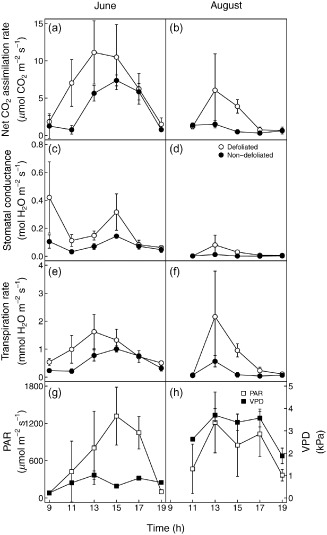
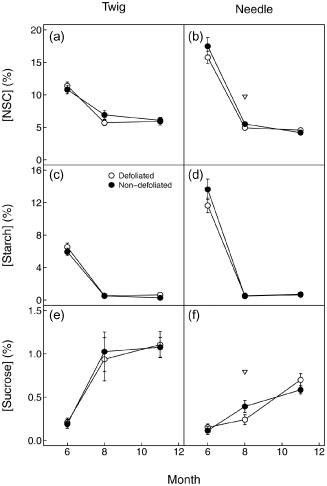
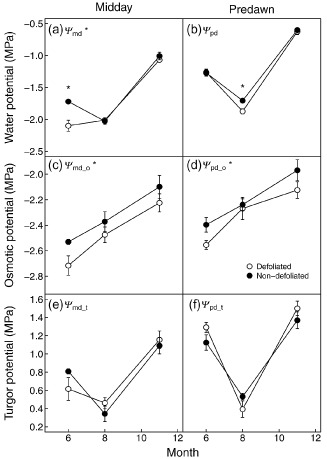
Understanding physiological processes involved in drought-induced mortality is important for predicting the future of forests and for modelling the carbon and water cycles. Recent research has highlighted the variable risks of carbon starvation and hydraulic failure in drought-exposed trees. However, little is known about the specific responses of leaves and supporting twigs, despite their critical role in balancing carbon acquisition and water loss. Comparing healthy (non-defoliated) and unhealthy (defoliated) Scots pine at the same site, we measured the physiological variables involved in regulating carbon and water resources. Defoliated trees showed different responses to summer drought compared with non-defoliated trees. Defoliated trees maintained gas exchange while non-defoliated trees reduced photosynthesis and transpiration during the drought period. At the branch scale, very few differences were observed in non-structural carbohydrate concentrations between health classes. However, defoliated trees tended to have lower water potentials and smaller hydraulic safety margins. While non-defoliated trees showed a typical response to drought for an isohydric species, the physiology appears to be driven in defoliated trees by the need to maintain carbon resources in twigs. These responses put defoliated trees at higher risk of branch hydraulic failure and help explain the interaction between carbon starvation and hydraulic failure in dying trees.
了解干旱导致树木死亡所涉及的生理过程,对于预测森林的未来以及模拟碳循环和水循环至关重要。最近的研究强调了干旱胁迫下树木碳饥饿和水力衰竭的可变风险。然而,尽管树叶和支撑小枝在平衡碳获取和水分流失方面起着关键作用,但对它们的具体反应却知之甚少。我们在同一地点比较了健康(未落叶)和不健康(落叶)的苏格兰松,测量了调节碳和水资源所涉及的生理变量。与未落叶树木相比,落叶树木对夏季干旱表现出不同的反应。在干旱期间,落叶树木维持气体交换,而未落叶树木则减少光合作用和蒸腾作用。在树枝尺度上,健康等级之间非结构性碳水化合物浓度的差异很小。然而,落叶树木往往具有较低的水势和较小的水力安全边际。未落叶树木表现出典型的等水物种对干旱的反应,而落叶树木的生理似乎是由维持小枝中碳资源的需要驱动的。这些反应使落叶树木面临更高的树枝水力衰竭风险,并有助于解释垂死树木中碳饥饿和水力衰竭之间的相互作用。