Galati Alessandra, Micheli Emanuela, Alicata Claudia, Ingegnere Tiziano, Cicconi Alessandro, Pusch Miriam Caroline, Giraud-Panis Marie-Josèphe, Gilson Eric, Cacchione Stefano
Department of Biology and Biotechnology 'Charles Darwin', Sapienza University of Rome, 00185 Rome, Italy Institute Pasteur-Fondazione Cenci-Bolognetti, Sapienza University of Rome, 00185 Rome, Italy.
Department of Biology and Biotechnology 'Charles Darwin', Sapienza University of Rome, 00185 Rome, Italy.
Nucleic Acids Res. 2015 Jul 13;43(12):5824-37. doi: 10.1093/nar/gkv507. Epub 2015 May 20.
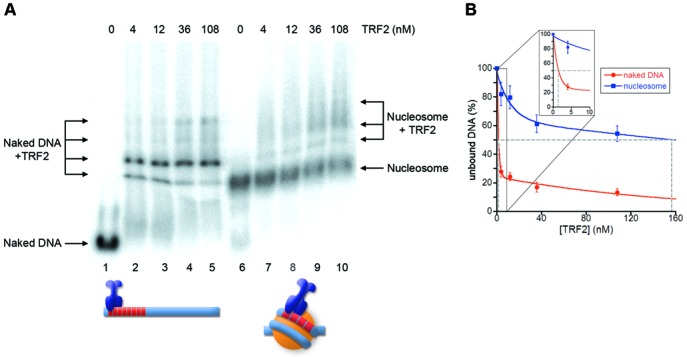
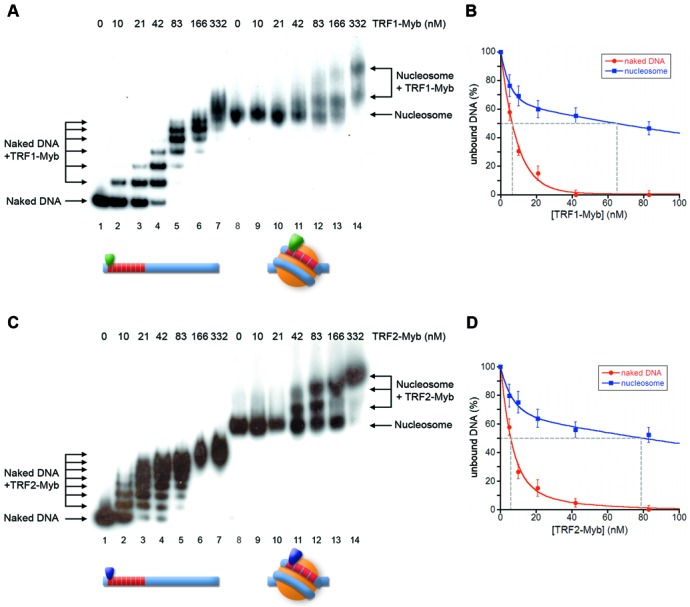
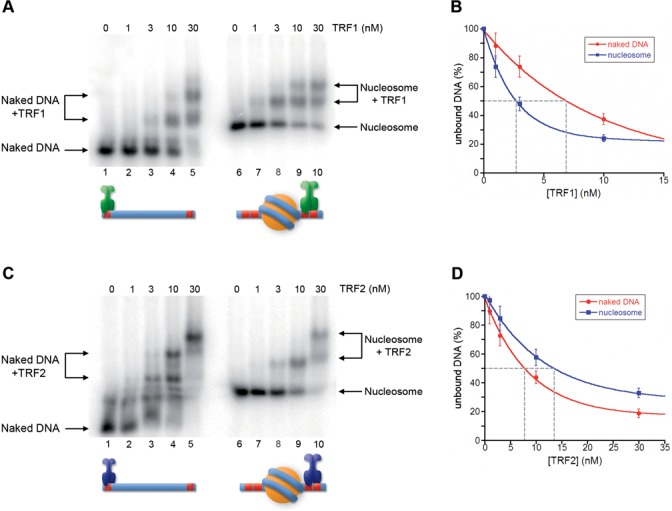
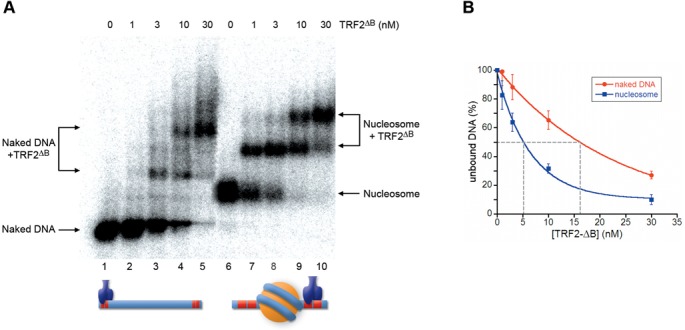
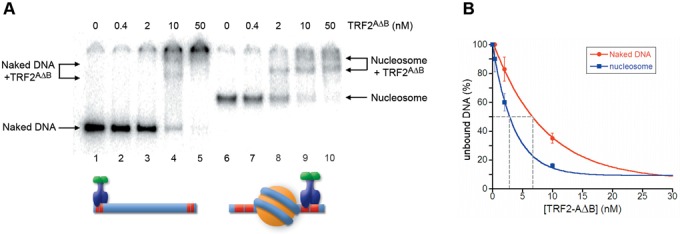
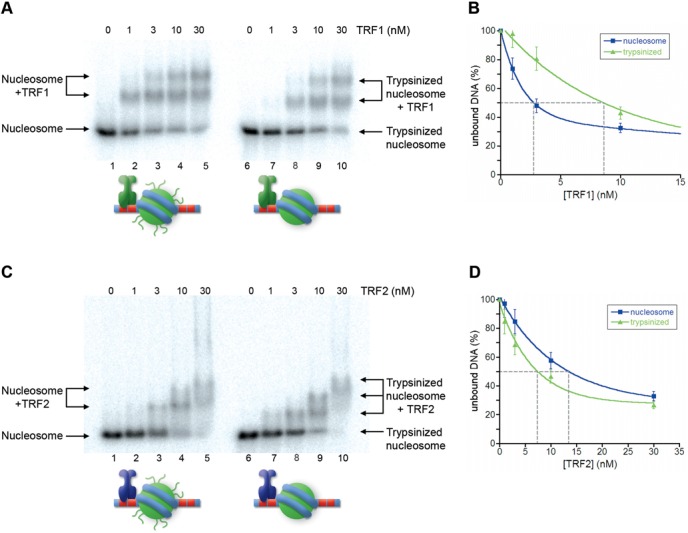
The ends of eukaryotic chromosomes need to be protected from the activation of a DNA damage response that leads the cell to replicative senescence or apoptosis. In mammals, protection is accomplished by a six-factor complex named shelterin, which organizes the terminal TTAGGG repeats in a still ill-defined structure, the telomere. The stable interaction of shelterin with telomeres mainly depends on the binding of two of its components, TRF1 and TRF2, to double-stranded telomeric repeats. Tethering of TRF proteins to telomeres occurs in a chromatin environment characterized by a very compact nucleosomal organization. In this work we show that binding of TRF1 and TRF2 to telomeric sequences is modulated by the histone octamer. By means of in vitro models, we found that TRF2 binding is strongly hampered by the presence of telomeric nucleosomes, whereas TRF1 binds efficiently to telomeric DNA in a nucleosomal context and is able to remodel telomeric nucleosomal arrays. Our results indicate that the different behavior of TRF proteins partly depends on the interaction with histone tails of their divergent N-terminal domains. We propose that the interplay between the histone octamer and TRF proteins plays a role in the steps leading to telomere deprotection.
真核生物染色体的末端需要受到保护,以免激活导致细胞进入复制性衰老或凋亡的DNA损伤反应。在哺乳动物中,这种保护是由一种名为端粒保护蛋白复合体(shelterin)的六因子复合体完成的,它将末端的TTAGGG重复序列组织成一种结构仍不明确的结构——端粒。端粒保护蛋白复合体与端粒的稳定相互作用主要取决于其两个组分TRF1和TRF2与双链端粒重复序列的结合。TRF蛋白与端粒的连接发生在一个以非常紧密的核小体组织为特征的染色质环境中。在这项研究中,我们表明TRF1和TRF2与端粒序列的结合受到组蛋白八聚体的调节。通过体外模型,我们发现端粒核小体的存在强烈阻碍TRF2的结合,而TRF1在核小体环境中能有效地结合端粒DNA,并能够重塑端粒核小体阵列。我们的结果表明,TRF蛋白的不同行为部分取决于其不同的N端结构域与组蛋白尾巴的相互作用。我们提出,组蛋白八聚体与TRF蛋白之间的相互作用在导致端粒去保护的过程中发挥作用。