Nimaichand Salam, Devi Asem Mipeshwaree, Tamreihao K, Ningthoujam Debananda S, Li Wen-Jun
Microbial Biotechnology Research Laboratory, Department of Biochemistry, Manipur University Canchipur, Imphal, India ; State Key Laboratory of Biocontrol and Guangdong Key Laboratory of Plant Resources, School of Life Sciences, Sun Yat-Sen University Guangzhou, China.
Molecular Genetics Laboratory, Department of Botany, North-Eastern Hill University Shillong, India.
Front Microbiol. 2015 May 5;6:413. doi: 10.3389/fmicb.2015.00413. eCollection 2015.
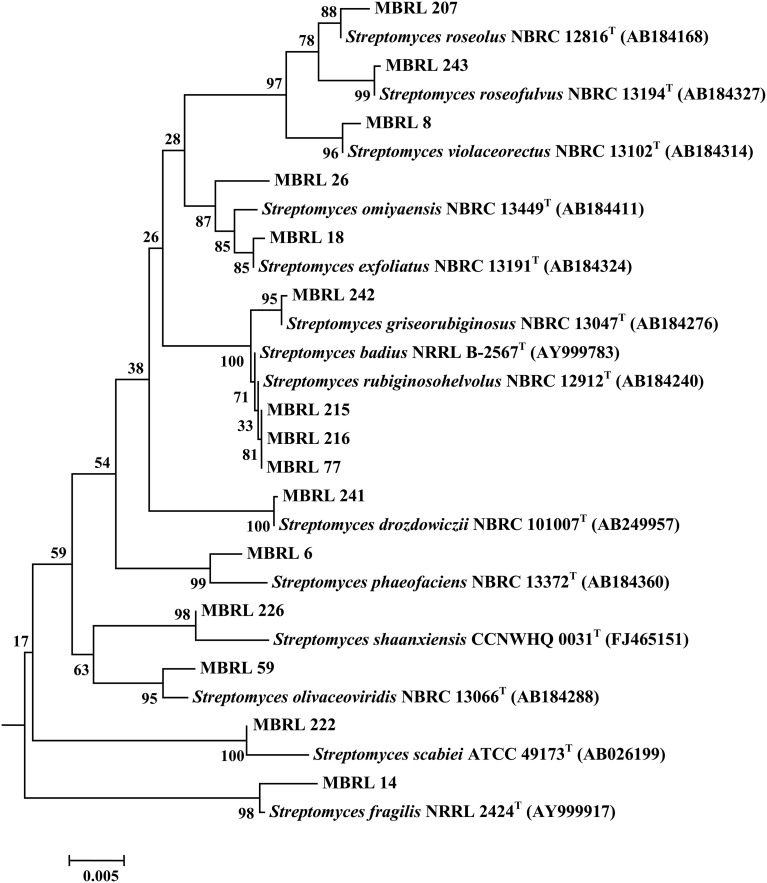
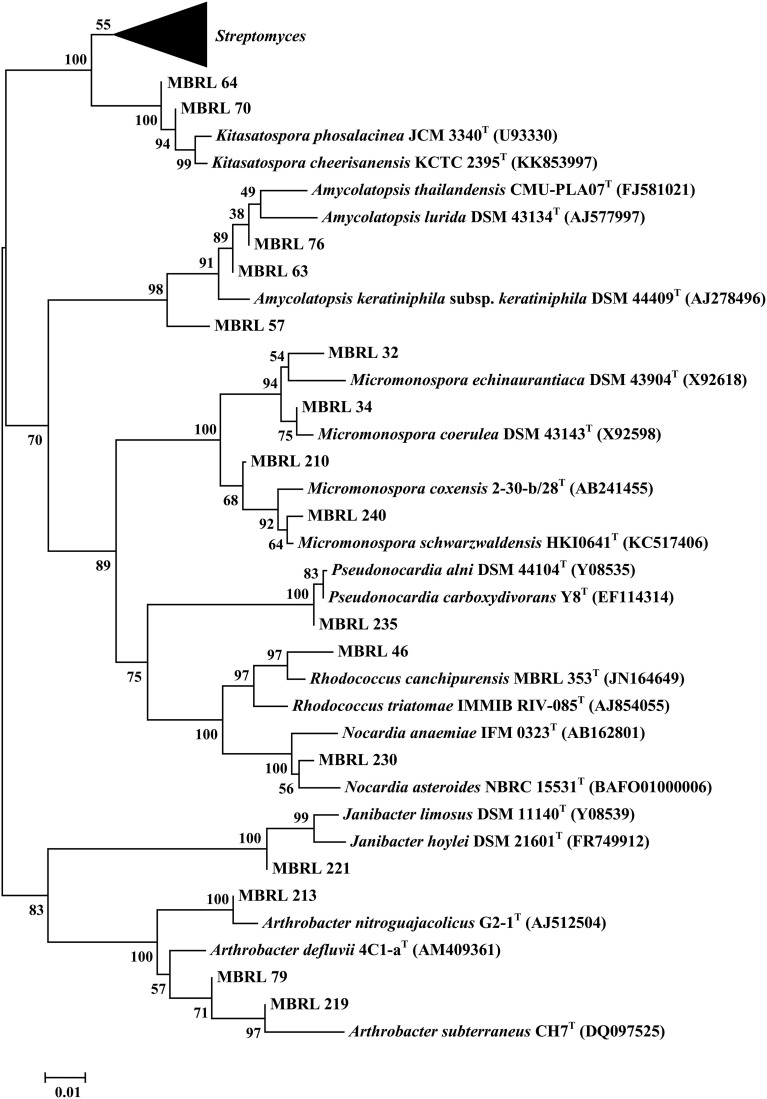
Studies on actinobacterial diversity in limestone habitats are scarce. This paper reports profiling of actinobacteria isolated from Hundung limestone samples in Manipur, India using ARDRA as the molecular tool for preliminary classification. A total of 137 actinobacteria were clustered into 31 phylotypic groups based on the ARDRA pattern generated and representative of each group was subjected to 16S rRNA gene sequencing. Generic diversity of the limestone isolates consisted of Streptomyces (15 phylotypic groups), Micromonospora (4), Amycolatopsis (3), Arthrobacter (3), Kitasatospora (2), Janibacter (1), Nocardia (1), Pseudonocardia (1) and Rhodococcus (1). Considering the antimicrobial potential of these actinobacteria, 19 showed antimicrobial activities against at least one of the bacterial and candidal test pathogens, while 45 exhibit biocontrol activities against at least one of the rice fungal pathogens. Out of the 137 actinobacterial isolates, 118 were found to have at least one of the three biosynthetic gene clusters (PKS-I, PKS-II, NRPS). The results indicate that 86% of the strains isolated from Hundung limestone deposit sites possessed biosynthetic gene clusters of which 40% exhibited antimicrobial activities. It can, therefore, be concluded that limestone habitat is a promising source for search of novel secondary metabolites.
关于石灰岩生境中放线菌多样性的研究很少。本文报道了使用ARDRA作为初步分类的分子工具,对从印度曼尼普尔邦洪东石灰岩样本中分离出的放线菌进行分析。根据产生的ARDRA模式,共137株放线菌被聚类为31个系统发育型组,并对每组的代表菌株进行16S rRNA基因测序。石灰岩分离株的属多样性包括链霉菌属(15个系统发育型组)、小单孢菌属(4个)、拟无枝酸菌属(3个)、节杆菌属(3个)、北里孢菌属(2个)、詹氏菌属(1个)、诺卡氏菌属(1个)、假诺卡氏菌属(1个)和红球菌属(1个)。考虑到这些放线菌的抗菌潜力,19株对至少一种细菌和念珠菌测试病原体具有抗菌活性,而45株对至少一种水稻真菌病原体具有生物防治活性。在137株放线菌分离株中,发现118株至少具有三个生物合成基因簇(PKS-I、PKS-II、NRPS)中的一个。结果表明,从洪东石灰岩矿床分离出的菌株中有86%拥有生物合成基因簇,其中40%具有抗菌活性。因此,可以得出结论,石灰岩生境是寻找新型次生代谢产物的一个有前景的来源。