Nakano Yoshimi, Yamaguchi Masatoshi, Endo Hitoshi, Rejab Nur Ardiyana, Ohtani Misato
Graduate School of Biological Sciences, Nara Institute of Science and Technology Ikoma, Japan.
Division of Strategic Research and Development, Graduate School of Science and Engineering, Saitama University Saitama, Japan ; PRESTO (Precursory Research for Embryonic Science and Technology), Japan Science and Technology Agency Kawaguchi, Japan.
Front Plant Sci. 2015 May 5;6:288. doi: 10.3389/fpls.2015.00288. eCollection 2015.
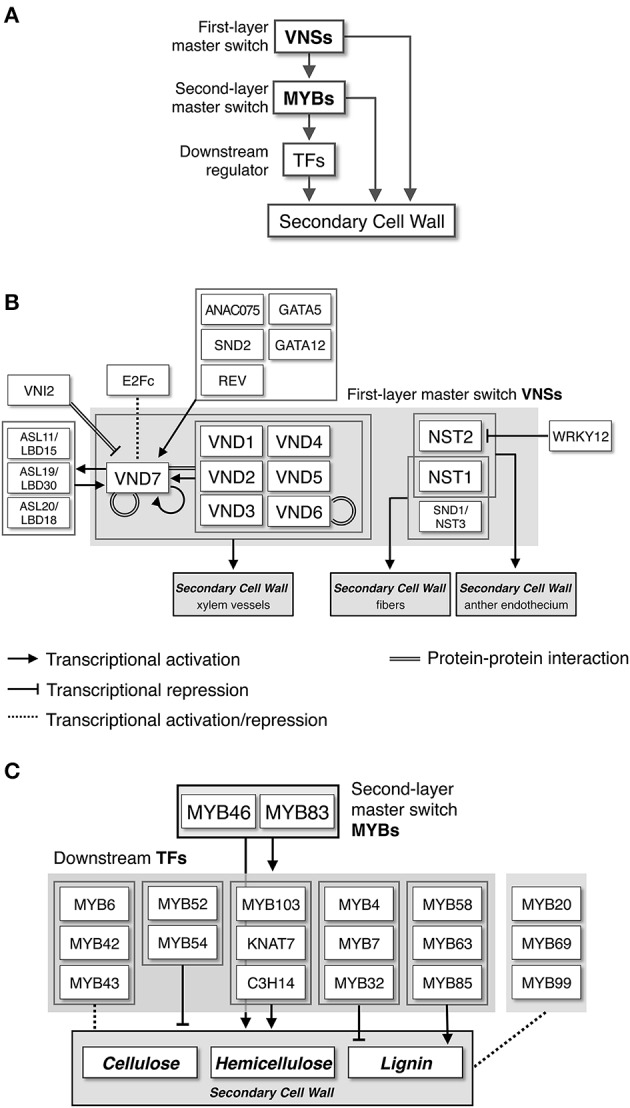
Plant cells biosynthesize primary cell walls (PCW) in all cells and produce secondary cell walls (SCWs) in specific cell types that conduct water and/or provide mechanical support, such as xylem vessels and fibers. The characteristic mechanical stiffness, chemical recalcitrance, and hydrophobic nature of SCWs result from the organization of SCW-specific biopolymers, i.e., highly ordered cellulose, hemicellulose, and lignin. Synthesis of these SCW-specific biopolymers requires SCW-specific enzymes that are regulated by SCW-specific transcription factors. In this review, we summarize our current knowledge of the transcriptional regulation of SCW formation in plant cells. Advances in research on SCW biosynthesis during the past decade have expanded our understanding of the transcriptional regulation of SCW formation, particularly the functions of the NAC and MYB transcription factors. Focusing on the NAC-MYB-based transcriptional network, we discuss the regulatory systems that evolved in land plants to modify the cell wall to serve as a key component of structures that conduct water and provide mechanical support.
植物细胞在所有细胞中生物合成初生细胞壁(PCW),并在特定细胞类型中产生次生细胞壁(SCW),这些细胞类型负责水分传导和/或提供机械支持,如木质部导管和纤维。次生细胞壁的特征性机械刚度、化学抗性和疏水性源于次生细胞壁特异性生物聚合物的组织,即高度有序的纤维素、半纤维素和木质素。这些次生细胞壁特异性生物聚合物的合成需要由次生细胞壁特异性转录因子调控的次生细胞壁特异性酶。在本综述中,我们总结了目前对植物细胞中次生细胞壁形成的转录调控的认识。过去十年中次生细胞壁生物合成的研究进展扩展了我们对次生细胞壁形成转录调控的理解,特别是NAC和MYB转录因子的功能。聚焦于基于NAC-MYB的转录网络,我们讨论了陆地植物中进化出的调控系统,这些系统可修饰细胞壁,使其成为水分传导和提供机械支持结构的关键组成部分。